Эрдэмтэд WASP-121 b экзопланетын өдөр ба шөнийн талыг зааглах бүсүүд агаар мандлын хувьд эрс ялгаатай болохыг тогтоов.
Макс Планкийн одон орон судлалын хүрээлэнгийн эрдэмтэн Сирил Гаппаар удирдуулсан баг Жэймс Вэбб сансрын дуран авайг ашиглан WASP-121 b гаригийн агаар мандлыг нарийвчлан судалжээ. Энэхүү хэт халуун хийн аварга гариг нь өөрийн одтой маш ойрхон оршдог тул 30 хүрэхгүй цагт нэг бүтэн тойрог хийдэг бөгөөд нэг тал нь үргэлж од руугаа харсан байдаг. Үүний улмаас өдөр тал нь 2500°C хүртэл халдаг бол шөнө тал нь 725°C орчим байж, хоёр талын температурын зөрүү 1800°C-д хүрдэг байна.
Судлаачид гаригийг одныхоо урд өнгөрөх үеийн агаар мандлаар нэвтэрсэн одны гэрлийн өөрчлөлтийг агшин бүрээр нь хэмжих замаар өглөө болон үдшийн зааг бүсүүдийг (terminator) ялган зураглажээ. Үдшийн бүсэд салхины нөлөөгөөр халуун агаар зүүн зүг рүү шилжиж, нүүрстөрөгчийн дутуу ислийн дохио илүү өндөр байсан бол усны молекулууд хэт халуунд задарч багассан байна. Харин өглөөний талд эрдэс бодисын үүлс байж болзошгүй гэж үзэж байгаа нь агаар мандлын онолуудыг боловсронгуй болгох чухал мэдээлэл боллоо.
Энэхүү аргачлал нь экзопланетыг бүхэлд нь нэг нэгж гэж үзэх бус, уртрагийн дагуух цаг уурын өөрчлөлтийг нарийвчлан судлах боломжийг олгож буйгаараа онцлог юм. Цаашид энэ аргаар бусад хэт халуун гаригуудын цаг уурын атласыг бүтээх боломжтой болж байна.
https://www.universetoday.com/article_images/Exoplanet_Transit_en_20260713_055015.jpg
Дэлгэрэнгүйг эх сурвалжаас харах
Эх сурвалжийг нээх ↓
What would it be like to stand at the boundary between night and day on a planet locked forever facing its star? Astronomers have just found the closest thing yet to an answer, catching the James Webb Space Telescope in the act of watching one such twilight boundary evolve in real time.
The planet in question is WASP-121 b, an ultra-hot gas giant orbiting so close to its host star that a single year there lasts barely thirty hours. That proximity has locked the planet’s rotation to its orbit, so, much like our own Moon always shows Earth the same face, one side of WASP-121 b is permanently roasted by starlight while the other stares out into the cold of space. Average temperatures on the scorched dayside reach roughly 2500 degrees Celsius, while the permanent night side sits at a comparatively mild 725 degrees, a difference of nearly 1800 degrees between the two hemispheres of a single world.
Artist impression of the James Webb Space Telescope (Credit : NASA)
Led by Cyril Gapp, a PhD student at the Max Planck Institute for Astronomy, a research team set out to study the planet’s twilight zones, the morning and evening terminators that separate its blazing day from its darker night. As WASP-121 b passes in front of its star, it rotates by roughly thirty degrees over the course of the transit, letting astronomers peer past dusk and dawn toward slivers of the fiery dayside beyond. By tracking exactly how starlight filtering through the atmosphere changed second by second during that transit, rather than simply averaging the whole thing together as earlier studies had done, the team was able to map out how conditions shift across the length of a single planet.
The results revealed two strikingly different twilight zones. The evening terminator, with fierce winds sweeping heat eastward from the dayside, absorbed noticeably more starlight than its morning counterpart, and showed a telltale rise in carbon monoxide signal driven by that extra heat. Water told an even more dramatic story. In the searing evening atmosphere, temperatures climbed high enough to tear water molecules apart entirely, leaving noticeably less of it behind compared to the cooler morning side.
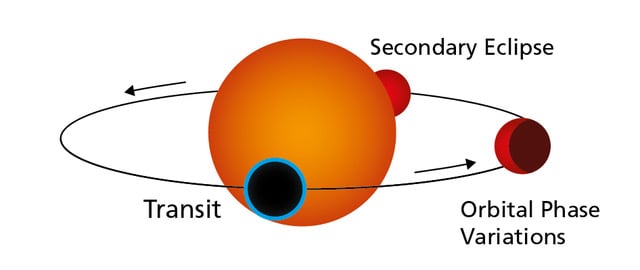
As a planet passes in front of its star, a sliver of starlight filters through its atmosphere on the way to us, carrying clues about what that atmosphere is made of, and, as with WASP-121b, how it changes from dawn to dusk (Credit : MPIA-Grafikabteilung)
When the team compared their results against computer models of the planet’s atmosphere, the real signal turned out stronger than predicted, hinting at a genuine physics puzzle. The most likely explanation is clouds, not of water but of vaporised minerals such as silicates, quietly cooling the morning terminator by blocking infrared light from the hot layers beneath. Since modelling clouds accurately remains notoriously difficult, this discrepancy offers researchers a valuable clue about where current atmospheric models still fall short.
Beyond WASP-121 b itself, the technique marks a genuine breakthrough in method. Rather than treating an exoplanet as a single averaged blob of atmosphere, astronomers can now trace conditions longitude by longitude across a world hundreds of light years away. The team has already identified further ultra-hot planets suited to the same approach, promising a growing atlas of alien weather, measured one twilight at a time.
Source : WASP-121 b: JWST reveals atmospheric differences between morning and evening terminators