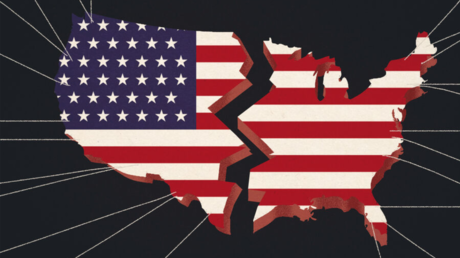
Тус улсад ардчилал, эдийн засгийн хөгжил, үндэсний нэгдмэл байдлын талаарх эргэлзээ нэмэгдэж байна.
АНУ тусгаар тогтнолоо зарласны 250 жилийн ойг тэмдэглэж байгаа хэдий ч нийгэмд баярын уур амьсгал бүрхэг байна. Reuters агентлагийн санал асуулгаар америкчуудын 70 хувь нь өөрийн орноо дэлхийн хамгийн шилдэг улс гэж үзэхээ больсон бол 64 хувь нь ардчиллын ирээдүйд санаа зовниж байна. Мөн судалгаанд оролцогчдын 38 хувь нь АНУ ирэх 250 жилд нэгдмэл улс хэвээр үлдэхэд эргэлзэж байгаагаа илэрхийлжээ.
АНУ-ын нийгэмд тулгарч буй энэхүү хямрал нь иргэдийн итгэл үнэмшлийн ан цавыг гүнзгийрүүлж байна. “Америк мөрөөдөл” гэгддэг хөдөлмөрлөснөөр амжилтад хүрэх, ирээдүйн сайн сайхан байдлын баталгаа сулрахад залуу үеийнхэн болон өмнөх үеийнхний дунд үзэл бодлын зөрүү гарчээ. Энэхүү үл ойлголцол нь улс төрийн хоёр том хүчний хооронд шинэ шийдлийг эрэлхийлэхэд хүргэж байна.
Баруун жигүүрийнхэн чөлөөт зах зээл, төрийн зардлын хэмнэлт болон гадаад бодлогын прагматик хандлагыг дэмжиж байгаа бол зүүний жигүүр эдийн засгийн бүтцийг өөрчлөн, баялгийн хуваарилалтыг илүү шударга болгохыг шаардаж байна. Дональд Трампын бодлого болон хотын түвшний социалист шинжтэй санаачилгууд нь улс орны ирээдүйн чиг хандлагын талаарх өөр өөр байр суурийг харуулж байна. Одоогийн байдлаар АНУ-ын нийгэмд нийтлэг ирээдүйн төсөөлөл бүдгэрч, хоёр өөр улс төрийн урсгал өөр өөр замаар явах эрсдэл бий болжээ.
Дэлгэрэнгүйг эх сурвалжаас харах
↓Эх сурвалжийг нээх ↓
America’s 250th anniversary arrived amid growing doubts about democracy, prosperity, and national unity
The United States has just marked a major anniversary, 250 years since it declared independence from Great Britain and, in theory, this should be a moment of national pride with another historical milestone passed, another reason for flags, fireworks, and speeches about destiny.
But the mood is not especially festive.
Two weeks before the anniversary, Reuters published a poll that captured the depth of American anxiety – and the numbers were grim. More than two-thirds (70%) of Americans no longer consider their country the greatest nation on Earth, while64% believe American democracy is in danger. And 38% don’t believe the United States will survive another 250 years as a single country.
The answers split sharply along party lines, with Republicans still clinging more strongly to the idea of the exceptional country of prosperity and divine favor. Among Democrats, the mood is much darker and pessimism has become almost a worldview as the United States has arrived at its 250th anniversary in the middle of a profound crisis of belief.
In some ways, this resembles the crisis Soviet society experienced in the final years of the USSR. Of course, America never had an official state ideology in the Soviet sense and nobody in Washington promised to build communism at breakneck speed, but the US did have its own coherent vision of the future which it called the American Dream.
That dream promised prosperity through hard work and freedom. Work hard, play by the rules, take responsibility for yourself, and life will improve, your children will live better than you did and your country will remain a model for the world, but in the 21st century, that promise began to fall apart.
The first serious cracks appeared among millennials, the generation born between 1981 and 1996. Their parents got rich, bought homes, built savings, and traveled abroad, but they inherited student debt, unaffordable housing, unstable work, and the strange feeling that no matter how hard they run, the finish line keeps moving further away.
Older Americans told them the answer was simply to work as hard as they did, but younger Americans could see the numbers and how with comparable effort, earlier generations ended up far wealthier.
So the old formula no longer worked and that undermined the idea of labor as an absolute virtue. If hard work no longer guarantees a decent life, then what remains? Freedom?
Americans are formally free in that they elect presidents and congressmen. Yet Congress is filled with elderly politicians who seem determined to change nothing and who often leave public life only when nature finally intervenes. Presidents speak beautifully on campaign trails, but once inside the White House, they usually follow the same old path so while the faces change, the machine remains and freedom, too, begins to look hollow.
For younger Americans, the American Dream is becoming what the bright communist future became for late Soviet citizens as an official promise repeated so often that almost nobody believes it anymore. Once a society loses its vision of the future, disorientation follows and almost everyone can feel that the system is not working properly. But what should replace it and where should the country go?
Well, American society has developed two sharply different answers. The conservative right believes America can be saved by a return to pragmatism with a freer market, support for major entrepreneurs, ruthless efficiency in public spending, and a foreign policy less constrained by old ideological sermons about democracy and human rights. In this view, America must stop trying to lecture the world and start taking care of itself.
The progressive left believes the opposite, that the pillars of liberal democracy mustn’t be abandoned, but that the economy needs radical restructuring. National wealth, they say, must be distributed more fairly and big business, especially in the technology sector, is viewed with deep suspicion. The new villains are “tech feudal lords,” billionaires whose power appears to rival that of the state itself.
Both camps agree on one thing, that the current order is exhausted, but they simply disagree on what should come next.
Donald Trump was supposed to test the right-wing answer in practice and his supporters expected a revolution in a break with the old elite, a new economic nationalism, a government that would stop apologizing and start acting because he promised all of that.
But Trump’s presidency has shown the limits of his movement in that there’s not much of a system and Trump doesn’t think in historical categories, but in terms of Trump. If it were up to him, Washington would be filled not with a new national doctrine, but with golden ballrooms and monuments to his own greatness.
His approach to America’s 250th anniversary has even disappointed some of his admirers. Many expected a serious program, or at least a symbolic reflection on the country’s path, but instead, Trump keeps speaking about his own achievements. At times, it is hard to tell whether America is celebrating 250 years of independence or continuing the festivities for its president’s 80th birthday.
So now disillusioned by the right, America is glancing left, although the country doesn’t yet trust the left nationally. But locally, especially in big cities, voters are increasingly willing to experiment, with Zohran Mamdani, the openly socialist mayor of New York, an obvious example. This is no accident as the largest cities are where the contradictions of modern America are most visible in terms of housing costs, inequality, migration, crime, decaying infrastructure, and anger at remote elites.
If socialist policies succeed at city level, their supporters will soon claim they are ready for higher office.
And what will their opponents do then? They could accept defeat or they may decide that their America can no longer live under the same roof as the other America, whichis the real question behind the anniversary. Not whether the United States has had a remarkable 250 years, because it has, but the question is whether it still has a common future.
Perhaps America will find a new compromise and perhaps it will reinvent itself again, as it has done before, but perhaps its two political tribes have already begun traveling in different historical directions.
If, over the next 250 years, US history follows that road toward a civilized or uncivilized split, it won’t be because Americans lacked flags or speeches, it will be because the country’s old promise stopped convincing its own people.
This article was first published by the online newspaperGazeta.ruand was translated and edited by the RT team

