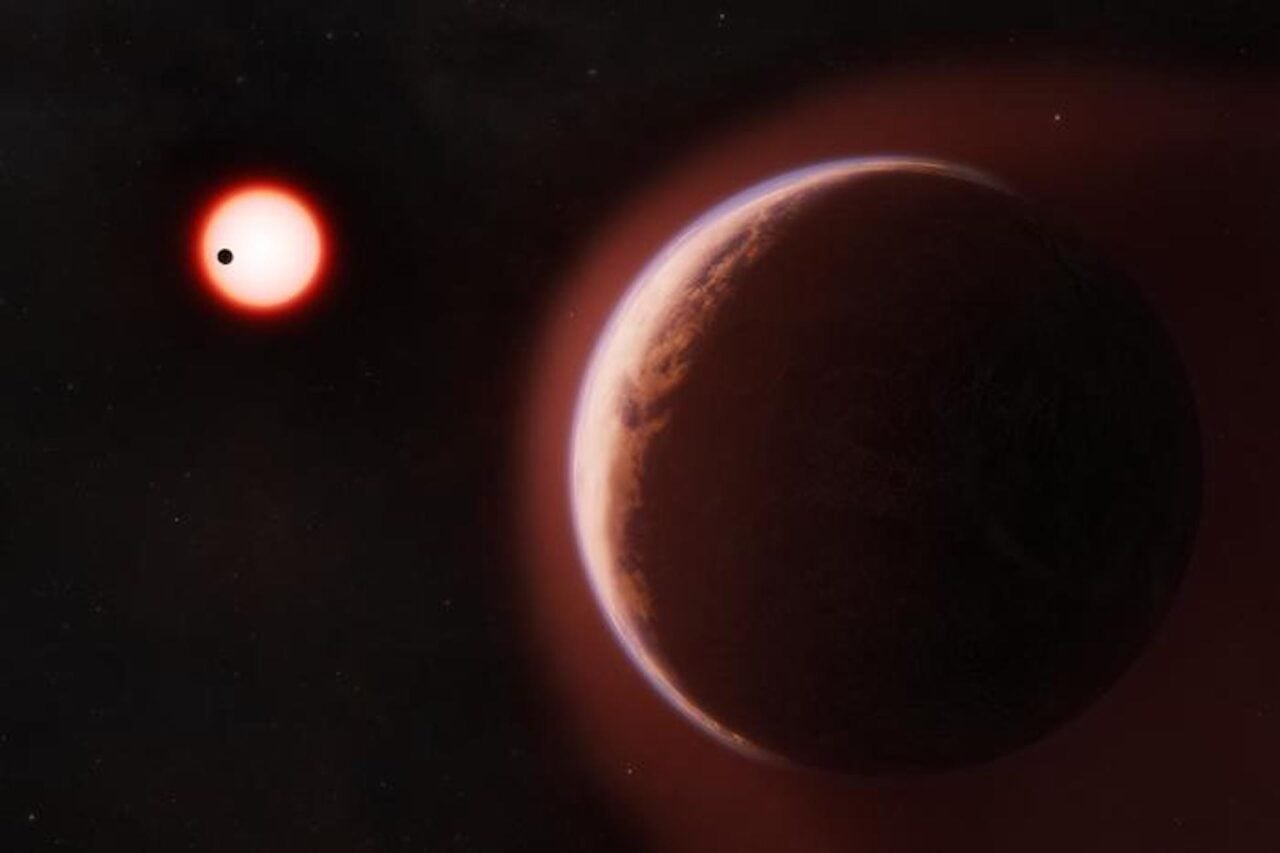
Эрдэмтэд дэлхийтэй төстэй, амьдрал орших боломжтой бүсэд байрлах чулуурхаг гарагийн агаар мандлыг анх удаа илрүүлсэн нь харь гарагийн амьдрал хайх судалгаанд томоохон дэвшил боллоо.
Science сэтгүүлд нийтлэгдсэн судалгаагаар, Дэлхийгээс 48 гэрлийн жилийн зайд орших, улаан одой одны тойрог замд эргэлддэг LHS 1140 b хэмээх экзопланетийн агаар мандлыг тогтоожээ. Чили дэх Лас Кампанас ажиглалтын төвийн Магеллан Клэй дуран авайг ашиглан хийсэн ажиглалтаар тус гараг одныхоо урд гарах үед гелигээр баялаг агаар мандлын ул мөр илэрсэн байна. Энэ нь амьдрал орших боломжтой бүсэд байрлах чулуурхаг гараг агаар мандалтай байж болохыг нотолсон анхны тохиолдол юм.
Харвардын их сургуулийн судлаач Коллин Черубим болон түүний баг тус гараг олон тэрбум жилийн турш гелигээр баялаг агаар мандлаа хадгалж ирсэн болохыг тогтоожээ. Хэдийгээр гели нь амьдралыг тэтгэхэд хангалтгүй ч, энэхүү агаар мандлын дор амьдралд ээлтэй өөр хийнүүд байх магадлалтай гэж эрдэмтэд үзэж байна. Тус гараг нь Дэлхийгээс 5.6 дахин их масстай бөгөөд радиус нь 70 хувиар том юм.
https://www.science.org/doi/10.1126/science.aea9708
https://www.eurekalert.org/news-releases/1135901
LHS 1140 b нь одныхоо амьдрал орших боломжтой буюу гадаргуу дээр нь шингэн ус байх боломжтой зайд оршдог. Судлаачид тус гараг нь одтойгоо таталцлын хүчээр түгжигдсэн буюу нэг тал нь үргэлж од руугаа харж байдаг онцлогтой ч, агаар мандалтай байх нь гадаргуу дээрх нөхцөлийг амьдралд илүү таатай байлгах боломжтой гэж дүгнэжээ. Энэхүү судалгаа нь цаашид ижил төстэй гарагуудыг нээн илрүүлэх судалгааны үндэс суурь болж байна.
Дэлгэрэнгүйг эх сурвалжаас харах
Эх сурвалжийг нээх ↓
A rocky world orbiting within its star’s habitable zone may be surrounded by a helium-rich atmosphere, providing the strongest evidence yet that planets with Earth-like conditions could support life outside the solar system.
In a new study published in Science, a team of astronomers reports the first detection of an atmosphere around an Earth-like rocky planet orbiting within the star system’s habitable zone. The findings represent a serious breakthrough in the search for life beyond Earth, providing the strongest evidence yet that a rocky planet in a habitable zone has retained an atmosphere.
“An atmosphere is essential for a planet to support life as we know it,” Collin Cherubim, lead author of the study who recently earned his Ph.D. from Harvard University, said in a statement. “This is the first time anyone has found an atmosphere on a rocky planet in the habitable zone of another star.”
The habitable zone
The planet, called LHS 1140 b, is located approximately 48 light-years away from Earth. It orbits a red dwarf star, which is much smaller and cooler than our Sun.
The team of scientists behind the new study observed LHS1140b using the Magellan Clay telescope at Las Campanas Observatory in Chile. As it transited in front of its star, the scientists found traces of helium escaping from the planet into space. After ruling out other possible explanations, the team determined that the rocky planet is in possession of a helium-rich atmosphere.
LHS 1140 b orbits its star within the so-called habitable zone, the ideal distance from a star that would allow a planet to host liquid water on its surface. Within the habitable zone, a planet is not too close, where it would be too hot, nor too far, where it would be too cold.
Astronomers have discovered thousands of exoplanets, hundreds of which were found in the habitable zone around their stars. Only a few dozen, however, were rocky, Earth-like planets, and none so far have resulted in a confirmed detection of an atmosphere.
“Twenty years ago we wondered whether other terrestrial-type planets even existed,” Robin Wordsworth, professor of Earth and planetary sciences at Harvard and one of Cherubim’s dissertation advisors, said in a statement. “Then we learned they’re common, and found some in the habitable zone. The next question was whether any of them had managed to keep an atmosphere. Now we know at least one has.”
The search for life continues
The recent study is the first to show the presence of an atmosphere surrounding a rocky planet in the habitable zone beyond our solar system.
Based on their observations, the scientists behind the new study suggest exoplanet LHS 1140 b has an upper atmosphere rich in helium that’s been there for billions of years but is slowly escaping to space. Helium, on its own, would not be able to sustain life. There may, however, be more life-sustaining gases below the helium, the study suggests.
The planet shares some Earth-like characteristics, including a rocky composition and temperatures that may allow for liquid water. It’s 5.6 times the mass of Earth, with a radius that’s around 70% larger. LHS 1140 b is also tidally locked, meaning one side of it is permanently facing its star; astronomers aren’t entirely certain if these various factors hinder habitability. Same for the presence of the red dwarf, a class of dim stars known to regularly spew deadly ultraviolet radiation.
That said, the planet’s temperatures could support liquid water on its surface, and the presence of an atmosphere raises the possibility that it may help the planet retain water and maintain conditions that are more favorable for habitability.
The researchers behind the new study are hoping to find similar worlds with the same potential for habitability. “This has been a model validation, and hopefully it’s just the first of many more observations to come,” Cherubim said.