Археологичид Мехико-Керетаро төмөр замын бүтээн байгуулалтын өмнөх малтлагын үеэр хүний гавлын яс бүхий эртний зан үйлийн тахилын ширээг олж илрүүлжээ.
Мексикийн Үндэсний Антропологи, Археологийн хүрээлэнгийн (INAH) судлаачид МЭ 950-1100 оны хооронд цэцэглэн хөгжиж байсан Тольтек соёл иргэншлийн нийслэл Тула хотын нутаг дэвсгэрээс уг олдворыг олсон байна. “Момозтли” хэмээн нэрлэгдэх энэхүү жижиг тахилын ширээ нь эртний элитүүдийн ордны цогцолборын төвд байрлаж байсан байж болзошгүй гэж археологич Виктор Франциско Эредиа Гиллен тайлбарлав.
Малтлагаар тахилын ширээний орчимд дөрвөн хүний гавлын яс болон бусад ясны үлдэгдлийг илрүүлжээ. Эдгээр ясны зарим нь хүзүүний нугалмтайгаа холбоотой байсан нь тухайн хүнийг нас барсны дараа бус, харин амьд ахуйд нь хүчээр толгойг нь авсан байж болзошгүй гэсэн таамаглалыг төрүүлж байна. Судлаачид ясан дээрх зүсэлтийн ул мөрийг шинжлэх замаар энэхүү зан үйл нь золиослолын зорилготой байсан эсэхийг тогтоохоор ажиллаж байна.
Тольтекчууд нь Ацтекийн эзэнт гүрний өмнө Мексикийн төв хэсэгт уран барилга, урлагийн соёлыг түгээгч томоохон соёл иргэншил байсан юм. Одоогийн байдлаар археологичид олдворуудыг баримтжуулж, цаашид хэрхэн хадгалах талаар судалгаа явуулж байна.
Дэлгэрэнгүйг эх сурвалжаас харах
↓Эх сурвалжийг нээх ↓
A gruesome monument has emerged from the ground where a new railway track is to be laid in Mexico.
Just a few meters below the surface, archaeologists performing salvage work ahead of construction found a momoztli – the Indigenous Nahuatl name for a small ritual altar where offerings were left by the community.
But this particular altar, found in the former Toltec capital of Tula – known in Nahuatl as Tollan – and tentatively dated to the city’s Tollan phase between 950 and 1100 CE, gave researchers a macabre surprise.
Tula flourished after the decline of the metropolis Teotihuacan to the southeast and before the rise of the Aztec Empire.
The city became the heart of the Toltec civilization, whose architecture, religion, and artistic traditions influenced later cultures across central Mexico. By the time the Aztecs arrived centuries later, they revered the Toltecs as legendary builders and craftsmen.
In addition to an assortment of obsidian blades and ceramic vessels, the archaeology team found human remains.
As excavations continued, the scale of the find became clearer. Four skulls emerged around the altar, one still attached to several neck vertebrae – which has prompted the archaeology team to investigate whether the individual was decapitated.
If the head had become separated naturally after burial, it would normally detach only after the soft tissues holding it to the neck had decayed. Instead, the skull appears to have been removed while those tissues were still intact, suggesting it was deliberately severed from the body.
But that may not even be the most important part of the story.
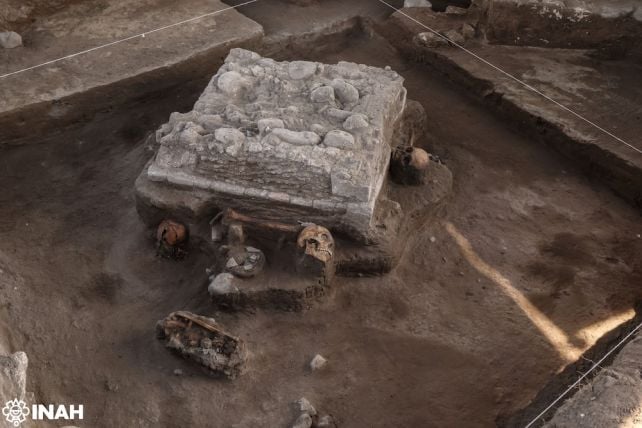
The researchers also uncovered walls and floors suggesting the altar once stood in the center of a courtyard, perhaps within an elite residence or administrative complex.
“We assume that these were either rooms or part of an elite context, or for groups of higher rank, remains of palaces that may have existed on the site,” explained archaeologist Víctor Francisco Heredia Guillén of the National Institute of Anthropology and History (INAH) in Mexico.
“We know that at the outskirts of Tula there were neighborhoods of the upper and middle classes, and much further away, those of the common people.”
The altar itself measures roughly a meter (3.3 feet) square, and consists of three layers of stone – a base made from quarried stone, possibly andesite; a middle layer of modular blocks hewn from the same stone; and a top layer of river stones and basalt.
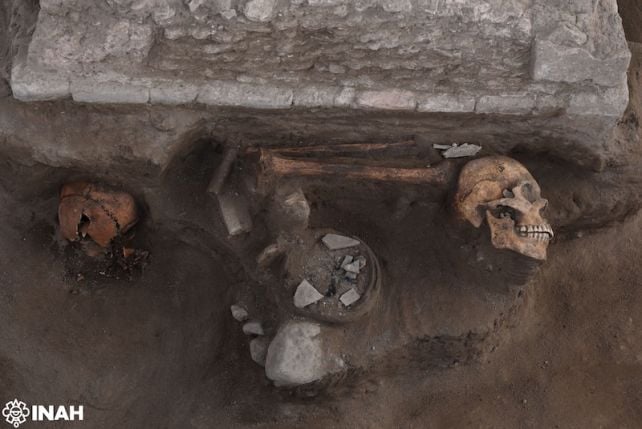
Two skulls were found at the base of the altar, one facing upwards and the other to the southwest. The remaining two skulls, what appear to be several human femurs, and other artifacts were uncovered from beneath a compacted layer of stucco in front of the altar.
The researchers say the remains could represent ritual sacrifice, and will be examining the bones for signs of it.
“Although metals were already being worked in the Postclassic period, we know that here decapitations were still done with obsidian or flint knives, and they left cut marks on the bones,” Heredia Guillén said.
Momoztli were small ceremonial altars where offerings were presented to deities or ancestors. Archaeologists commonly find ceramics, obsidian blades, and other ritual deposits around them – and human remains, too.

Related: DNA Analysis Overturns Myths of Maya Empire’s Child Sacrifice Rituals
The discovery was made during archaeological salvage work carried out ahead of the construction of Mexico’s new Mexico City-Querétaro passenger railway. Such excavations are designed to investigate, document, and recover archaeological remains before construction proceeds.
For now, the altar has been painstakingly documented using photography, drone surveys, and detailed sketches while archaeologists decide how best to preserve it.
Other artifacts recovered from the site have been transferred to laboratories for further study, the researchers said.
This article was fact-checked by Fiona MacDonald and edited by Rebecca Dyer. While we pride ourselves on our process, we are only human. If you spot a mistake, please let us know.