Дайны улмаас гэр бүлээ тэжээх шаардлагатай болсон Газын зурвасын хүүхдүүд хүнд хүчир хөдөлмөр эрхлэх нь түгээмэл үзэгдэл болж, олон улсын хүмүүнлэгийн эрх зүйн ноцтой зөрчил үүсээд байна.
Газын зурвас дахь гэр бүлүүдийн 90 гаруй хувь нь нэн ядууралд өртөж, олон улсын тусламж хангалтгүй байгаагаас хүүхдүүд өдөр тутмын хэрэгцээгээ хангахын тулд хүнд ачаа зөөх, хог хаягдал ангилах зэрэг аюултай ажил хийхээс өөр аргагүйд хүрчээ. Олон улсын хөдөлмөрийн байгууллага болон НҮБ-ын мэдээлснээр, 10-17 насны хүүхдүүдийн дунд хөдөлмөр эрхлэлтийн түвшин дайнаас өмнөх үеэс тав дахин нэмэгдсэн байна. Сургуулиудын 85 орчим хувь нь сүйдсэний улмаас 625,000 гаруй сурагч боловсролоос бүрэн тасраад байгаа нь тэднийг хөдөлмөрийн зах зээлд шилжихэд хүргэж байна.
Эмнэлгийн байгууллагууд хүүхдүүдийн дунд хүнд гэмтэл, нуруу нугасны гажиг, хэт ачааллаас үүдэлтэй бие махбодын болон сэтгэл зүйн хүндрэлүүд эрс нэмэгдэж байгааг анхааруулж байна. Газын сэтгэцийн эрүүл мэндийн хөтөлбөрийн тайланд дурдсанаар, ийм нөхцөлд ажиллаж буй хүүхдүүд “хуримтлагдсан хортой стресс”-т өртөж, мэдрэлийн систем нь байнга түгшүүрийн байдалд ордог аж.
Нийгмийн хөгжлийн яамны зүгээс дэд бүтэц сүйдэж, хяналт шалгалтын боломж хязгаарлагдсанаас хүүхдийн хөдөлмөрийг зогсоох боломжгүй байгааг илэрхийлжээ. НҮБ-ын өмнөх үеийн албан тушаалтан Мартин Гриффитс энэхүү нөхцөл байдлыг олон улсын хамтын нийгэмлэг хүмүүнлэгийн коридор болон санхүүгийн тогтвортой дэмжлэгийг хангаж чадаагүйн үр дагавар гэж тодорхойлсон байна. Олон улсын эрх зүйн хүрээнд энэ нь зөвхөн орон нутгийн асуудал бус, бүхэл бүтэн үеийнхнийг хамгаалалтгүй орхисон ноцтой зөрчил болж байгааг тэрээр онцолжээ.
Дэлгэрэнгүйг эх сурвалжаас харах
↓Эх сурвалжийг нээх ↓
This article first appeared on our partner site, Independent Arabia
On a pavement beside a crowded shelter in the centre of the Gaza Strip, 11-year-old Aws sways from side to side. Under a scorching sun, he tries to balance two gallons of drinking water, each weighing around 15 kilograms which is half his body weight.
He sinks the soles of his bare feet into sand, rubble and dust, while sweat streams down his forehead, leaving streaks across a face that lost its innocent features long ago.
Aws is not looking for friends to play with, but customers to buy the water he transports on his rickety wooden cart. The few measly dollars he earns are brought back each evening to his family’s tent where he throws down his exhausted body with the heavy sigh of a forty-year-old man.
cookie.trim() === ‘__DEBUG__=true’)) { console.log(‘Ad logs: “mpu1”, injectedAtParagraph: 3’); }]]>
Aws is not an isolated case in Gaza, where child labour has gone from being a rare occurrence to an increasingly common sight as displaced families try to stave off starvation.
Like Aws, Bara’ too is forced to work: “Every day I pull a water cart from 7am until sunset. The jerrycans are heavy and my back always aches when I go to sleep. At the end of the day, I earn $20 (£15), which I use to buy food.”
Meanwhile, Yazan spends long hours sifting through the rubble to collect wood or scouring rubbish dumps for plastic waste to sell.
cookie.trim() === ‘__DEBUG__=true’)) { console.log(‘Ad logs: “taboola-carousel-thumbnails”, injectedAtParagraph: 6’); }]]>
Even with an injury that forced him out of work for a week after a large nail pierced his foot, Yazan could not afford to stop. To feed his siblings, he returns daily to gruelling labour, risking his life among collapsing cracked walls, sharp metal shards and unexploded ordnance.
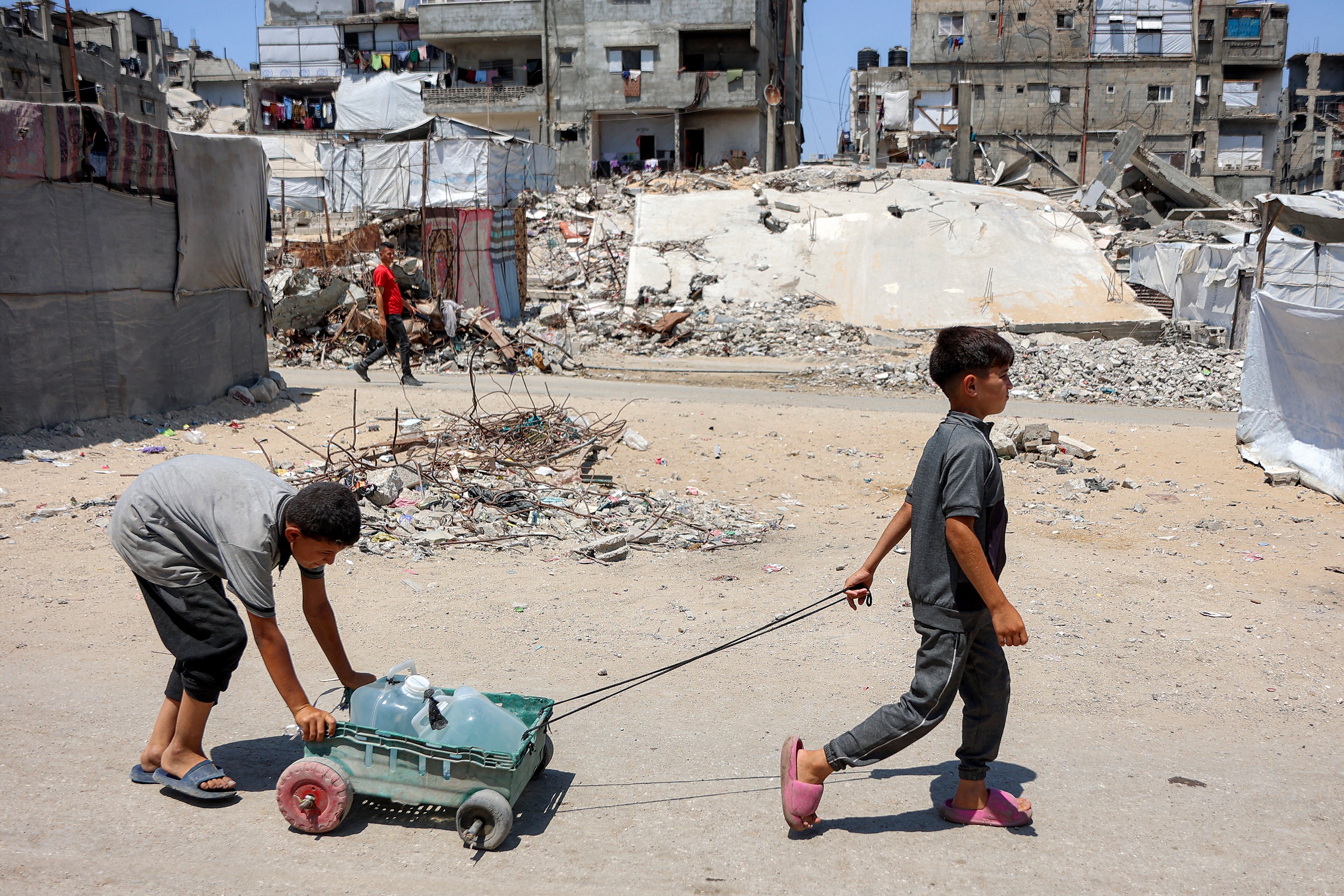
Other children move food parcels and sacks of flour, handling heavy loads intended for adults.
According to data from the Global Education Cluster, more than 625,000 pupils have been completely deprived of formal education for three consecutive years due to the destruction of approximately 85 per cent of school buildings.
cookie.trim() === ‘__DEBUG__=true’)) { console.log(‘Ad logs: “mpu2”, injectedAtParagraph: 8’); }]]>
Data from the International Labour Organisation (ILO) shows that more than 90 per cent of families have been pushed below the extreme poverty line, making child labour the family’s last resort to secure the cost of bread and water.
According to UN Women, the loss of a family’s primary breadwinner – whether through death or severe injury – has forced children, particularly young boys, to become their households’ first and only line of economic defence. Consequently, the proportion of 10- to 17-year-olds driven into harsh street labour has surged, multiplying more than fivefold compared to pre-war levels.
From a human rights and legal perspective, child labour constitutes a flagrant violation of international conventions and treaties protecting children.
cookie.trim() === ‘__DEBUG__=true’)) { console.log(‘Ad logs: “mpu3”, injectedAtParagraph: 11’); }]]>
Sarah recounts the details of the difficult decision she had to take to put her son to work: “I never imagined that my son, Karam, who was top of his class at school, would abandon his studies to stand behind a stall. But after we lost everything and ended up sleeping in a tent, we found ourselves without a single dollar to our name.
“Aid alone is not enough and prices are sky-high. My son sets off at dawn to help me, and my heart breaks for him, but if he stayed in the tent, his younger siblings would go hungry.”
Lingering scars
On the ground floor of the Al-Aqsa Martyrs’ Hospital in Deir al-Balah, field medical officer Khalil al-Daqran is alarmed at the paediatric cases he sees in A&E departments and outpatient clinics.
He tells Independent Arabia: “Many children have sustained severe injuries while working on the streets, requiring urgent surgical intervention. Furthermore, we are recording an alarming rise in skeletal deformities and compression of developing vertebrae.”
On a psychological level, the child is forcibly torn from a world of play and spontaneous exploration to be thrust into the harsh world of adults.

Kanaan, 12, who sells tinned food at the camp market in the centre of the Strip, says: “Every day I return to my tent with a sore back from standing and walking in the sun. But the worst pain comes when someone shouts at me because I’ve been late in getting them what they want.”
A report on child labour by the Gaza Mental Health Programme found that “Gaza’s children who are forced into the labour market are exposed to what is scientifically known as cumulative toxic stress, which causes the child’s nervous system to operate in a constant state of emergency.”
The United Nations Children’s Fund (UNICEF) also warns that children in Gaza face an educational crisis. The longer a child remains out of school, the greater the risk of them permanently dropping out to enter the labour market and shoulder economic responsibilities beyond their physical capacity.
Failure of the international community
I’timad al-Tahrawi, spokesperson for the Ministry of Social Development, expressed concern at the rise of child labour but said little could be done. He told Independent Arabia: “The Ministry and its institutions have been virtually paralysed as a result of the continuous targeting of our headquarters and field staff. Monitoring and inspection teams are now unable to operate on the ground due to a lack of logistical resources, fuel and security.
“We cannot prevent a child who is supporting a family whose breadwinner has been killed, or who lives in extreme poverty, from working without providing them with a financial alternative. However, the Ministry is currently unable to provide regular cash allowances to thousands of families due to the blockade and the loss of revenue.”
Martin Griffiths, former UN Under-Secretary-General, says: “The phenomenon of child labour in Gaza is a direct result of the international community’s failure to establish safe and sustainable humanitarian corridors that ensure an adequate flow of cash and food aid to families.
“When families are left without financial support throughout three years of war, child labour becomes inevitable. This is where the violation shifts from a local issue to an international crime resulting from the economic blockade and the destruction of infrastructure.
“International humanitarian law mandates that international powers provide alternative care and immediate protection for children in conflict zones. What is happening in Gaza sets a dangerous precedent for stripping an entire generation of its protection.”
Translated by Mirane Abou Zaki; Reviewed by Tooba Khokhar and Celine Assaf