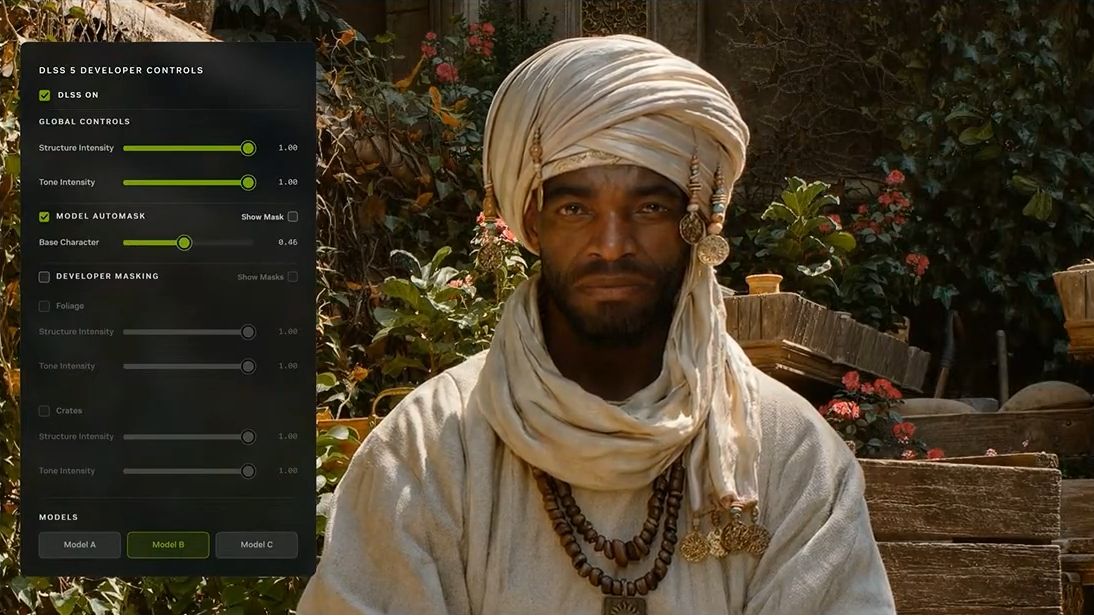
NVIDIA компани SIGGRAPH 2026 арга хэмжээний үеэр DLSS 5 технологид зориулсан хоёр үндсэн тохиргооны хянагчийг танилцуулж, хөгжүүлэгчид дүрсний чанарыг хэрхэн удирдах боломжтойг тайлбарлав.
DLSS 5 нь үндсэндээ хиймэл оюун ухааны тусламжтайгаар дүрсний чанарыг сайжруулах “шүүлтүүр” байдлаар ажилладаг бөгөөд хөгжүүлэгчид ‘structural intensity’ (бүтцийн эрчим) болон ‘tone intensity’ (өнгө аяс) гэсэн хоёр хянагчийг ашиглах боломжтой болно. Бүтцийн эрчим нь орчны хаалт (ambient occlusion), гэрлийн ойлт зэрэг нарийн хэсгүүдийг тохируулдаг бол өнгө аясын хянагч нь гэрэлтүүлэг болон ерөнхий өнгөний тэнцвэрт нөлөөлдөг. NVIDIA-ийн зүгээс энэхүү технологи нь геометрийн бүтцийг өөрчлөхгүйгээр дүрслэлийг илүү бодитой болгоход чиглэж байгааг онцолсон юм.
Хөгжүүлэгчид тоглоомын орчин дахь объект бүр дээр эдгээр хянагчийг тус тусад нь ашиглах эрхтэй байх бөгөөд ингэснээр дүр болон арын дэвсгэр зургийг өөр өөр түвшинд тохируулах боломж бүрдэнэ. Энэ нь уламжлалт аргаар хийхэд өндөр өртөгтэй байдаг гэрэл сүүдрийн эффектүүдийг бодит цаг хугацаанд үүсгэхэд туслах юм.
Одоогоор ердөө хоёрхон хянагч байгаа нь зарим талаар хангалтгүй мэт санагдаж болох ч NVIDIA энэ нь одоо байгаа дүрс сайжруулах технологиудыг орлох бус, харин тэдгээрийг өргөжүүлэх нэмэлт шийдэл гэдгийг тодотголоо. Компани хөгжүүлэгчдийн санал хүсэлтийг авч, цаашид илүү олон хяналтын хэрэгсэл нэмэхээр ажиллаж байна. DLSS 5 энэ намар худалдаанд гарахад эдгээр тохиргоо хэрхэн хэрэгжихийг харах үлдлээ.
Дэлгэрэнгүйг эх сурвалжаас харах
↓Эх сурвалжийг нээх ↓
Nvidia announced DLSS 5 back in March and it received, let’s say, mixed reactions. A lot of people weren’t happy about how, judging by the demos, it seemed to essentially just slap a ‘yassifying’ AI filter on top of a game scene. Nvidia itself confirmed that all the tech has to work with for each AI frame is a traditional 2D frame and motion vectors, essentially confirming the “filter” idea. Now, at SIGGRAPH 2026, the company has explained that developers will get two main sliders to control DLSS 5’s intensity.
My initial reaction was probably the same as yours: two whole sliders, whoop-de-doo. It’s hardly a massive improvement from the one on-to-off masking slider we previously thought devs would have access to. But let’s take a look at what they’re actually controlling and how it works before we jump to conclusions.
The two sliders are for ‘structural intensity’ and ‘tone intensity’. Despite what the word “structure” might seem to imply, Nvidia is keen to point out that “it is not changing the geometry in any way, and it is uplifting the image.”
The structural intensity slider in fact is “modulating the high-frequency detail of the frame.” This includes things such as ambient occlusion, subsurface scattering, and reflections. The tone intensity slider is “modulating the low frequency detail of the frame”, including “expressive” things such as lighting and, well, overall tone.
To play devil’s advocate for a moment, the fact that these are the only controls given to devs could just mean that model is in fact tailored so well that it’s not worth giving more control over it than necessary. The company explains the model preserves artistic intent thanks to “internal buffers”, so perhaps it wants to keep these buffers intact.
You can see the controls in action in the segment below.
Nvidia also says that the company is building more controls for developers to use and is “working with our partners to incorporate their feedback.”
It’s also worth noting that game devs will be able to mask different objects in a game scene, changing the structural and tone intensities for each independently. Devs might, for instance, want to give some background objects the full DLSS 5 makeover but keep a lighter touch with the characters.
To be fair, judging by the demo given by Nvidia’s creative artist, introduced as ‘Gaff’, cranking up the structural intensity a little can indeed add a bit more realism to the scene without affecting the overall tone of a scene. That would be the ideal, I think. Things such as subsurface scattering can make a big difference, and Gaff notes that this “would be incredibly expensive to do in traditional rendering.”
Alright, that’s my devil’s advocating done. It does make sense for this to be Nvidia’s strategy, given it needs to keep everything quick and snappy for rendering by making the model so that it “does not need to peek ahead”, instead just using a render and motion vectors to create what is essentially an AI filter. But that doesn’t make it any less disappointing that there are, as of now, just two sliders to use.
Still, I suppose it’s all optional. And Nvidia is keen to note this new addition to its AI feature list will exist alongside the others which are still being worked on. It “extends the existing pipeline. It does not replace them.”
At any rate, we’ll just have to see whether the further controls alluded to will be available when DLSS 5 launches this fall.

