АНУ-ын Northrop Grumman компани хиймэл дагуулыг цэнэглэх, засварлах зориулалт бүхий хоёр робот гартай шинэ хөлгөө өнөөдөр хөөргөхөөр төлөвлөж байна.
Northrop Grumman компанийн бүтээсэн “Mission Robotic Vehicle” (MRV) хөлөг нь тойрог замд буй хиймэл дагуулуудад үйлчилгээ үзүүлэх, тэдгээрийн ашиглалтын хугацааг сунгах зориулалттай юм. Гэсэн хэдий ч тус хөлгийн робот гар нь дайсны хиймэл дагуулыг устгах, гэмтээх эсвэл тойрог замаас нь гаргах зэрэг цэргийн ажиллагаанд ашиглагдаж болзошгүй гэсэн болгоомжлол үүсээд байна. Компанийн гүйцэтгэх захирал Кэти Уорден энэ талаар тайлбар өгөхдөө, тус технологийг хэрхэн ашиглах нь АНУ-ын засгийн газрын бодлогоос хамаарна гэдгийг онцолсон байна.
АНУ-ын Сансрын хүчин (U.S. Space Force) сансар огторгуйг дайны талбар гэж үзэн, өөрийн хиймэл дагуулуудыг хамгаалах болон шаардлагатай үед довтолгооны ажиллагаа явуулах чадавхыг хөгжүүлж байгаагаа ил тод зарласан. Тус хүчний удирдлагууд сансарт бусад улс орнуудын хөгжүүлж буй робот гартай хиймэл дагуулууд болон интерцептор пуужингуудыг томоохон аюул занал гэж тодорхойлж байна.
MRV хөлөг нь DARPA болон Тэнгисийн цэргийн судалгааны лабораторийн хамтын ажиллагааны үр дүнд бүтээгдсэн RSGS системийн нэг хэсэг юм. Одоогоор АНУ-аас гадна ОХУ, БНХАУ зэрэг улсууд сансарт засвар үйлчилгээ болон тагнуулын зориулалтаар ашиглаж болох “хос зориулалттай” технологиудыг хөгжүүлж буй нь сансрын тойрог зам дахь өрсөлдөөнийг улам хурцатгаж байна.
Дэлгэрэнгүйг эх сурвалжаас харах
↓Эх сурвалжийг нээх ↓
A spacecraft equipped with two robotic arms, developed by Northrop Grumman, is set to be launched today. The company plans to establish an entire fleet of these Mission Robotic Vehicles (MRVs), ostensibly to offer a commercial service to refuel and repair satellites in orbit. However, the question has been raised about whether the MRV could also be used to attack enemy assets in space. The U.S. Space Force has said publicly that it is pursuing offensive space-based capabilities, primarily to help protect friendly satellites from growing threats.
Whether the MRV, or a derivative thereof, could be employed in an offensive role explicitly came up during a quarterly Northrop Grumman earnings call this morning. The company does not appear to have ruled out the possibility.
“As part of our satellite servicing portfolio, we’ve developed the first commercial robotic spacecraft capable of repairing, relocating, and servicing satellites in geosynchronous orbit via two robotic arms,” Northrop Grumman CEO Kathy Warden had highlighted in her introductory remarks at the start of the call. “It can also install life extension jetpacks onto other satellites for government or commercial customers, prolonging their useful life for up to eight years.”
“The spacecraft is known as the Mission Robotic Vehicle, or MRV, and our first MRV is scheduled to launch later today, weather permitting,” she added.
“You probably can’t provide quantitative terms here, but just from a qualitative perspective, what’s the potential market for an offensive version of that spacecraft that could be used to disable adversary satellites?” Scott Mikus, Director for Aerospace, Defense and Space Research at Melius Research, asked later on during the call.
“So I appreciate the question. I will leave it up to the U.S. government to decide how that capability might fulfill mission objectives that they have in that regard,” CEO Warden said in response. “But certainly, it’s our objective to offer our clients options for technology deployment, and for them to determine policy for when and how they might deploy that technology.”
To take a step back, if all goes to plan, a SpaceX Falcon 9 space launch rocket carrying the MRV will blast off from Cape Canaveral sometime in a four-hour window starting at 5:15 PM ET today. The rocket will also carry three Mission Extension Pods (MEPs), which are the “life extension jetpacks” that Warden mentioned.
As noted, the MRV has two robotic arms that allow it to place the MEPs onto other satellites in orbit, as well as perform other tasks. The arms are part of what is formally called the Robotic Servicing of Geosynchronous Satellites (RSGS) payload. The RSGS system was developed through a program led by the U.S. Defense Advanced Research Projects Agency (DARPA), in cooperation with the U.S. Naval Research Laboratory (NRL). It is worth noting here that RSGS is the product of U.S. government work in this vein stretching back decades. There have also been other similar developments elsewhere globally, including in China and Russia, as we will come back to later on.
The MRV’s upcoming mission will include rendezvousing with satellites belonging to Australian firm Optus and SES in Luxembourg and attaching MEPs to them, according to a report from Spaceflight Now. Both of these companies are commercial telecommunications providers.
Northrop Grumman’s fact sheet on the MRV says the spacecraft is capable of performing an array of on-orbit inspection and servicing missions beyond refueling via the MEPs. The robotic vehicle can also be used to ‘tow’ satellites from one position to another and help clear debris. All of this requires the ability to maneuver very closely with other target objects in space. This, in turn, brings us to the question of the MRV potentially offering an offensive anti-satellite capability.
For years, TWZ has highlighted how robotic arms on spacecraft are an inherently dual-use capability that could be used to launch attacks in space. In general, arms like this could be used to damage or destroy key systems on adversary satellites, such as optics or solar panels, or to just pull them out of orbit. In the latter case, the target could be towed into a degrading orbit where, if control could not be reestablished, it would re-enter the Earth’s atmosphere and be destroyed.
The U.S. military itself has repeatedly pointed to adversary satellites with robotic arms as one of many potential threats to its own space-based capabilities.
“We’re basically responding to a warfighting domain where our adversaries have already put interceptors in space, and we want to make sure that we rebalance that in terms of deterrence,” Chief of Space Operations Gen. Chance Saltzman, the Space Force’s top officer, said at a roundtable at the Air & Space Forces Association’s (AFA) annual Warfare Symposium in February. Saltzman was responding to a direct question from our Howard Altman.
“Interceptors by definition refer to a handful of well-acknowledged capabilities that other countries have, like ground and air-launched anti-satellite missiles or capabilities like the SJ-21 [the Chinese Shi Jian 21 satellite], which has a grappling arm,” a Space Force spokesperson also told TWZ at that time when asked for clarification about the “interceptors in space” Saltzman had mentioned.
‘Inspector satellites’ that could have dual-use purposes have been a hot topic of discussion for years now, with Russian developments drawing particular attention. A ‘killer satellite’ with close maneuvering capability could employ a variety of means beyond robotic arms to try to disable, damage, or even destroy a target in space. This could include electronic warfare jammers,directed energy weapons,chemical sprays, andsmall projectiles. The space-based inspector could itself be used as a kinetic kill vehicle and deliberately smashed into the target.
Close inspection of other satellites in space also provides opportunities to gather intelligence about their capabilities and monitor their activities. U.S. satellites, as well as those belonging to Russia and other countries, have been observed doing just this over the years. Some commercial satellite imagery firms are even now offering space-based situational awareness as a service.
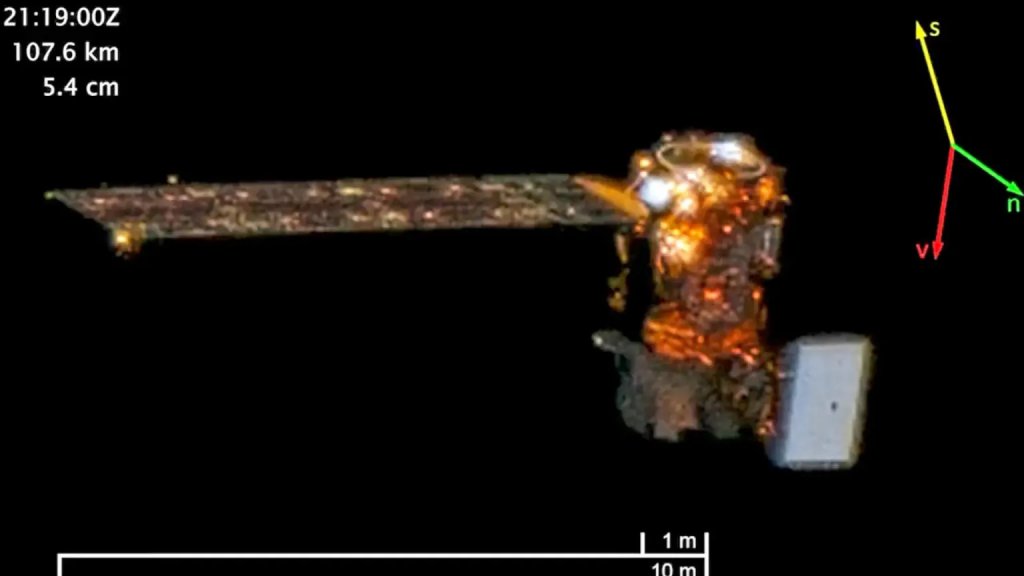
As underscored by DARPA and NRL’s work on RSGS payload, the U.S. military already has a clear interest in the MRV spacecraft’s core capabilities. On-orbit refueling, in particular, is seen as offering vital freedom of maneuver to help safeguard friendly satellites from attack. Right now, ‘running and hiding’ is the most immediate option available for responding to threats, but doing so requires satellites to burn precision fuel, eating into their operational lifespan.
The Space Force also has an entire unit dedicated to a still-evolving “orbital warfare” mission set that has defensive and offensive elements.
“Protecting and defending satellites can’t simply be done by protect and defend. You can’t run away from a bully forever. Sometimes you got to turn around and punch,” Lt. Gen. Gregory Gagnon, head of U.S. Space Force Combat Forces Command (CFC), said at another roundtable at the AFA Warfare Symposium in February. “So protect and defend, although necessary, is insufficient to deliver space control. We also need, as part of our joint force, the ability to attack.”
Gagnon cited China’s massively expanding space-based capabilities as a key driver behind this viewpoint. He’s also mentioned plans for Space Delta 9, the formation tasked with orbital warfare, to begin exploring new offensive and defensive tactics using an experimental satellite.
“This prototype will be operated by my Orbital Warfare Delta. This is the only Orbital Warfare Delta in the United States government. Their job will be working on their maneuvers, which is one of the seven joint functions of warfighting, so that they can deliver offensive and defensive capabilities that are precise and not imprecise,” he explained. “They’re going to work on driving that spacecraft in a way that we couldn’t drive spacecraft before.”
The scale and scope of demands to protect U.S. satellites in orbit is only set to grow significantly in the coming years, fueled further now by the Golden Dome initiative. Golden Dome is a multi-faceted effort aimed at delivering a hugely expanded national missile defense architecture. A core element of the plan as it stands now is space-based anti-missile interceptors, which will be supported by large, distributed sensor and communications satellite constellations. In a report released in May, the Congressional Budget Office (CBO) assessed that 7,800 interceptors in orbit could be needed to make the concept work.

As already noted, the U.S. military has a clear interest in the on-orbit refueling and servicing capabilities that Northrop Grumman’s MRV spacecraft is designed to provide now. This could also be key to protecting and sustaining elements of Golden Dome, as well as other critical new space-based sensor and other satellite constellations.
The scheduled launch of the first MRV spacecraft today is a very important milestone all around, and one that might open the door to a very different kind of ‘armed’ space-based capability.
Contact the author: joe@twz.com
The post Could This New Northrop Spacecraft Use Its Robotic Arms To Attack Enemy Satellites? appeared first on TWZ.