Улаанбурхан өвчний тархалт эрчимжиж, 2026 оны долдугаар сарын 21-ний байдлаар 2025 оны нийт тохиолдлын тоог давсан нь нийгмийн эрүүл мэндийн салбарынхны санааг зовоож байна.
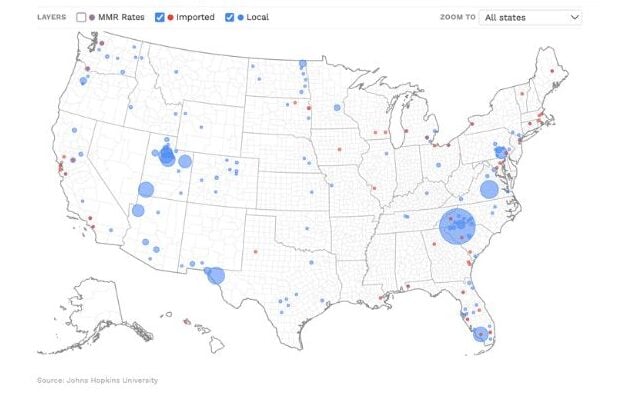
АНУ-ын Өвчний хяналт, урьдчилан сэргийлэх төвөөс (CDC) мэдээлснээр, 2025 онд улаанбурхан өвчний 2,289 тохиолдол бүртгэгдсэн бол 2026 оны долдугаар сарын 21-ний өдөр энэ үзүүлэлт албан ёсоор эвдэгдлээ. Энэ нь 1991 онд 9,643 тохиолдол бүртгэгдсэнээс хойших хамгийн өндөр үзүүлэлт юм. Улаанбурхан нь агаар дуслын замаар маш хурдан халдварладаг вирус бөгөөд нэг өвчтөнөөс 18 хүртэлх хүнд халдварлах эрсдэлтэй.
Johns Hopkins Bloomberg School of Public Health-ийн эпидемиологич Уильям Мосс болон бусад мэргэжилтнүүд энэ өвчлөлийг урьдчилан сэргийлэх бүрэн боломжтой байсан гэж үзэж байна. Улаанбурхан өвчний шинж тэмдэгт халуурах, ханиалгах, тууралт гарах зэрэг шинжүүд багтах бөгөөд хүндэрсэн тохиолдолд уушгины хатгалгаа, тархины үрэвсэл зэрэг эрүүл мэндийн ноцтой хүндрэл үүсгэж, улмаар нас барах аюултай. Өнгөрсөн онд тус улсад улаанбурхан өвчний улмаас гурван хүн нас барсан байна.
Мэргэжилтнүүдийн дүгнэж буйгаар, вакцинжуулалтын хамралт буурсан нь энэхүү дэгдэлтийн гол шалтгаан болжээ. Үүнд вакцинжуулалтын талаарх төөрөгдөл, эрүүл мэндийн байгууллагад итгэх итгэл суларсан зэрэг хүчин зүйлс нөлөөлж байна. “Unbiased Science”-ийн үүсгэн байгуулагч Жессика Стейер улаанбурхан өвчнийг даван туулсан ч дархлааны тогтолцоонд “ой санамжийн алдагдал” буюу бусад халдвараас хамгаалах чадвараа түр зуур алдах эрсдэлтэйг анхаарууллаа.
Вакцинжуулалт нь улаанбурхан өвчнөөс сэргийлэх хамгийн үр дүнтэй арга хэвээр байна. Шинжлэх ухааны олон удаагийн судалгаагаар улаанбурхны вакцин нь аутизм болон гэдэсний үрэвсэлт өвчин үүсгэдэггүй болохыг нотолсон бөгөөд вакцины нийтлэг сөрөг нөлөө нь өвчний өөрийнх нь хүндрэлээс харьцангуй ховор тохиолддог байна. Одоогоор эрдэмтэд вакцинжуулалтыг илүү хялбар болгох үүднээс хамрын шүршигч болон наалт хэлбэрийн вакциныг хөгжүүлэхээр ажиллаж байна.
Дэлгэрэнгүйг эх сурвалжаас харах
↓Эх сурвалжийг нээх ↓
Measles cases in the United States have just passed a “grim milestone”, reaching numbers that haven’t been seen in 35 years.
In 2025, the Centers for Disease Control and Prevention reported a total of 2,289 measles cases.
Today, 21 July 2026, that number was officially breached.
The last time US measles cases exceeded this 2026 number was in 1991, when 9,643 cases were reported, following 27,808 cases in 1990.
Annual cases dropped in the following years, to just 312 in 1993, after a second vaccine dose was recommended and school vaccination programs began.
Since then, measles case numbers have remained low.
Until 2025, that is.
Public health experts are deeply concerned. Last year, three people died from the disease. No deaths have yet been reported in 2026, but with each new case, the odds are getting worse.
“This was truly a problem of our own making and completely preventable.” – public health expert Jessica Steier
William Moss is an epidemiologist with the Johns Hopkins Bloomberg School of Public Health, where he is part of a team closely tracking the national measles outbreak.
He says this is a “grim milestone” that could have been avoided.
“It is tragic that in 2026, only partway through the year, we are surpassing the 2025 total,” Moss told ScienceAlert.
Measles is a highly contagious viral disease that is easily spread by airborne particles when an infectious person coughs, sneezes, or talks.
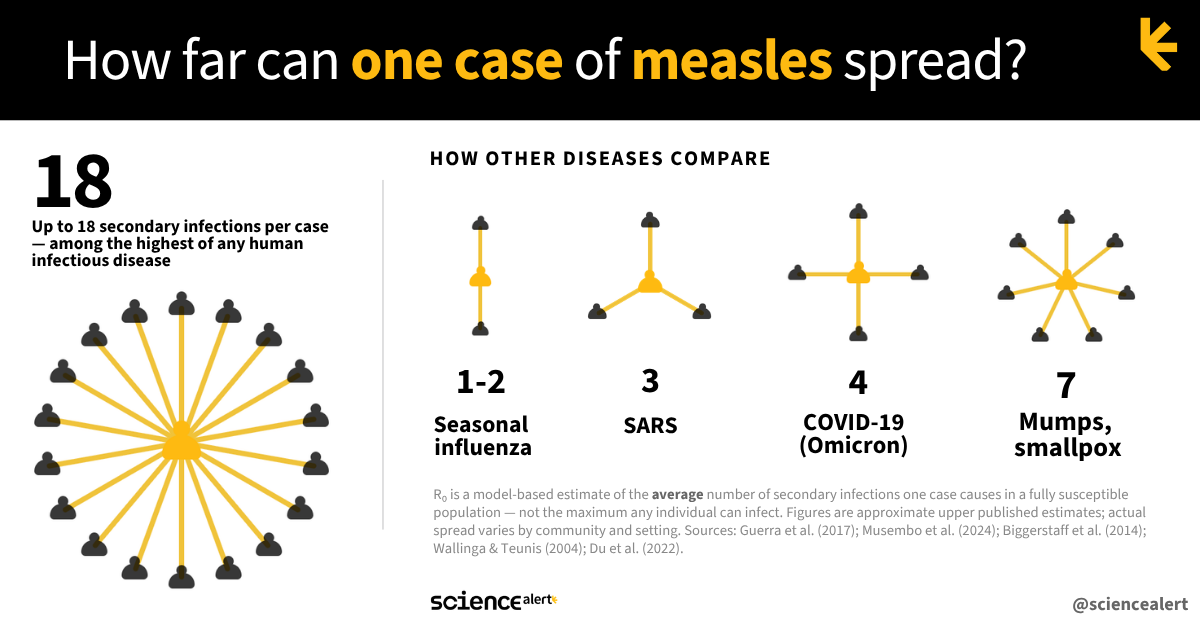
For every one person infected, they’ll spread the virus to up to 18 other people. By contrast, the infection rate (or R0) is around 2 for the flu and up to 4 for SARS-CoV-2.
When the measles virus first lands in your body, it hijacks your cells to produce more copies of itself. Usually, these early moments of infection occur in the upper respiratory tract and lungs, where it begins to affect your ability to breathe.
From there, the virus infects immune cells that carry it to the lymph nodes, where it has an easy route to travel throughout the body.
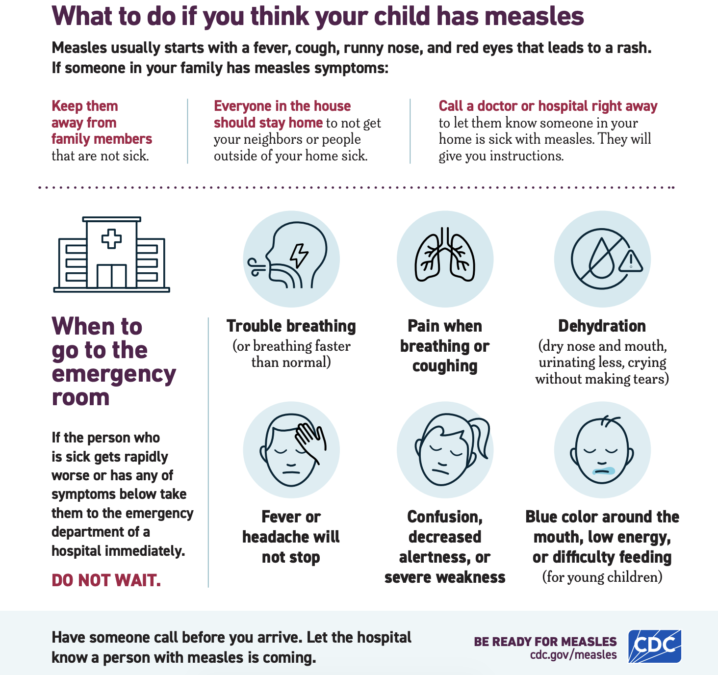
Symptoms include fever, coughing, and a red, raised rash.
Infected people may also develop other symptoms, such as ear infections, pneumonia, diarrhea, or encephalitis (inflammation in the brain that can cause brain damage).
“This was truly a problem of our own making and completely preventable,” public health expert Jessica Steier, founder of Unbiased Science, said in an interview with ScienceAlert.
“We eliminated measles in 2000 after decades of hard-won public health work, and now we’re watching that progress erode… It is devastating for the children in our country.”
In severe cases, measles can lead to hospitalization and may even result in death.
Experts advise that the best way to protect yourself and your family from measles is to get vaccinated.
“In countries where measles is endemic, parents, health care workers, and political leaders are aware of the devastating effects of measles,” Moss, whose work has mainly been situated in resource-poor countries, told ScienceAlert.
“In many of these countries, the challenge is to improve access to measles vaccines, not convince people of the value of measles vaccine.”

And yet, while most communities in the US have access to vaccines, many people are choosing not to vaccinate themselves or their children, or are hesitant to do so, either due to vaccine fatigue or complacency, fears around side effects, or a loss of trust in medical institutions.
Religious exemptions and philosophical objections can also seed pockets of vulnerability in particular communities.
“We know [under-vaccination] is a long-standing problem because of the wide age range of cases: only 20 percent of cases are in children younger than 5 years of age but 50 percent are in older children and 20 percent in adults older than 20 years,” Moss said.
Experts say a major factor may be that we have collectively forgotten just how bad measles was before the vaccine, which was first rolled out in 1963.
“Successful vaccination programs undermine themselves because people forget how devastating these vaccine-preventable diseases can be,” Moss explained.
“Much of the public has forgotten the deaths and disability due to smallpox, polio, measles, congenital rubella syndrome and other preventable diseases.”
Death is not the only concern when it comes to measles.
“Many parents think that surviving measles is all they need to worry about. It’s not,” Steier said.
“Even a mild case can trigger what’s called ‘immune amnesia’, when a child recovers from measles only to find their immune system has forgotten defenses it had already built against other infections, and it can take two to three years to rebuild what was lost.”
The measles vaccine (which also tackles mumps and rubella) works by introducing weakened versions of the virus into the body, so that the immune system – especially T cells, white blood cells, and natural killer cells – can learn to recognize and fight this intruder before it actually arrives.
It’s a bit like swapping out an opponent’s real sword for a foam one while practicing for battle. By the time the real enemy arrives, sharpened blade in hand, the immune cells are already two steps ahead of it.
Scientists have confirmed that the measles vaccine does not cause irritable bowel disease or autism – by conducting many high-quality and rigorous studies following up large numbers of vaccinated and unvaccinated children.
The most common side effects of a measles vaccination include pain, swelling, and redness around the injection site, and occasionally, a fever that lasts a few days (that’s the immune cells honing their battle skills).
In very rare cases, the vaccine may cause febrile seizures, a drop in blood platelet count (thrombocytopenia), or anaphylaxis (a severe allergic reaction).
These concerning side effects are much rarer than serious complications associated with the disease itself.
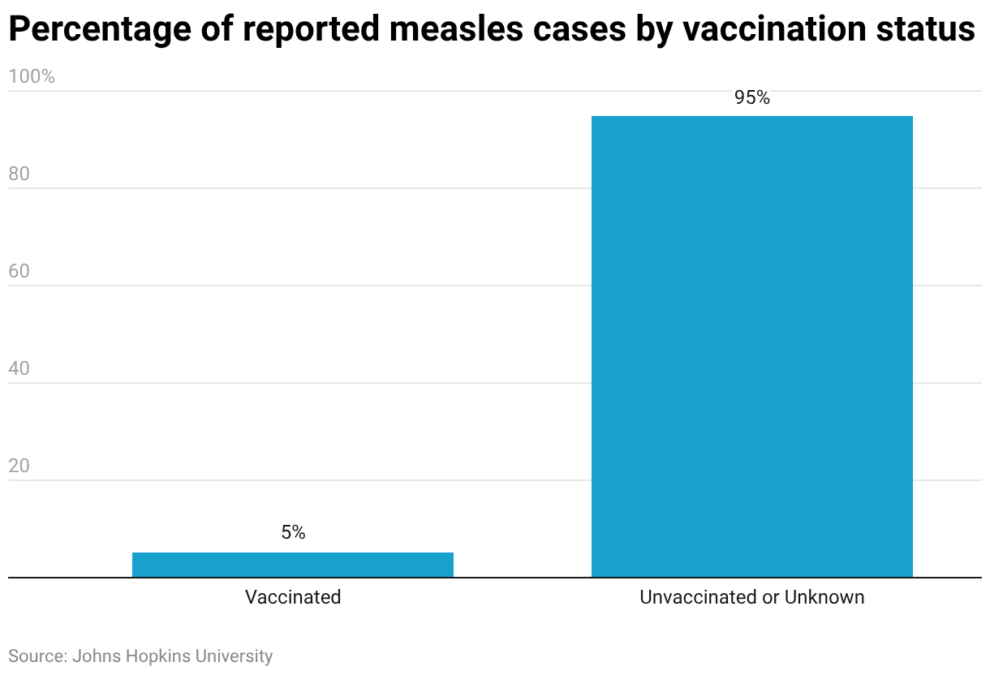
Data show that people who have received two doses of the measles vaccine are well protected against the virus, while those who are unvaccinated or have an unknown vaccination status are affected at far higher rates.
For the United States to return to measles elimination status, Steier and Moss agree there are some major hurdles ahead.
On one hand, there’s the question of resourcing the outbreak response in a system already stretched thin.
“If we continue to have measles virus transmission here in the United States, we will continue to have entirely preventable illness, hospitalizations and deaths, a strained public health system that will not have the resources or personnel to address other issues, and will incur the large financial costs of measles outbreaks,” Moss warned.
And then there’s the larger issue of vaccine coverage, disinformation, and eroded confidence in the health system.
Research published in the scientific journal Vaccine suggests that the removal of school vaccination mandates in the wake of COVID-19 correlates strongly with the resurgence of measles cases in the US.
Restoring confidence in vaccination programs is a challenge that many in the field are reckoning with.
“We always say that a parent who decides not to vaccinate their child believes they’re making the right decision, not a reckless one,” Steier said.
“We need to recognize there is a trust gap here, not simply a knowledge gap to be corrected with more facts.”

“Unfortunately, some parents are in communities that actively discourage vaccination, and those messages may come from trusted local voices (neighbors, faith leaders, other parents), which makes them stick,” Steier added.
“What’s more likely to help is communication from messengers within their own community, addressing specific fears directly rather than dismissing them, and being honest about uncertainty rather than projecting false certainty.”
Related: Universal Vaccine Blocks Viruses, Bacteria, And Allergies With a Nasal Spray
Historically, the measles vaccine has done the heavy lifting in terms of lives saved, accounting for 60 percent of the 154 million lives saved since 1974, according to the World Health Organization.
To extend that benefit, scientists are working to make vaccination as quick, easy, and pain-free as possible to encourage more people to get immunized, with nasal sprays and vaccine patches in the works.
Until those become widely available, the current measles vaccine is one of our best weapons in the fight against infectious disease, and it works better the more people who are armed with it – the community invisibility cloak that goes with your personal immunity sword.
To keep up to date with the ongoing outbreak, visit the Johns Hopkins US Measles Tracker.
This article was fact-checked by Clare Watson and edited byRebecca Dyer.While we pride ourselves on our process, we are only human. If you spot a mistake, please let us know.