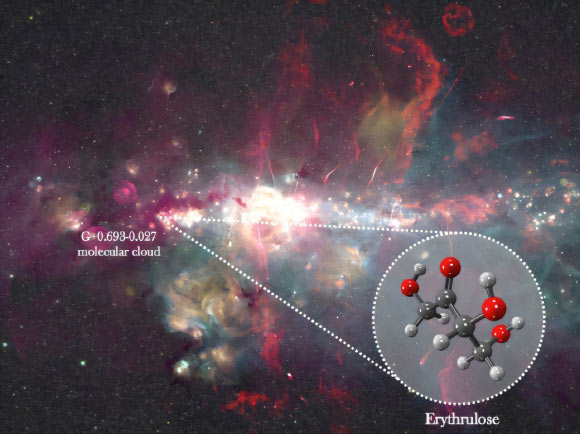
Мэргэжилтнүүд манай галактикийн төв хэсэгт орших хий, тоосны үүлнээс амьд организмын өмнөх химийн үйл явцад чухал ач холбогдолтой молекулыг олж тогтоожээ.
Одон орон судлаачид дэлхийгээс 26,745 гэрлийн жилийн зайд орших G+0.693−0.027 хэмээх хийн үүлнээс бөөрөлзгөнө жимсэнд агуулагддаг эритрулоз (erythrulose) хэмээх дөрвөн нүүрстөрөгчийн сахар илрүүлсэн байна. Испани дахь Йебес (Yebes) болон IRAM 40 метрийн радио телескопуудыг ашиглан хийсэн энэхүү судалгаа нь од хоорондын орон зайд сахар илрүүлсэн анхны тохиолдол болж байна. Судлаачид молекулын эргэлтийн үед ялгардаг радио долгионы давтамжийг ашиглан 12 төрлийн химийн ул мөрийг баталгаажуулжээ.
C4H8O4 томьёотой энэхүү нэгдэл нь сансарт илэрсэн хамгийн том цагираг бус молекул бөгөөд дөрвөн хүчилтөрөгчийн атом агуулсан анхны молекул юм. Эритрулоз нь ДНХ, РНХ-ийн бүтцэд шууд оролцдоггүй ч РНХ-ийн барилгын материал болох рибонуклеотид үүсгэх урвалд оролцох боломжтой. Энэ нь гараг эрхэс болон амьдрал үүсэхээс өмнө сансрын хэт хүйтэн орчинд нарийн нийлмэл химийн нэгдлүүд үүсдэгийг баталж байна.
Судалгааны багийнхны таамаглаж буйгаар эритрулоз нь сансрын тоосны ширхгүүдийг бүрхсэн мөсөн гадаргуу дээр илүү энгийн молекулуудын урвалаар үүсдэг аж. Судалгааг удирдсан Изаскун Хименес-Серрагийн тэмдэглэснээр, энэхүү нэгдэл нь урьд өмнө таамаглаж байснаас найм дахин их хэмжээтэй байгаа нь одон орон химийн салбарт шинэ ойлголтыг авчирч байна. Энэхүү олдвор нь РНХ-ийн бүрэлдэхүүн хэсэг болох рибоз зэрэг бусад сахарыг сансраас олох боломжтойг харуулж байгаа юм.
Дэлгэрэнгүйг эх сурвалжаас харах
↓Эх сурвалжийг нээх ↓
Astronomers have identified erythrulose, a four-carbon sugar found naturally in raspberries, inside a cloud of gas and dust near the center of the Milky Way. The molecule was detected in G+0.693−0.027, a chemically rich cloud about 26,745 light-years from Earth, using two radio telescopes in Spain.
The study published in Nature Astronomy describes the finding as the first detection of a sugar in the interstellar medium, the gas and microscopic dust spread between stars. The discovery shows that a relatively complex sugar can form through non-biological chemistry before planets and living organisms exist.
Erythrulose is not one of the sugars that forms the backbone of DNA or RNA. However, it can change into related sugars under certain conditions and take part in reactions that produce ribonucleotides, the building blocks of RNA. Its presence in a molecular cloud adds to evidence that some ingredients linked to prebiotic chemistry can develop in space.
Radio telescopes identified the sugar’s chemical fingerprint
Astronomers observed the cloud using the Yebes 40-meter telescope and the IRAM 30-meter telescope. These instruments measure radio waves emitted or absorbed by molecules. As a molecule rotates, it interacts with radio waves at a specific set of frequencies, creating a pattern that researchers can use as a chemical fingerprint.
The team identified 12 groups of emission lines that matched laboratory measurements and calculations for erythrulose. Molecular clouds contain many chemicals with overlapping radio signals, so the researchers also considered emissions from more than 180 other known molecules before assigning the pattern to the sugar.
Erythrulose has the formula C4H8O4, meaning that it contains four carbon atoms, eight hydrogen atoms and four oxygen atoms. With 14 atoms in total, the researchers describe it as the largest non-cyclic molecule yet identified in interstellar space. It is also the first interstellar molecule found with four oxygen atoms and only the second known chiral molecule detected there.
A chiral molecule can occur in two forms that mirror each other, much like left and right hands. This feature is important in biology because living systems often use one mirrored form more than the other. The observations did not determine which form of erythrulose was present, but they show that chiral chemistry can develop under interstellar conditions.
The sugar may form on icy grains of space dust
The team’s chemical models indicate that erythrulose can form on microscopic grains coated with ice. These grains provide surfaces where molecules can gather and react in an environment that is otherwise extremely thin and cold. Some of the sugar may later leave the ice and enter the surrounding gas, where radio telescopes can detect it.
The proposed pathway begins with simpler two-carbon molecules, including glycolaldehyde and ethylene glycol, that have already been found in space. The models suggest that these compounds can react on dust-grain surfaces and gradually produce the four-carbon structure of erythrulose without cells, enzymes or another biological source.
The researchers were surprised to find that erythrulose appeared to be at least eight times more abundant than two comparable three-carbon sugars, glyceraldehyde and dihydroxyacetone. Neither smaller sugar was detected in the same observations, even though the survey was sensitive enough to search for weak signals.

“This finding was unexpected, as the prevailing view in astrochemistry is that interstellar molecules grow in size through the sequential addition of carbon atoms,” study lead Izaskun Jiménez-Serra said in a report on the discovery.
Different molecules may form, break apart and leave icy grains at different rates. Some may also return to the grains after entering the gas. These processes could make a four-carbon sugar easier to detect than smaller molecules that initially appear simpler to produce.
Interstellar sugar adds to evidence of prebiotic chemistry
Sugars perform several jobs in living organisms. Some supply energy, while others form parts of genetic material. Ribose is part of RNA, for example, and deoxyribose is part of DNA. Erythrulose has a different structure, but it belongs to the same broad family of compounds.
Under watery conditions, ketose sugars such as erythrulose can rearrange into related aldose sugars. This process, called isomerization, changes how the atoms are organized without changing the molecule’s overall formula. The study notes that erythrulose can therefore contribute to mixtures involved in experimental pathways that produce RNA components.
Scientists had previously detected biologically important sugars in meteorites and in samples collected from asteroid Bennu. Astronomers had also found glycolaldehyde in space, but the study distinguishes it from a true sugar. Erythrulose is the first compound classified as a sugar to be directly identified in an interstellar cloud.
“The detection of erythrulose is very exciting because it opens up the possibility of discovering in space other sugars such as ribose, which is part of RNA,” study co-author Carlos Briones said.
Sugars formed in space may enter young planetary systems
Molecular clouds are cold regions where stars and planetary systems develop. Chemicals formed on icy dust grains can become part of the disks surrounding young stars. Some may later be preserved inside comets, asteroids and other small bodies as planets take shape.
Detecting erythrulose in a molecular cloud establishes that at least one complex sugar can form before a planetary system exists. This supports the idea that some organic ingredients may already be present in the material from which stars, planets, asteroids and comets develop.
The finding does not show that erythrulose produced life or created RNA on the early Earth. It identifies a possible source of extraterrestrial organic material that could later reach planets through asteroids and comets. The study’s chemical models and laboratory work support a pathway in which radiation and surface reactions produce sugars inside processed interstellar ice.
On Earth, erythrulose occurs in small quantities in red raspberries and is used in some sunless tanning products. In G+0.693−0.027, its radio signature records abiotic sugar formation in a cold cloud near the Milky Way’s center.
Enjoyed this article? Subscribe to our free newsletter for engaging stories, exclusive content, and the latest news.

