Хар нүхний оршин тогтнолыг баталсан 1.4 нарны масс бүхий Чандрасекарын хязгаар нь орчин үеийн одон орон судлалын тулгын чулуу болжээ.
1930-аад онд Субрахманян Чандрасекарын дэвшүүлсэн цагаан одой оддын масс 1.4 нарны массаас хэтэрвэл тогтвортой байдлаа алдаж, сүйрлийн шинжтэйгээр нуран унах тухай таамаглалыг тухайн үеийн эрдэмтэд, тэр дундаа Эддингтон эрс үгүйсгэж байв. Гэвч 1960-аад оноос онолын тооцоолол болон сансрын ажиглалтууд хуримтлагдсанаар хар нүх нь математикийн хийсвэр ойлголт бус, бодит орчлон ертөнцийн нэгэн хэсэг болох нь тодорхой болжээ. 1971 онд Cygnus X-1 эх үүсвэрийг илрүүлснээр хар нүхний оршин тогтнолыг шинжлэх ухааны нийгэмлэг хүлээн зөвшөөрсөн юм.
Чандрасекарын тооцоолсон 1.4 нарны массын хязгаар нь өдгөө сансар огторгуйн зайг хэмжих “стандарт лаа” буюу Ia төрлийн супернова дэлбэрэлтийг судлахад чухал үүрэг гүйцэтгэж байна. Эдгээр дэлбэрэлтийн гэрэлтэлтийг ашиглан 2011 онд Нобелийн шагнал хүртсэн орчлон ертөнцийн тэлэлтийн хурдатгалыг нээсэн билээ. Чандрасекар өөрөө 1983 онд “Хар нүхний математик онол” хэмээх суурь бүтээлээ хэвлүүлж, өсвөр насандаа тавьсан таамаглалаа шинжлэх ухааны түвшинд бүрэн нотолсон юм.
Тэрээр 1983 онд физикийн салбарын Нобелийн шагналыг хүртэхдээ, өөрийг нь залуу насанд нь үл тоомсорлож байсан цагаан одой оддын судалгааных нь төлөө шагнасанд бага зэрэг сэтгэл дундуур байсан ч уг нэр хүнд нь шинжлэх ухааны ганцаардмал замд яваа бусад эрдэмтдэд урам зориг өгнө хэмээн найдаж буйгаа илэрхийлжээ. Ийнхүү хүн төрөлхтөн хар нүхний нууцыг тайлахдаа Чандрасекарын олон жилийн өмнө гаргаж ирсэн тоон хязгаар дээр тулгуурласан байна.
https://www.universetoday.com/articles/chandrasekhar-and-the-limits-of-physics-part-1-triumph
https://www.universetoday.com/articles/chandrasekhar-and-the-limits-of-physics-part-2-humiliation
Дэлгэрэнгүйг эх сурвалжаас харах
Эх сурвалжийг нээх ↓
(This is Part 4 of a series on the life and work of Chandrasekhar. Read Part 1, Part 2, and Part 3 first.)
And then there were the black holes.
Back in the 1930s, Eddington had mocked Chandra for so much as gesturing toward them, because that’s what the mass limit really implied. If a white dwarf above 1.4 solar masses can’t hold itself up, then something has to happen to it, and that something is catastrophic collapse: a star crushing itself down past every stable configuration we knew of. Even once the field grudgingly accepted Chandra’s physics, and they had little choice, because he was right, they went to considerable lengths to avoid its conclusion. They invented escape hatches. Maybe massive stars always shed enough material to sneak back under the limit. Maybe catastrophic collapse was technically allowed by the math but simply never happened out in the real universe, so nobody had to lose any sleep over it.
By the 1960s they had to lose sleep over it. The theoretical work piled up, the observations started rolling in, and the black hole went from a mathematical curiosity that made everyone uncomfortable to a nearly certain feature of the real cosmos. Stars really do collapse. Some of them really do fall past the point of no return and wall themselves off behind an event horizon. The absurd result was the correct one all along.
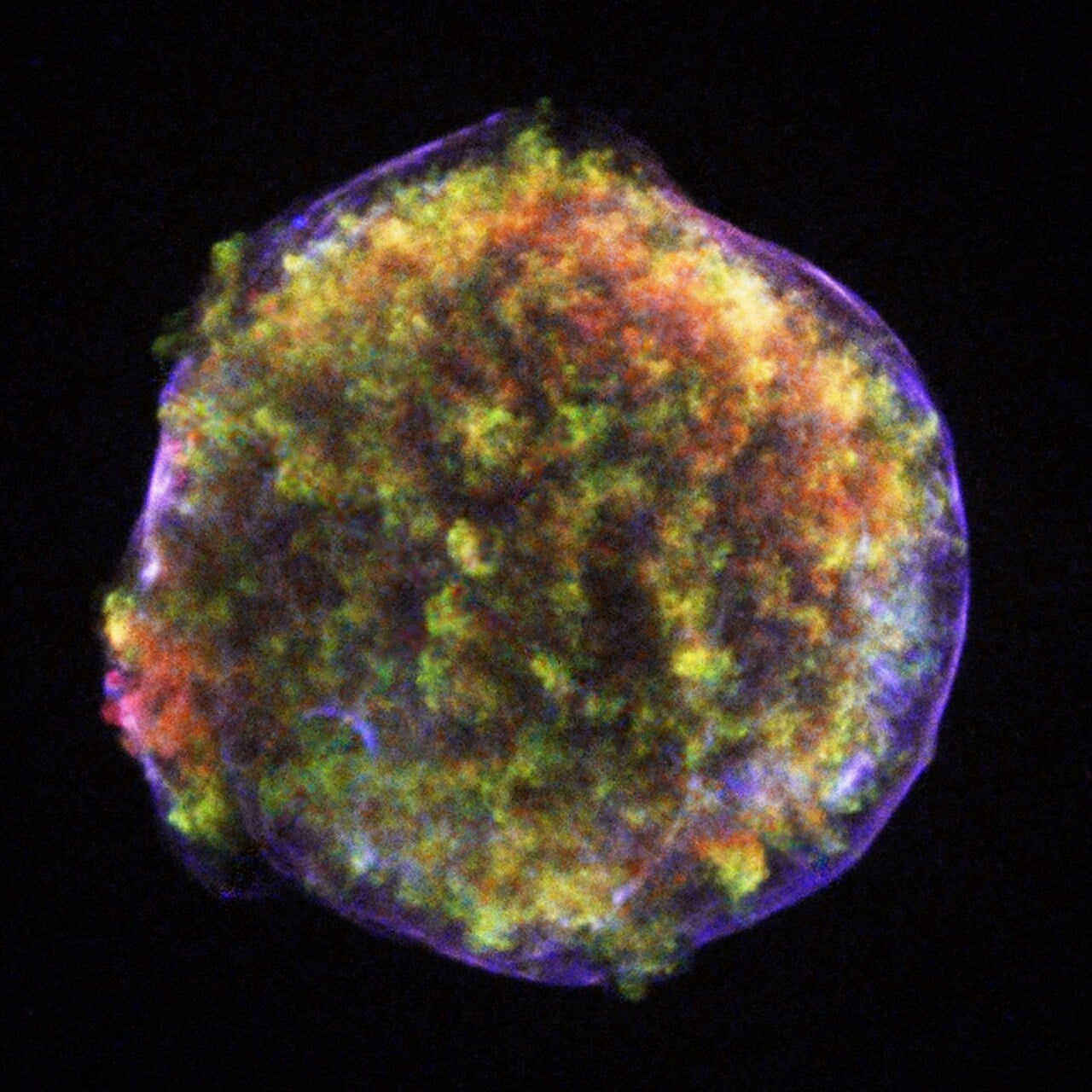
And it wasn’t just theory catching up. In 1971 astronomers pinned down Cygnus X-1, a violent source of X-rays orbiting a massive but invisible companion, and it became the first object nearly everyone agreed was a genuine black hole in the real sky. Meanwhile that 1.4 solar mass figure, the one Eddington had called buffoonery, quietly became one of the most useful numbers in all of astronomy. When a white dwarf in a binary system slowly steals mass from its companion and creeps up toward the Chandrasekhar limit, it detonates as a Type Ia supernova. And because they all go off at almost exactly the same mass, they all blaze with almost exactly the same brightness. That makes them standard candles, cosmic mile-markers we use to measure distances across billions of light-years. It was measurements of these very explosions that revealed the expansion of the universe is accelerating, a discovery that won its own Nobel Prize in 2011. Chandra’s teenage number sits quietly at the heart of it.
And Big Chandra, in his usual style, simply became the master of the subject. In 1983 he published “The Mathematical Theory of Black Holes,” the definitive treatise on the very objects he had first gestured toward as a teenager on a boat and been ridiculed for. He had gone away, learned an entirely new field down to its foundations, and come back to write its bible.
That same year, roughly half a century after a nineteen-year-old got off a boat in England with a number in his head, the seventy-two-year-old Chandra was awarded the Nobel Prize in Physics.
And here’s the beautifully Chandra twist: he was a little irritated by it. The prize cited his early work on white dwarfs, the calculation that had taken him a matter of weeks on an ocean voyage, and not the near-decade he’d poured into the theory of black holes. He’d been recognized, at long last, for the very thing he’d been humiliated over, and even the recognition managed to slightly miss the point. He accepted it anyway, and he accepted the vindication that came with it, with characteristic grace: “I am grateful for the award since it is possible that it may provide a measure of encouragement to those who, like myself, have been motivated in their scientific pursuits principally for achieving personal perspectives, while wandering, mostly, in the lonely byways of Science.”
Oh, and Eddington? The most preeminent astronomer of his age, the man who stood up in that room in 1935 and called it all buffoonery? He never got a Nobel Prize. Not for this, not for anything.
So remember the number. 1.4. It’s the mass, in Suns, above which a dead star can no longer hold itself up, the line past which gravity wins and a star falls out of the ordinary universe entirely. The universe handed that number to a teenager who had barely found his footing, and it took the rest of the world about fifty years, and one very public humiliation, to admit he’d read it correctly.
Beauty was a guide toward truth after all. It just took everyone else a while to catch up.

