Эрдэмтэд 1956 онд онолын хувьд урьдчилан таамагласан боловч өнөөг хүртэл ажиглагдаагүй байсан “Пайнсын чөтгөр” хэмээх квант бөөмийг анх удаа туршилтаар баталгаажууллаа.
Иллинойсын их сургуулийн Урбана-Шампейн хот дахь физикчид стронцийн рутенат (Sr₂RuO₄) хэмээх металлыг судалж байх явцдаа энэхүү ер бусын бөөмийг олж илрүүлжээ. Физикч Дэвид Пайнсын онолоор бол энэхүү “чөтгөр” нь массгүй, цахилгаан цэнэггүй, гэрэлтэй харилцан үйлчлэлцдэггүй, электронуудын хамтын хэлбэлзэл буюу плазмоны нэгэн төрөл юм. Энэхүү бөөм нь металл доторх электронууд өөр өөр эрчим хүчний бүсэд фазын зөрүүтэй хөдөлснөөс үүсдэг тул ердийн оптик багажаар илрүүлэх боломжгүй байсан аж.
Судлаачид “импульсээр шийдвэрлэх электрон энерги алдагдлын спектроскопи” (M-EELS) хэмээх дэвшилтэт аргыг ашиглан уг бөөмийг илрүүлжээ. Энэхүү арга нь гэрэл ашигладаггүй тул цахилгаан цэнэггүй бөөмүүдийг бүртгэх боломжийг олгосон байна. Туршилтын явцад илэрсэн бөөмийн хурд болон импульсийн өгөгдөл нь Пайнсын онолтой бүрэн нийцэж байв.
Энэхүү нээлт нь олон бүст металлуудын шинж чанар, тэр дундаа хэт дамжуулагчийн төлөв байдал болон фазын шилжилтийн үеийн физик үйл явцыг тайлбарлахад чухал ач холбогдолтой юм. Судалгааны багийнхан уг бөөм нь зөвхөн стронцийн рутенатаар хязгаарлагдахгүй, олон бүст металлуудад түгээмэл байж болохыг тэмдэглэжээ. 2023 оны наймдугаар сард Nature сэтгүүлд нийтлэгдсэн энэхүү судалгаа нь онол болон туршилтын хоорондох 67 жилийн зөрүүг ийнхүү арилгалаа.
Дэлгэрэнгүйг эх сурвалжаас харах
↓Эх сурвалжийг нээх ↓
Physicists at the University of Illinois Urbana-Champaign were not hunting for a demon. They were studying an exotic superconducting material when something in their data refused to match any known particle.
After years of analysis, the team confirmed they had detected Pines’ demon, a strange quantum entity that physicist David Pines had predicted in 1956 but that had never been observed in an equilibrium three-dimensional metal. The findings were published in Nature in August 2023, closing a 67-year gap between theory and experiment.
What Pines Predicted, and Why It Was So Hard to Find
In 1956, David Pines theorized that electrons in certain metals could combine to form a composite particle with highly unusual properties: no mass, no electric charge, and no interaction with light. He called it a demon, borrowing the name partly from James Clerk Maxwell’s famous thought experiment and partly from his own acronym for “distinct electron motion.” The prediction sat in the theoretical literature for decades, widely discussed but never experimentally confirmed.
Technically, a demon is a type of plasmon, a collective quantum oscillation among electrons in a solid. Standard plasmons carry charge and respond to light, making them relatively straightforward to detect. A demon does neither, and that invisibility is precisely what made it so difficult to find. The demon arises when a metal contains electrons in more than one energy band: if those electrons move out of phase with each other, their charges cancel, producing a neutral mode that leaves no signature in conventional optical experiments.
Theorists had long suggested that demons could influence phase transitions in certain semimetals, the optical behavior of metal nanoparticles, and superconductivity in materials such as metal hydrides. Because demons are also massless, they can form at any energy level, meaning they may exist across a wide range of temperatures. “The vast majority of experiments are done with light and measure optical properties,” said Peter Abbamonte, who led the research. “Being electrically neutral means that demons don’t interact with light. A completely different kind of experiment was needed.”
A Serendipitous Signal in Strontium Ruthenate
The Illinois team was not looking for Pines’ demon when they found it. They were examining strontium ruthenate (Sr₂RuO₄), a multiband metal that also acts as a superconductor at very low temperatures, hoping to find clues about why high-temperature superconductivity occurs in related materials. The demon turned up as an unexpected signal while they conducted an exploratory survey of the material’s electronic properties.
The detection method was key. Abbamonte and former graduate student Ali Husain used momentum-resolved electron energy-loss spectroscopy (M-EELS), which fires electrons into the material at a precisely controlled momentum and measures how energy is exchanged.
Unlike optical experiments, M-EELS does not rely on light, meaning it can detect electrically neutral excitations that conventional methods would miss. Strontium ruthenate was a strong candidate because its three electron bands, labeled α, β, and γ, include two with sufficiently different velocities to allow out-of-phase oscillation, exactly the condition Pines had described.
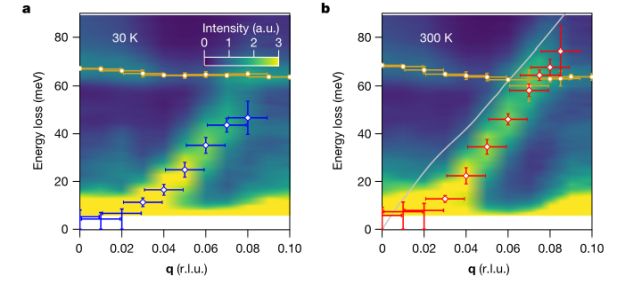
When Husain examined the data, he found an excitation that matched no known quasiparticle. Its velocity, around 1.065 × 10⁵ meters per second at room temperature, was too fast to be an acoustic phonon and too slow to be a surface plasmon. It also appeared massless. As Husain recalled: “At first, we had no idea what it was. Demons are not in the mainstream. The possibility came up early on, and we basically laughed it off. But, as we started ruling things out, we started to suspect that we had really found the demon.”
Theorist Edwin Huang then ran microscopic calculations of the material’s electronic structure, finding a particle formed by the β and γ bands oscillating out of phase, just as Pines had described.
Confirming Neutrality Through Momentum Analysis
Finding an unusual excitation was not enough. The team also needed to confirm that the particle carried no net electric charge, the defining property that separates a true demon from other gapless electronic modes. They did this by analyzing how the intensity of the signal changed as a function of momentum.
A charged excitation follows a specific scaling law tied to electron energy conservation. A neutral one should scale with a higher power of momentum, reflecting the fact that it does not contribute to electrical screening over long distances. The measured power law for the demon’s integrated intensity came out at approximately q⁻¹·⁸, well above the −5 threshold expected for a charged mode, confirming the particle’s electrically neutral character. The detection was replicated across five separate measurements from four different strontium ruthenate crystals, ruling out a measurement artifact.
The team also found details that opened new questions. The demon’s damping was smaller than existing models predicted, possibly because the quasi-one-dimensional structure of the β band suppresses the usual Landau damping decay in the momentum-energy region where the demon disperses. Cooling the sample from room temperature to 30 Kelvin also caused the demon’s velocity to drop by 31 percent, a behavior the current theoretical framework does not fully account for.
What the Discovery Suggests About Multiband Metals
The conditions that allow a demon to form are not unique to strontium ruthenate. The Nature paper states that the findings indicate demons may be a pervasive feature of multiband metals, a broad category across condensed matter physics.
Earlier spectroscopy studies of strontium ruthenate had missed the demon entirely because their momentum resolution was too coarse. The M-EELS setup used here resolved momentum roughly five times more finely, and that precision made the detection possible.
The theoretical picture also remains incomplete. The current framework fails to account for quadratic dispersion behavior observed at very low momentum, suggesting that local field corrections or other interaction effects play a role not yet captured by existing models.
The researchers propose that a meV-resolved scanning transmission electron microscope in a defocused configuration could enable higher-resolution studies in the future, and that other multiband metals may prove equally productive targets.
Enjoyed this article? Subscribe to our free newsletter for engaging stories, exclusive content, and the latest news.