LIDAR технологийн тусламжтайгаар хийсэн судалгаагаар Амазоны ширэнгэн ойд МЭ 200 оны орчимд 3 сая хүртэлх хүн амтай, нарийн зохион байгуулалттай соёл иргэншил оршин байсныг тогтоов.
Хельсинкийн их сургуулийн археологич-антропологич Мартти Пэрссинэн тэргүүтэй судлаачид Бразилийн Акре мужийн ойн бүрхүүл дор нуугдсан эртний геометр хэлбэрийн байгууламжуудыг илрүүлжээ. LIDAR буюу лазер сканнердах технологийн ачаар судлаачид 4497 хавтгай дөрвөлжин км талбайг судалж, өмнө нь мэдэгдээгүй байсан 396 байгууламжийг нэмж олсон байна. МЭӨ 600 оноос МЭ 850 он хүртэл оршин тогтносон “Акуири” хэмээх энэхүү соёл иргэншил нь нийт 30,000 орчим газар шорооны байгууламж бүхий сүлжээг үүсгэж байжээ.
Эдгээр байгууламж нь нэгдмэл эзэнт гүрэн бус, харин нийтлэг зан үйл, улс төрийн үйл ажиллагаанд зориулагдсан зам, талбайгаар холбогдсон олон нийтийн сүлжээ байсан гэж үздэг. Тухайн үед эдгээр газар нь одоогийнх шиг зэрлэг онгон байгаль бус, харин эрдэнэ шиш, маниок, хөвөн тариалсан талбай, модон байшингууд бүхий нягт суурьшилтай газар нутаг байжээ. Мартти Пэрссинэний онцолсноор, энэхүү олдвор нь Амазоныг хүн ам багатай, онгон зэрлэг бүс байсан гэх уламжлалт ойлголтыг үгүйсгэж байна.
Судалгааны үр дүнд Акуири соёл иргэншил 183,000 хавтгай дөрвөлжин км талбайг хамарч байсан байж болзошгүй гэх тооцоолол гарчээ. Гэсэн хэдий ч МЭ 850-1000 оны хооронд энэхүү соёл иргэншил яагаад мөхсөн нь одоогоор тодорхойгүй байгаа бөгөөд энэ нь археологийн шинжлэх ухааны хувьд дараагийн томоохон судалгааны сэдэв болоод байна. Шинжлэх ухааны уг нээлтийг “Nature” сэтгүүлд нийтэлжээ.
Дэлгэрэнгүйг эх сурвалжаас харах
↓Эх сурвалжийг нээх ↓
Today, the Amazon rainforest is revered as one of Earth’s most immaculate wildernesses.
Nearly 2,000 years ago, it looked very different.
Between around 600 BCE and 850 CE, a civilization known as the Aquiry transformed swaths of southwestern Amazonia, carving enigmatic geometric earthworks into the landscape.
Now, a new LIDAR survey suggests that civilization was even larger than archaeologists imagined, hinting at a people that built as many as 30,000 earthworks and had a peak population of up to 3 million people around 200 CE.
For archaeo-anthropologist Martti Pärssinen of the University of Helsinki, the realization was transformative.
“I first experienced such a moment in 2002, when I flew with Alceu Ranzi and Sanna Saunaluoma over the monumental geometric earthworks and observed ancient roads connecting the sites in the state of Acre, Brazil, a region that had long been regarded as pristine rainforest,” Pärssinen told ScienceAlert.
“It completely transformed my understanding and made me realize how mistaken earlier assumptions had been.
“More recently, I felt something similar when I came to understand that there may actually be up to ten times more of these earthworks in the region than I had previously imagined.”
The Aquiry civilization wasn’t a single kingdom or empire, but a diverse network of communities connected by shared traditions.
We don’t know much about them – they left no written records, and their dwellings are long gone.
What we do have are their monumental earthworks: geometric spaces delineated by ditches that could be meters deep, linked together by straight roads, where people may have gathered for ceremonies and political events.
Today, the geometric earthworks and the ecological legacy of their land management are among the few visible traces the Aquiry left behind.
“The scale of the archaeological record suggests that many other regions across Amazonia may have been far more densely populated and intensively modified than previously assumed.” – archaeo-anthropologist Martti Pärssinen
In the centuries since their disappearance around 850 CE, the rainforest reclaimed much of what the Aquiry built. Hints of their structures emerged during land clearing, but the full scale remained lost beneath the trees.
LIDAR technology changed everything.
The technology fires laser pulses from an aircraft. Some penetrate gaps in the forest canopy and bounce off the ground, allowing researchers to reconstruct the hidden landscape beneath without disturbing the rainforest.
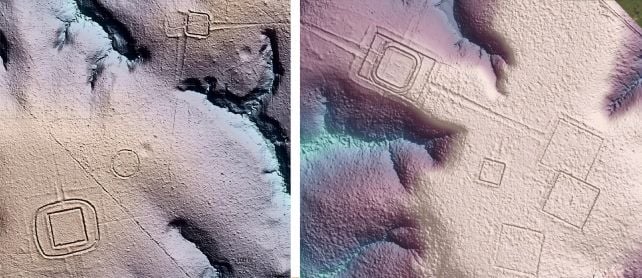
The researchers surveyed 4,497 square kilometers (1,736 square miles) of rainforest by flying a series of long, roughly 450-kilometer (280-mile) transects over the region.
Their entire dataset yielded 432 earthworks – 396 of which were previously unknown.
“What surprised us most was the extraordinarily large number of geoglyphs and other earthworks found within an area representing less than 3 percent of Greater Amazonia,” Pärssinen said.
“The scale of the archaeological record suggests that many other regions across Amazonia may have been far more densely populated and intensively modified than previously assumed.”
By extrapolating their results, combined with existing surveys, the researchers estimated that, at its peak, the Aquiry civilization may have covered an area as large as 183,000 square kilometers.

This space could have supported a population of around 1.2 to 3 million people, in a landscape with as many as 24,000 to 30,000 earthworks, the researchers estimated.
It would have been a dramatically different place than the wilderness we see today – a forest threaded with clearings where people lived, farmed, celebrated, and gathered.
“At the center of many of these clearings would stand large geometric earthworks connected by broad and narrow roads,” Pärssinen told ScienceAlert when asked what the landscape might have looked like around 200 CE.
“At certain times of the year, these places would come alive with ceremonies, gatherings, music, dancing, athletic competitions, and other communal events.”
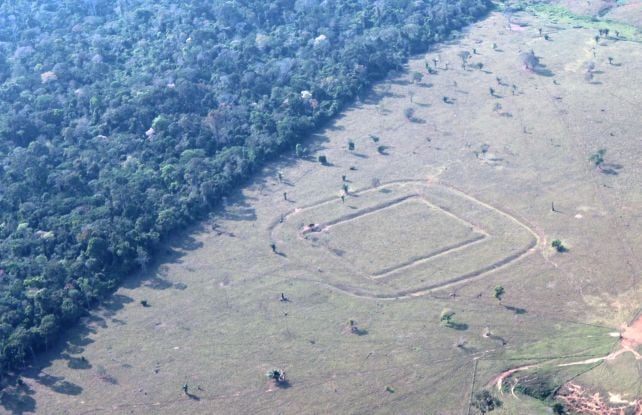
With LIDAR uncovering the histories of many ancient societies in the Amazon, Pärssinen said the traditional view of the rainforest as an untouched wilderness should be “abandoned”.
Instead, the new findings recast the Amazon as a rainforest shaped in many places by large human populations.
In their heyday, the Aquiry earthworks we see today would have likely been surrounded by “large wooden longhouses inhabited by substantial populations, alongside fields of maize, manioc, squash, and cotton,” Pärssinen said.
“In the nearby forests, there would likely be an abundance of managed fruit- and nut-bearing trees, reflecting centuries of human stewardship of the landscape.”
Related: Cluster of Ancient Lost Cities in The Amazon Is The Largest Ever Found
The discovery paints the clearest picture yet of the mysterious Aquiry and how they populated southwestern Amazonia for some 1,500 years. Much of their story, however, is still waiting to be told.
“Many questions remain unanswered,” Pärssinen said.
“One of the most important is what happened between approximately [CE] 850 and 1000. Why did this civilization disappear?”
The findings have been published in Nature.
This article was fact-checked by Rachel Garner and edited by Clare Watson. While we pride ourselves on our process, we are only human. If you spot a mistake, please let us know.