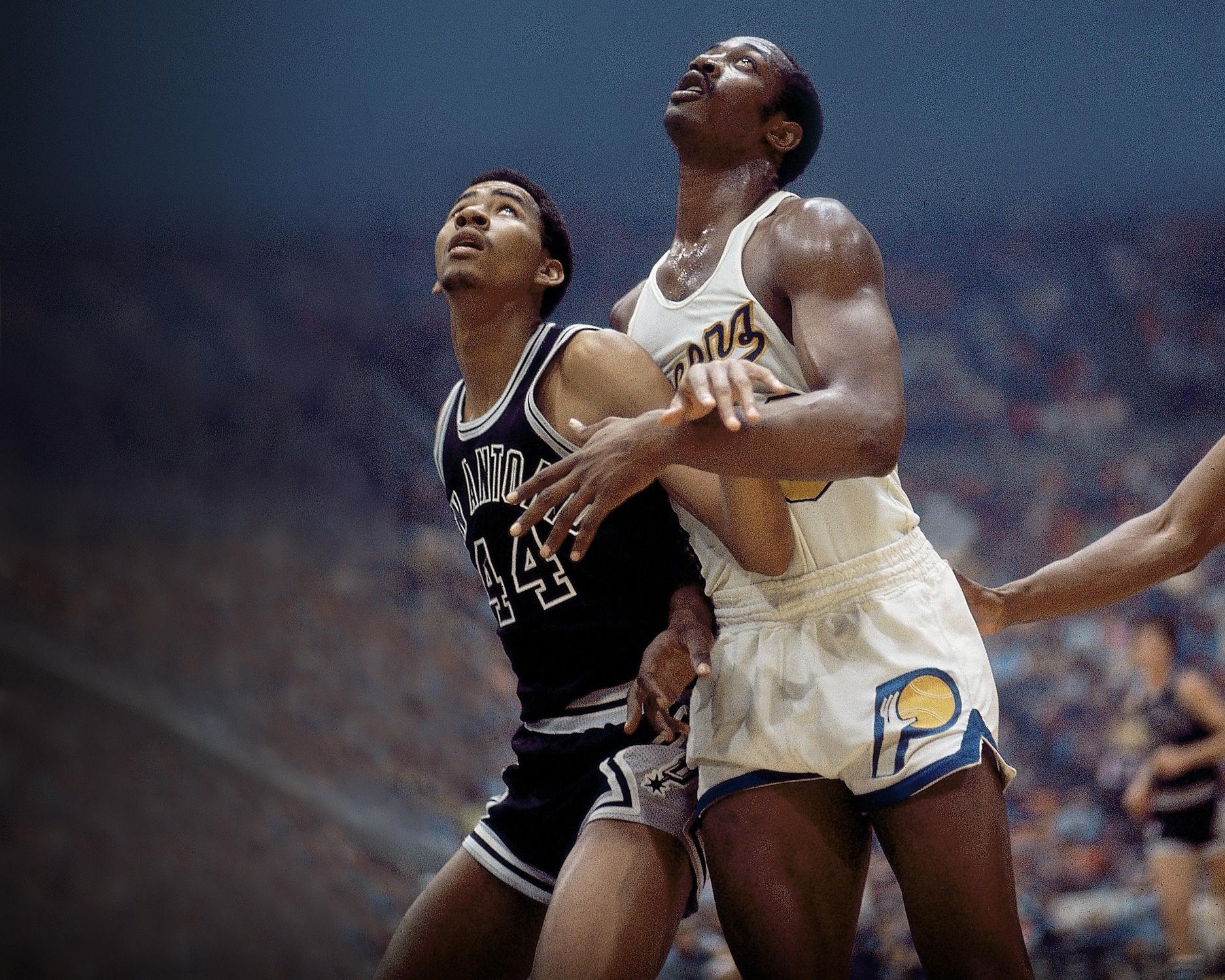
Америкийн сагсан бөмбөгийн холбоо буюу АБА лиг нь NBA-тэй нэгдэхээсээ өмнө шинэлэг өнгө төрх, тоглолтын хэв маягаараа сагсан бөмбөгийн түүхэнд томоохон хувьсгал хийсэн юм.
Виржиния Сквайрс багийн тоглогч байхдаа Жорж Гервин багийн анд Жулиус Эрвинг буюу Док-оос их зүйлийг суралцаж, бэлтгэлийн дараах ганцаарчилсан тоглолтууд түүнд өөртөө итгэх итгэл, лигт тоглох ур чадварыг олгожээ. Коллежийн үеийн асуудлаас болж нэр хүнд нь унасан Жорж Гервин АБА лигт өөрийгөө нээж, улмаар NBA-д ороод оноо авалтаараа тэргүүлэгчдийн нэг болж чадсан байна. 1976 оны нэгдүгээр сарын 27-нд болсон АБА лигийн бүх оддын тоглолтын үеэр анхны орчин үеийн слэм данкын тэмцээн зохиогдож, Жулиус Эрвинг чөлөөт шидэлтийн шугамаас нисэн амжилттай гүйцэтгэснээр түрүүлжээ.
Тухайн үед NBA-гээс илүү чөлөөт хэв маягтай байсан АБА лиг гурван онооны шидэлт, улаан, цагаан, хөх өнгийн бөмбөг болон бусад шинэлэг зүйлсийг сагсан бөмбөгийн спортод нэвтрүүлсэн билээ. Мөн Спенсер Хейвуд зэрэг коллежийн залуу тоглогчдыг драфтлаж тоглуулснаараа бусад залуу тоглогчдод зам тавьж өгсөн байна. Ральф Симпсон зэрэг тоглогчид АБА лигээс өөрийгөө хөгжүүлэх боломж олдсоныг дурдаж, лигийн дотоод харилцаа, нөхөрлөл маш сайхан байсныг онцолжээ.
1976 оны зун АБА болон NBA лигүүд албан ёсоор нэгдэж, Индиана Пэйсерс, Сан Антонио Спёрс, Нью-Йорк Нетс, Денвер Наггетс гэсэн дөрвөн баг NBA-д элссэн юм. Нэгдэлтийн дараах эхний улирлын Бүх оддын тоглолтын оролцогчдын тал хувийг хуучин АБА лигийн тоглогчид бүрдүүлсэн нь тус лигийн түвшин ямар өндөр байсныг нотолж байна.
Дэлгэрэнгүй эх сурвалжийг харах
Эх сурвалжийг нээх ↓
After practice, George Gervin wanted to go home. He was a rookie playing for the Virginia Squires of the upstart American Basketball Association, and the sleek, Detroit-born hooper didn’t yet know what being a pro quite meant. He didn’t know that the real workouts often started after practice. But his teammate Julius “Dr J” Erving quickly showed him the ropes.
“Doc would say, ‘Hey, young fella! Where you going? Me and you ain’t done!’” Gervin tells the Guardian. “Me and him would play one-on-one after practice. It was beautiful, probably one of the most beautiful experiences I had as a young pro.”
Today, Gervin is remembered as being one of basketball’s great scorers. Known as the Iceman, his finger roll is still studied by the best in the game. A Hall of Famer, Gervin led the National Basketball Association in scoring four out of five years from 1978 to 1982. But before that, he was considered damaged goods.
A fistfight in college saddled Gervin with a bad reputation. And though he averaged nearly 30 points per game for Eastern Michigan University as a sophomore in college, he was not an NBA prospect. So, he played a year in the CBA before earning a tryout in the ABA.
Still thought of as a subpar league in the 1970s, the fledgling ABA was hoping to force a merger with the more established NBA. The ABA needed all the talent it could get, so guys like Gervin got a shot. Gervin wasn’t drafted – instead, he impressed in his tryout and the Squires signed him. “Because I shot the ball well,” Gervin remembers.
Turns out, the ABA was just the step the scoring wing needed. “I came in a little young, inexperienced,” Gervin says. “Coming into a world that I needed to have some kind of guidance.” But those one-on-one games between the Iceman and Dr J proved to be beneficial for both mind and body.
“He’d throw me the ball and say, ‘Me and you are playing one-on-one,’” Gervin says. “At the same time, he wasn’t really competing against me. He was getting me ready. Seeing what I was made of. I tell him today that I owe him. Because he helped build my self-confidence and self-esteem. He helped me understand I had the ability to play in the league.”
Fifty years after the ABA merged with the NBA, ending the upstart league’s nine-year run, players like Gervin remain living reminders of its enduring influence. The merger, finalized in the summer of 1976, brought only four ABA franchises into the NBA, but many of the league’s innovations – and some of its brightest stars – would permanently reshape professional basketball.
Even now, Gervin and Erving remain close friends. Their paths have crossed countless times since those one-on-one practices in Virginia. But one day that especially stands out is 27 January 1976 – the day of the first modern pro basketball dunk contest.
The ABA, which was founded in the late 1960s as a rival to the NBA, soon became known as the more flamboyant and fun of the two. Though it didn’t have the national TV contracts and history the NBA did, what the ABA offered fans was high-flying dunks, a red-white-and-blue basketball, the three-point shot, and fashion out the wazoo, from muttonchop sideburns to afros. And no one symbolized the ABA’s cultural heft quite like Dr J.
A star on and off the court, Erving and the ABA made history on that January night in 1976. With no money for a half-time performer at the ABA All-Star game, officials organized a dunk contest, which featured, among others, Erving, Gervin, and leaper David Thompson. In the end, it was Dr J who won the trophy, flying from the free-throw line like Superman.
“Awful!” says Gervin, laughing, thinking about the contest. “I was awful! I couldn’t beat them. You’re going into a contest knowing you can’t win. I knew I couldn’t beat David Thompson or Doc. So, it was just being a part of the show. I was brave enough to accept defeat – part of something that was bigger than I ever thought.”
Julius Erving made history in winning the 1976 ABA slam dunk contest.
Still, despite the lack of hope to win, Gervin knew his name attached to the contest would draw eyeballs, even if he wasn’t known as a creative dunker as his peers. “I’m thankful that I said OK,” he says. “The game is basically entertainment. Being ABA, that’s what we were all about – entertaining.”
The NBA in the early 1970s was largely resistant to change. So, the ABA took on the job of pushing the game forward. Though the NBA did have high-wattage players like Walt “Clyde” Frazier, Lew Alcindor (later Kareem Abdul-Jabbar), Wilt Chamberlain, Oscar Robertson and others, it was nevertheless known as being slower, stodgier.
It also didn’t allow underclassmen to join its ranks – until Spencer Haywood.
Despite the NBA’s self-imposed four-year rule, the ABA drafted the 1968 Olympic gold medalist before he’d graduated from college. And Haywood, whose mother was working in poverty picking cotton in Mississippi, suited up. As a first-year player, he won both the Rookie of the Year and MVP trophies in Denver. His success opened the doors for other underclassmen like Ralph Simpson.
“Spencer and I played high school ball together in Detroit,” Simpson tells the Guardian. In college, Simpson starred for a season at Michigan State, averaging nearly 30 points. But then his father had a heart-attack and got sick. “Spencer said, ‘Well, why don’t you come out here with me.’ We didn’t have any money and things were getting kind of hard. I wanted to stay at school, but I got offered a little money and that’s how I got to Denver.”
A sweet-scoring swingman with a knack for rebounding, Simpson became a five-time ABA All-Star playing for coaches like Hall of Famer Larry Brown. “The ABA gave us a chance to develop,” says Simpson, who is also the father of Grammy-winning artist India Arie. “I probably wasn’t ready to play in the NBA, but after a year or two, I started to develop.”
Thompson was one of Simpson’s teammates in Denver. And Simpson was with his friend at the 1976 dunk contest. “I told Julius I thought David would beat him!” Simpson remembers. “But I think David got a little nervous looking at Dr. J and his status. Going into the last round, David was leading and missed a 360-degree dunk. And Julius—he didn’t miss any.”
Dr J capped the competition with that leaping dunk from the foul line. “Julius ended up winning it, taking off from the free-throw line,” says Simpson, with a laugh. “I thought his foot was on the line. But I wouldn’t tell Julius that! He’d get mad, probably.”
The ABA’s restless existence meant teams came and went, from the Miami Floridians, the San Diego Conquistadors and other oddball franchises. But if the teams were fleeting, the personalities were unforgettable. Every season seemed to introduce another larger-than-life figure, from the troubled Marvin “Bad News” Barnes to the politically minded Warren Jabali.
But Simpson remembers the strong camaraderie the league offered its workforce. Players were friends, despite the heated competitions. “Warren Jabali, he taught me a lot when he was in Denver for those two years,” Simpson says. “He probably was the best all-around guard.”
Jabali was a fire hydrant of a man. He was also militant in his political convictions. Simpson remembers going to an All-Star game in Virginia. The hotel they stayed at required the ABA players to room in the basement. “Warren really got upset about it and wanted us to boycott,” Simpson says. “We didn’t end up boycotting, but the owners got ahold of it, and when we got back to Denver, they cut Warren.”
Jabali later moved to Africa, phoning Simpson just before his plane took off to offer some last words of praise before the journey. “He told me, ‘Ralph, you’re the best one-on-one player in the ABA,’” Simpson says. “That came out of his mouth. That was exciing to me, he knew ball.”
In the summer of 1976, some 50 years ago, the ABA merged with NBA. Four of the remaining seven ABA teams were absorbed – the Indiana Pacers, San Antonio Spurs, New York Nets and Denver Nuggets. Simpson says part of the condition of Denver’s acceptance into the NBA was that he be shipped to Detroit to play for the Pistons. Whether that’s fact, he also says one of the greatest thrills of his career was putting on his hometown uniform.
“That brought tears to my eyes,” Simpson says. “I saw up in the stands, my dad was crying, too.”
For Gervin, the 1976 merger between the ABA and NBA was ultimately good. While there were downsides – dozens of players were left without jobs – pro basketball benefited from the union. The ABA had put people like Gervin and Simpson on the big stage, but after the merger, there was still more to prove on the hardwood. “We played with chips on our shoulder,” Gervin says. “We played to let the NBA fans know that we were for real and that we could play.”
But it worked. Among the 24 roster spots at the NBA All-Star game in 1977, just a year after the merger, half were filled by former ABA players, including Erving, Gervin, Thompson, and more. “I think that’s an indication of we wasn’t lying,” says Gervin.

