
Эрдэмтэд хөвөнгийн хортон шавжны авгалдайн гэдсэнд хөөсрүүлсэн полистиролыг задлах чадвартай дөрвөн төрлийн мөөгөнцөр байгааг олж тогтоолоо.
Жил бүр үйлдвэрлэгдэж буй полистиролын хэмжээ эрчимтэй өсөж байгаа хэдий ч түүнийг дахин боловсруулах үр дүнтэй арга одоогоор ховор байна. Уг асуудлыг шийдвэрлэх зорилгоор эрдэмтэд байгаль орчноос хуванцар идэгч шавж болон бичил биетүүдийг судалсаар байгаа юм. Бразилын Сан-Пауло холбооны их сургуулийн биохимич Флавио Энрике Силвагаар ахлуулсан судлаачдын баг Helicoverpa armigera буюу хөвөнгийн хортон шавжны авгалдайн гэдэснээс полистиролыг био задралд оруулах чадвартай мөөгөнцрүүдийг илрүүлжээ.
Судлаачид туршилтын явцад авгалдайн нэг хэсэгт кофе аяга, хөргөгчний дулаалга болон цахилгааны сав баглаа боодолд өргөн хэрэглэгддэг хөөсрүүлсэн полистирол өгч хооллон гэдэс дэх микробиомыг нь судалсан байна. Долоо хоногийн турш зөвхөн полистиролоор хооллосон авгалдайн гэдэснээс Aspergillus, Trematosphaeria, Metarhizium, Talaromyces зэрэг мөөгөнцөр бусад авгалдайг бодвол илүү өндөр хэмжээтэй илэрчээ. Дараа нь тэд эдгээр мөөгөнцрийн төрлүүдийг тусгаарлан авч, химийн аргаар бэлтгэсэн гөлгөр полистирол хальсан дээр 60 хоногийн турш ургуулж туршилт хийсэн байна.
Туршилтын үр дүүнд уг мөөгөнцрүүд хуванцрыг өөрийн нүүрстөрөгчийн эх үүсвэр буюу хоол хүнс болгон ашиглаж, гадаргуу дээр нь нүх сүв үүсгэн идэж эвдсэн болохыг электрон микроскопын тусламжтайгаар тогтоожээ. Ялангуяа Talaromyces төрлийн мөөгөнцөр хуванцар хальсыг цоолж, гиф буюу ширхгүүд нь гүн рүү нь нэвтэрсэн нь хамгийн тод ажиглагдсан байна. Гэсэн хэдий ч эдгээр мөөгөнцөр полистиролыг ямар химийн урвал эсвэл ферментийн тусламжтайгаар задалж байгаа болон боловсруулалтын явцад ямар бүтээгдэхүүн ялгарч буй нь одоогоор бүрэн тодорхойгүй хэвээр байна.
Эрдэмтэд хуванцар хог хаягдлыг байгальд ээлтэйгээр устгах болон үйлдвэрлэлийн түвшинд өргөжүүлэн ашиглахын тулд гадаргуугийн өөрчлөлтөд нарийвчилсан спектроскопийн шинжилгээ хийж, оролцож буй ферментүүдийг судлах нь дараагийн чухал алхам гэдгийг онцолжээ. Уг судалгааны үр дүнг BMC Microbiology эрдэм шинжилгээний сэтгүүлд нийтэлсэн байна.
Дэлгэрэнгүйг эх сурвалжаас харах
↓Эх сурвалжийг нээх ↓
Polystyrene production is growing rapidly each year, with market research suggesting it could reach some 62 million tons by 2034.
We’re yet to find a good way to recycle the stuff, so most polystyrene currently ends up in landfills.
Scientists have been looking to nature for solutions. So far, they’ve found plenty of insects that appear capable of munching away at our plastic problem, though it’s unclear exactly what happens to the plastic or how these grubs are breaking it down.
A recent study published in the journal BMC Microbiology suggests fungi might be far more involved than we realized.
Biochemist Flávio Henrique Silva from the Federal University of São Carlos in Brazil led a series of experiments to uncover four types of fungi in the guts of cotton bollworm larvae (Helicoverpa armigera) that appear to be capable of biodegrading polystyrene.
Expanded polystyrene foam (EPS) is commonly used in coffee cups, fridge insulation, and electronics packaging. It was this particular variety of polystyrene that was initially fed to the caterpillars to assess their gut flora.
Across seven days, some caterpillars were fed solely with EPS, others were fed a typical lab-grown caterpillar diet, and some were fed a 50/50 mix.
“Caterpillars fed EPS clearly had higher amounts of Aspergillus, Trematosphaeria, Metarhizium, and Talaromyces than those not fed EPS,” Silva and team report in their published paper.
“In the mixed diet, we observed an increasing proportion of the yeasts Cryptococcus and Malassezia.”
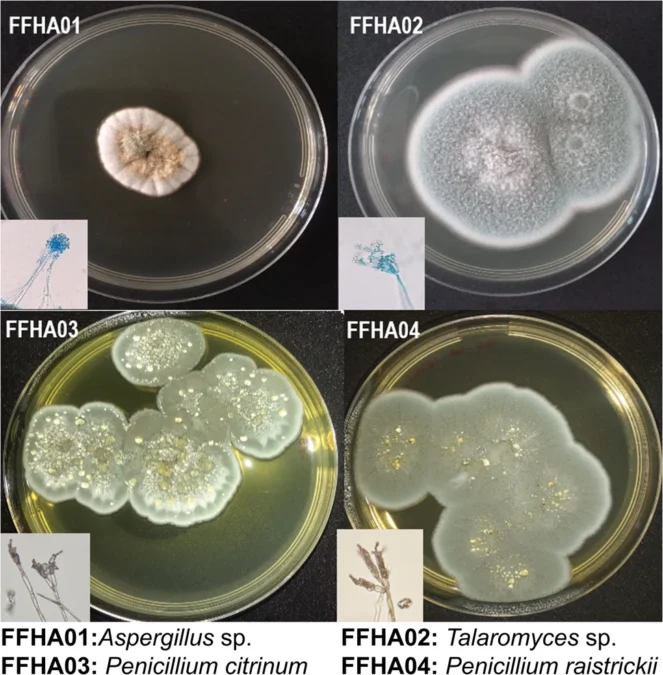
Next, the researchers isolated four species of fungi from the larvae’s intestines to test their capacity for digesting polystyrene.
These fungi were presented with a different form of polystyrene: Styrofoam that had been dissolved in xylene and then dried to form a film.
This process removes the air pockets typical of Styrofoam, resulting in a smooth film. That makes it really easy to see any impact the microbes might have, as you can see in the picture below.
In the central and right-hand columns, you can see low- and high-magnification images of polystyrene films that had one of four fungi species growing on them.
These fungi – one Aspergillus species, one Talaromyces species, and two species of Penicillium – were grown on the film for 60 days before these scanning electron microscope images were taken.
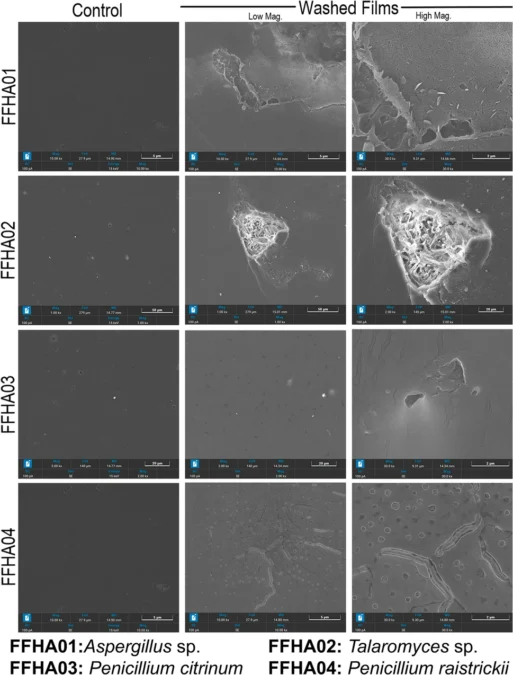
In these pictures, the fungi have been washed away to reveal the traces of their time spent living on the plastic: a series of trails and cavities etched into the film’s surface.
Talaromyces (FFHA02 in the above images) was a standout. The fungus bored holes in the plastic surface that its hyphae appeared to penetrate.
“If the fungus was able to grow on that film, it’s because it used the film as a carbon source – that is, a food source,” Silva explains.
On the left, for comparison, you can see polystyrene films that were not inoculated with fungal spores. Without any fungi potentially breaking the plastic down, these films remain smooth.

The chemical fate of the polystyrene in these experiments remains a mystery, although clearly the fungi are doing something.
Based on these experiments, which captured visual changes in the plastic surface, we don’t know anything about the chemical processes these particular fungi are using to ‘eat away’ at that material.
Understanding those chemical reactions, including the enzymes involved, is an important next step to determine whether these fungi are actually digesting the plastic or merely breaking it down into smaller and smaller pieces, and what the byproducts of those reactions might be.
Related: Plastic Waste Has Been Turned Directly Into Hydrogen Fuel – No Sorting Required
“Further studies, such as Fourier-transform spectroscopy, should be conducted to better characterize surface changes, including the incorporation of oxygen-related functional groups,” the researchers propose.
We also don’t know how much of the plastic samples the fungi degraded in two months, which means we can’t say how efficient the microbes are at decomposing polystyrene – important factors when it comes to scaling up any such biotechnology.
Many other microbes and insects have been identified for their plastic-degrading abilities, but they have yet to make a dent in our plastic problem. Isolating their key enzymes might be more suitable for industrial-scale applications.
“Our results suggest potential future applications of these fungi and/or their genes or enzymes in the degradation process of polystyrene,” the researchers conclude.
The research has been published in BMC Microbiology.
This article was fact-checked by Rachel Garner and edited by Clare Watson. While we pride ourselves on our process, we are only human. If you spot a mistake, please let us know.


