
Шинэ судалгаагаар дэлхийн хамгийн том гэрэлтдэг нуруутан амьтан болох далайн гүнзгий усны kitefin shark буюу Dalatias licha акул нь биеийн гэрлээ зөвхөн махчин амьтнаас нуугдахад бус, мөн олзоо эрж олоход ашигладаг байж болзошгүйг илрүүлжээ.
Бельгийн Луваены католик их сургуулийн далайн биологич Жюльен Клаес тэргүүтэй эрдэмтдийн баг Шинэ Зеландын зүүн зүгт орших Чатам Ризийн судалгааны үеэр баригдсан найман амьд акулыг шинжилж үзжээ. Шинжилгээгээр тэдгээр акулын хэвлийн хэсгийн цэнхэрдүү ногоон өнгийн гэрэл нь далайн гүний байгаль орчны сарнисан өдрийн гэрэлтэй тохирч байгааг тогтоосон байна. Гэсэн хэдий ч энэхүү гэрэлтэлт нь зөвхөн доошоо бус, хажуу тийш буюу ялангуяа хошуу, эрүү, сэлүүр рүү илүү өргөн тархдаг болохыг анзаарчээ.
Эрдэмтдийн үзэж байгаагаар энэхүү хажуу тийш чиглэсэн илүүдэл гэрэл нь биологийн гэрэлтүүлэгч прожектороор ажиллаж, далайн ёроолыг гэрэлтүүлэн харанхуй орчинд олзоо илрүүлэхэд тусалдаг аж. Уг зүйлийн акулууд маш удаан хөдөлдөг хэдий ч хурдан хөдөлдөг нялцгай биетэн болон бусад акулаар хооллодог тул энэхүү нууцлагдмал арга нь тэдэнд амьд үлдэх давуу тал олгодог байна. Мөн биеийн дээд хэсэгт орших нурууны сэлүүр нь өнгэлөн далдлалтад тохирохгүйгээр тод гэрэлтдэг нь амьт хоорондын дохио эсвэл олз татах зорилготой байж болох аж.
Энэхүү нээлт нь далайн гүний амьтдын биологийн олон янз байдал болон гэрэлтэлтийн (bioluminescence) үндсэн ойлголтыг шинэ шатанд гаргаж байна. Эрдэмтэд уг таамаглалыг бүрэн батлахын тулд байгаль орчин дахь амьтдын бодит зарим төрх байдлыг судлах шаардлагатайг онцолжээ. Судалгааны үр дүнг iScience сэтгүүлд нийтэлсэн байна.
Дэлгэрэнгүйг эх сурвалжаас харах
↓Эх сурвалжийг нээх ↓
In the deep, dim ocean, a world of eat-or-be-eaten, lighting up may seem like a counterintuitive survival strategy.
Nevertheless, it helps many animals hide from predators that might strike from below – a shine that conceals the shadow they cast against the faint light filtering down from above.
Now, however, scientists have found evidence that one of the most stunning bioluminescent animals in the ocean may have been using its light in another way all along.
The kitefin shark (Dalatias licha) is the world’s largest glowing vertebrate and has no known natural predators.
And instead of simply hiding, it may also use its glow like a searchlight to find prey, reports a team led by marine biologist Julien Claes of Université catholique de Louvain in Belgium.
“What differs is the selective context: the identity of the visual observer whose detection the organism is evolving to avoid,” the team writes in a paper published in iScience.
Counterillumination is a surprisingly common form of camouflage in the open ocean.
The deeper into the ocean you dive, the less light penetrates. It’s scattered and absorbed by water molecules until, eventually, the sea is completely dark. At the top of the water column, conditions are well-lit; by a few hundred meters down, everything becomes murky and dim.
The animals that live in this part of the ocean can have vision exceptionally sensitive to the little light that filters down.
An animal swimming overhead can stand out starkly as a dark silhouette against the faint glow from above. Bioluminescent counterillumination lights up that silhouette just enough so that it blends in with the dim light.
Since the kitefin shark – in which bioluminescence was only confirmed a few years ago – has no known natural predators, that suggests its glow has less to do with evasion and more to do with concealment.
But concealment from what?
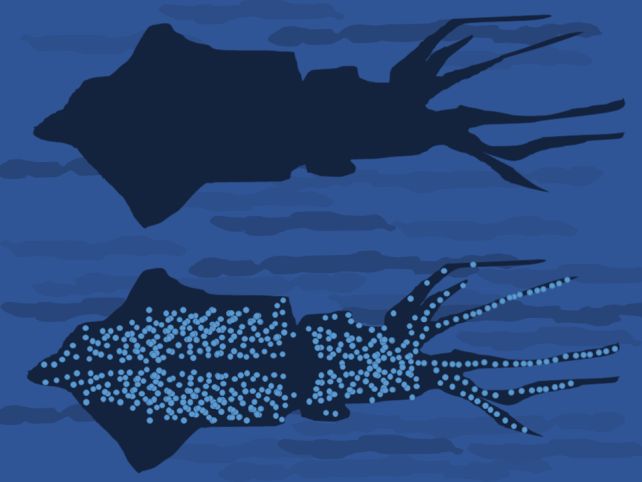
Usually, counterillumination needs to be incredibly precise. It’s not enough for an animal simply to glow; its light needs to resemble the ambient light it is trying to disappear against.
One other curious characteristic of kitefin sharks sharpened the mystery.
Unlike other animals that use counterillumination, kitefin shark bioluminescence covers almost their whole body, including the dorsal fin. If camouflage was the only purpose, why would the shark’s fin need to glow?
To investigate, the researchers examined eight live sharks caught as bycatch during a survey of Chatham Rise, to the east of New Zealand,
They asked three questions: How bright is the glow? What color is it? And – crucially – in which direction does it shine?
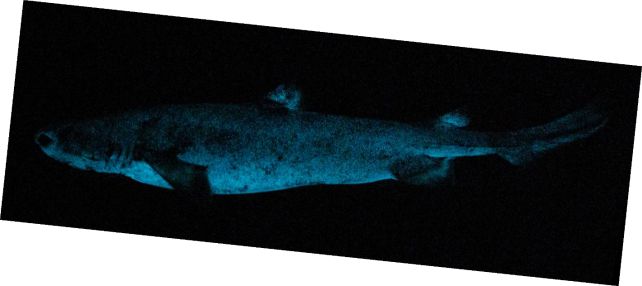
The measurements revealed that the glow on the underside of the shark has the color and brightness that would be expected for counterillumination – a bluish-green light peaking at a wavelength of 491 nanometers.
That color closely matches the residual daylight found at these depths, while the brightness of the glow matched the daylight predicted at depths of around 480 to 540 meters (1,575 to 1,770 feet) – smack-bang in the shark’s habitat range.
But then it got weird.
When the researchers looked at the direction of the shine, they found that instead of closely matching the pattern of downwelling daylight, the kitefin’s glow spreads sideways, significantly more broadly than any of the other counterilluminating animals they used for comparison.
The effect was strongest towards the front of the shark – the nose, the jaw, and the pectoral fins.
“One parsimonious explanation,” the researchers write, “is that this excess lateral emission functions as a biological searchlight, illuminating the seafloor to the sides of the shark and potentially enhancing prey detection in the otherwise dark benthic environment.”
It’s not as weird as it sounds. Other sea creatures, such as the splitfin flashlightfish (Anomalops katoptron) and stoplight loosejaws (Malacosteus), use bioluminescence to find prey.
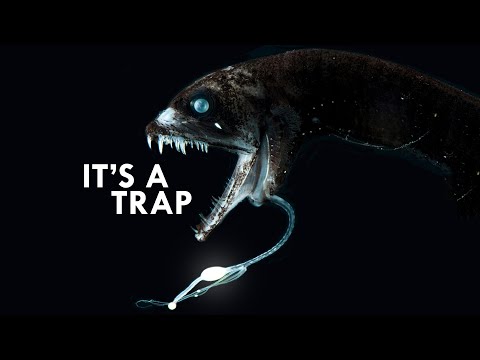
The two strategies aren’t necessarily contradictory: The downward glow could conceal the shark from prey below, while the excess sideways light could illuminate prey off to the sides.
This could also help explain the shark’s survival strategy. The kitefin is the slowest-swimming shark on record, moving at a speed of just 13 centimeters (5 inches) per second – yet its prey are often fast-moving, visually capable species such as lanternsharks and cephalopods. A stealth-based approach makes sense.
But that’s not the end of the kitefin’s peculiarities. Remember that glowing dorsal fin? It’s absolutely terrible camouflage.
The glow is about an order of magnitude dimmer than the belly glow – but still two orders of magnitude brighter than the ambient upwelling light. If you were swimming around in the benthic depths and approached the shark from the side, the fin would glow like a beacon.

“This pattern,” the researchers write, “is incompatible with any camouflage function and is more consistent with intraspecific signaling or prey attraction.”
Related: Bioluminescence on Earth Evolved Over 500 Million Years Ago, Study Finds
However, they also caution that, while these theories are plausible, for now they remain unconfirmed.
The research was conducted through physical examinations of sharks brought up from the deep and examined aboard the survey vessel. To confirm, we’d need to observe how they behave in the wild.
But the findings do suggest that our understanding of counterillumination is incomplete.
It’s usually understood as a way of hiding from things that might eat you. The kitefin shark could flip that idea on its head – using the very same trick to both hide from and find things to eat.
The findings have been published in iScience.
This article was fact-checked by Peter Dockrill and edited by Peter Dockrill. While we pride ourselves on our process, we are only human. If you spot a mistake, please let us know.


