
Бүлэг хүмүүс асуудлыг жижиг хэсгүүдэд хувааж, хамтран шийдвэрлэх нь зүгээр л таамаглалаа нэгтгэснээс хавьгүй илүү үр дүнд хүргэдэг болохыг судалгаагаар тогтоожээ.
Аргентины Торкуато Ди Телла их сургуулийн нейро эрдэмтэн Федерико Баррера-Лемарчандын удирдсан судалгааны баг олон нийтийн шийдвэр гаргах чадварын нууцыг тайлах туршилт явуулжээ. “Nature Communications” сэтгүүлд нийтлэгдсэн уг бүтээлд, олон нийтийн мэргэн ухаан нь зөвхөн хувь хүний таамаглалын дундаж үр дүнгээр хэмжигддэггүй, харин асуудлыг задлан шинжлэх хамтын үйл явцаас хамаардаг болохыг тогтоосон байна.
Судлаачид 900 оролцогчийг хамруулсан гурван цуврал туршилтыг хийжээ. Эхний туршилтаар оролцогчид асуудлыг хэрхэн шийдэж байгааг ажиглахад, асуудлыг жижиг хэсгүүдэд хувааж, логик дарааллаар хэлэлцсэн бүлгүүд хамгийн оновчтой хариултад хүрсэн байна. Энэхүү стратегийг судлаачид “Хамтын Фермийн тооцоолол” хэмээн нэрлэжээ.
Хоёр дахь туршилтаар уг аргыг зааж сургахад, асуудлыг хэсэгчлэн задалж тооцоолсон бүлгүүд зөвхөн таамаглалаа нэгтгэсэн бүлгүүдээс илүү өндөр амжилт үзүүлсэн байна. Гурав дахь туршилтаар ганцаараа ажиллагсдаас илүүтэйгээр бүлгээрээ хамтран ажиллаж, бие биеийнхээ тооцоог хянасан бүлгүүд хамгийн өндөр үр дүн үзүүлжээ.
Эдгээр олдвор нь олон нийтийн шийдвэр гаргах үйл явцыг сайжруулахад чухал ач холбогдолтой юм. Судлаачид асуудлыг задлан шинжлэх энэхүү арга нь зөвхөн тоон тооцоолол төдийгүй бусад төрлийн нарийн төвөгтэй шийдвэр гаргах үйл явцад хэрэглэгдэх боломжтойг онцолсон байна.
Дэлгэрэнгүйг эх сурвалжаас харах
↓Эх сурвалжийг нээх ↓
Two heads, the saying goes, are better than one – and there’s wisdom in a crowd.
The notion that humans, as a collective, are better at decision-making than any one individual is not new; indeed, the Western jury system is predicated on it.
It’s long been thought that the more opinions you throw into the mix, the better the outcome – with the group’s final answer emerging somewhere in the middle.
But according to a new Nature Communications study led by neuroscientist Federico Barrera-Lemarchand of the Torcuato Di Tella University in Argentina, the truth may be more complicated – and more interesting.
The researchers found that groups don’t perform best by simply pooling their initial guesses. Instead, they become more accurate when they work through a problem together, breaking it into smaller pieces before reassembling them into a new answer.
The researchers call this reasoning strategy Collective Fermi Estimation.
The ‘wisdom of crowds’ phenomenon is more common than you might think. It’s been observed everywhere from forecasting geopolitical events and financial markets to medical diagnoses. Given its widespread use and importance, researchers have long wanted to understand why it works – and why it sometimes doesn’t.
However, studies haven’t always agreed. Some have found that social interaction can actually make estimates worse, as people begin following one another instead of thinking independently.
On the other hand, averaging the consensus estimates of small groups consistently produces better results than averaging the independent estimates of much larger crowds. So when does the group consensus undermine collective accuracy – and when does it give it a boost?
One important question asks what actually happens during a successful discussion. Do groups simply combine everyone’s initial guesses, or do they reason their way to an entirely new answer? That’s what the new study set out to test.
The researchers hypothesized that groups become more accurate when they collectively break complex problems into smaller, easier ones – a strategy known as the Fermi method – rather than simply averaging everyone’s initial estimates.
They wanted to know whether doing this collectively was the key to smarter group judgments.
They recruited 900 people across three experiments designed to examine how small groups reach consensus.
In the first experiment, small groups of four people broke off into chatrooms to try to find answers to general-knowledge numerical estimation questions. They were given no instructions on how to do this.
The researchers then read through the conversations that took place within each group and compared them with the outcomes.
Groups that naturally broke questions into smaller parts and reasoned through them together ended up with more accurate answers than groups that mainly exchanged their initial guesses. And it wasn’t because one smart person dominated the discussion – participation was fairly even.
For the second experiment, the researchers wanted to find out if this strategy could be taught.
They divided the groups into two sets. One set of groups was instructed to share their initial estimates and combine them for an average.
The other set of groups was told to split the problem into smaller pieces, estimate those smaller pieces, and then combine those estimates into an answer.
The second set consistently produced more accurate answers.
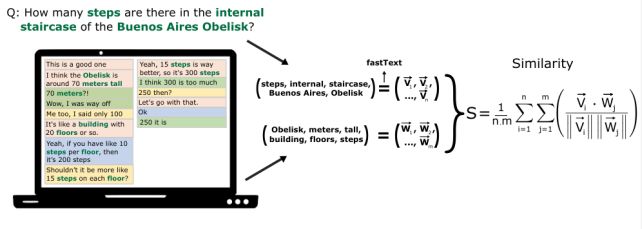
Finally, in the third experiment, everyone was instructed to use the Fermi method, but half the participants worked alone, while the others worked in groups.
The individuals did improve when they used the method… but the group results were still more accurate. This suggests that sharing and checking each other’s estimates in a group setting adds something that individuals working alone can’t do.
Here’s where it gets interesting. The researchers analyzed the language used in the conversations and found that the most successful groups tended to discuss concepts that were more closely related to the problem they were trying to solve.

For example, when discussing the number of steps in a monument, the more successful teams might use language like “staircase,” “building,” and “floors” – indicating that they were breaking the problem into smaller, more manageable pieces before arriving at an estimate.
Related: You’re Not Indecisive, You’re Unbiased. Science Says So.
The researchers caution that they only tested numerical estimation tasks, so it remains to be seen whether the same strategy improves other kinds of group decisions.
However, the finding suggests that what they call “problem decomposition” offers a learnable, more efficient pathway to group decision-making, and could have implications anywhere groups are asked to solve difficult problems together.
“This work shows that collective reasoning, and in particular reasoning by approximation, underlies enhanced collective accuracy during deliberation, and offers tools to detect and foster such processes, contributing to basic understanding of human group decision-making and informing practical applications aimed at improving crowdsourcing strategies,” they write in their paper.
The findings have been published in Nature Communications.
This article was fact-checked by Fiona MacDonald and edited by Fiona MacDonald. While we pride ourselves on our process, we are only human. If you spot a mistake, please let us know.


