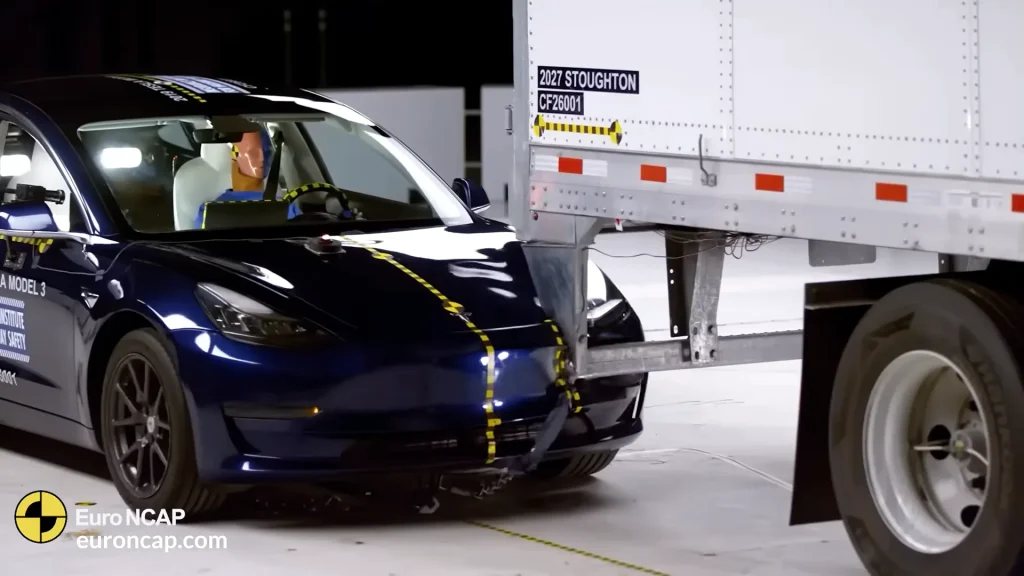
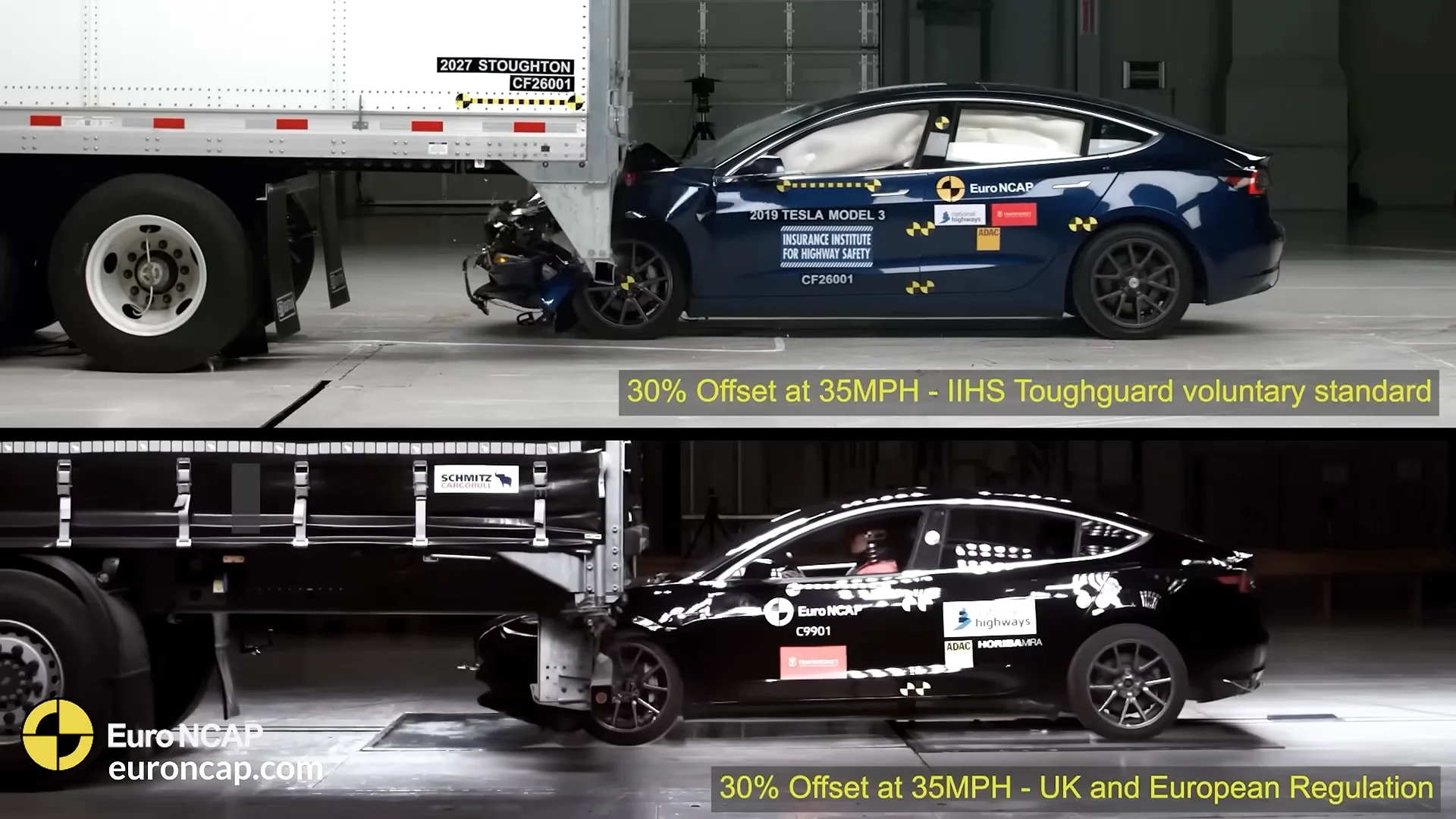
АНУ болон Европын ачааны машины чиргүүлийн хойд талын хамгаалалтын стандартын ялгаа нь 56 км/ц (35 миль/ц) хурдтай мөргөлдөх үед зорчигчийн амьд үлдэх магадлалд эрс ялгаатай үр дүн үзүүлж байна.
Их Британийн “Conquer Driving” сувгийн шинжилгээгээр Европын ачааны машины чиргүүлийн доогуур орохоос хамгаалах хаалт нь хангалттай бат бөх бус болохыг тогтоожээ. Туршилтын явцад Tesla Model 3 автомашин ачааны машины араас мөргөхөд чиргүүлийн доогуур орж, улмаар салхины шил болон дээврийн багана хүнд гэмтэл авч, зорчигчийн бүхээгт аюултай нөхцөл байдал үүсэж байна.
Харин АНУ-д ашиглагддаг “TOUGHGUARD” загварын илүү бат бөх хамгаалалтын хаалт нь ослын үед автомашины урд хэсгийн цохилт шингээгч бүсийг бүрэн ажиллуулдаг байна. Энэ нь цахилгаан автомашиныг илүү хурдан зогсоож, аюулгүйн дэр болон бүсийг үр дүнтэй ажиллуулан зорчигчдыг хамгаалдаг болохыг туршилтаар баталжээ.
Замын хөдөлгөөнд оролцохдоо ачааны машины араас мөргөх эрсдэлээс сэргийлэхийн тулд хоёр секундын зай баримтлах нь хамгийн үр дүнтэй арга гэдгийг мэргэжилтнүүд зөвлөж байна. Ингэснээр гэнэтийн тоормосны үед зогсох хангалттай хугацаатай болж, мөргөлдөх эрсдэлийг бууруулдаг байна.
Дэлгэрэнгүйг эх сурвалжаас харах
↓Эх сурвалжийг нээх ↓
If you drive a car in the United States, you are much more likely to survive this particular type of collision at 35mph than you are in Europe.
It might sound bizarre that a collision of one nature in one country is different if you cross the Atlantic and into Europe, where cars are broadly similar.
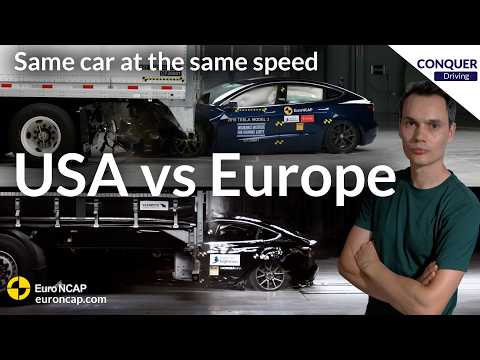
However, YouTuber Conquer Driving from the UK has explored the topic and explained why it is the case with this type of accident.
What is the accident in question?
As explained by the YouTuber, the accident in question involves hitting the back of a lorry at 35mph, or a semi-truck in America.
It is odd to think one accident might be fatal in one part of the world, versus not so much in another part.
But as is explained in the video, the problem comes down to the rear bumper on the lorry’s trailer.
The video shows a Tesla Model 3 hitting the back of a European lorry in a crash test, and the problem is quite obvious.
The underrun protection on the trailer does nothing to stop the Tesla hitting the lorry, and it smashes right underneath the trailer.
After that, the windscreen and roof pillar hit the trailer, and the cabin has quite clearly taken the brunt of the impact.
The glass roof is peeled away, and the crash test dummy has had a huge hit.
This is what happens in the United States
In short, the bumpers at the back are not strong enough to resist the impact of a car from behind.
Compare that to the American ‘TOUGHGUARD bumpers’, and it visually looks a lot stronger.
The question is, can it stop a Tesla Model 3 at the same speed as when it hits a European truck?
In short, the answer is yes. The front crumple zone of the Tesla does its job and cushions the impact from the trailer.
The EV is stopped quicker, the airbags and seatbelts deploy, and the passengers inside the car are protected.
A side-by-side comparison between the two shows the Model 3 runs right underneath the European trailer and is heavily damaged.
Above that is the American trailer, and as can be seen, the damage is far less severe and the EV does not go underneath the trailer.
How to avoid a collision with the back of a lorry
There are easy ways to ensure you don’t find yourself in a collision with the back of a lorry.
As the YouTuber explained, following at a good distance is the easiest thing you can do.
Don’t get too close to the trailer running in front of you.
A two-second gap is the best gap to have, allowing plenty of time to stop if you suddenly need to brake.
Plus, being further away means gentler braking, and making it less likely someone will run into the back of your car.
With the trailers offering so little protection, maybe it’s time Europe adopted the TOUGHGUARD approach.

