
Европын судлаачид 2000 жилийн настай хүж уугиулагч савнуудыг шинжилсний дүнд эртний Ромын айл өрхүүд ямар үнэртэй байсныг тодорхойлжээ.
Археологичид Помпей болон Боскореале хотоос олдсон шавар хүж уугиулагч хоёр саванд химийн нарийн шинжилгээ хийжээ. Судалгаагаар тухайн үеийн чинээлэг айлуудын гэрт модлог, шороон болон нимбэгийн үнэр ханхийдаг байсныг тогтоосон байна. Энэ нь эртний Ромын гэр бүлийн шүтлэгийн зан үйлд ургамлын гаралтай зүйлс болон үнэрт давирхайг өргөл болгон ашигладаг байсныг батлах анхны биет нотолгоо болж байна.
Судлаачид микроскоп, хийн хроматограф болон масс-спектрометрийн аргаар савны үлдэгдлийг шинжлэхэд амьтны ялгадас огт илрээгүй бөгөөд харин царс, лавр, жимсний мод зэрэг ургамлын үлдэгдэл олон тоотой байжээ. Түүнчлэн, нэгэн савнаас илэрсэн үнэрт давирхай нь Араб, Африк болон Азиас гаралтай болохыг тогтоосон нь Ромын эзэнт гүрний худалдааны өргөн сүлжээг илтгэж байна.
Энэхүү олдвор нь эртний хүмүүсийн өдөр тутмын зан үйл, шашны шүтлэгт үнэртэн ямар чухал байр суурь эзэлж байсныг харуулж байна. Эртний бичвэрүүдэд дурдсан дарс болон хүж өргөх ёслолын химийн ул мөр хадгалагдан үлдсэн нь “Антикуити” сэтгүүлд нийтлэгдсэн энэхүү судалгааны онцлох үр дүн болжээ.
Дэлгэрэнгүйг эх сурвалжаас харах
↓Эх сурвалжийг нээх ↓
For all the trials and heartbreaks of modern life there is at least one luminous and gratifying reward.
Never before in human history have we been able to see so far out into the Universe, or so deeply into cells, thanks to the work of thousands of scientists.
We can even peer into our own collective past and discover how the world smelled to our ancient ancestors.
Using what anthropologists call sensory archaeology, researchers can reconstruct ancient “smellscapes”.
Case in point: We now know that the interiors of wealthy people’s homes in Pompeii smelled woody and earthy, with a hint of citrus.
A team of European researchers figured this very specific detail out by analyzing 2,000-year-old ancient incense burners.
The researchers focused on two terracotta incense burners, or censers, that had been excavated decades ago from Pompeii and the nearby town of Boscoreale.
One came from a building that was being converted into an inn when Mount Vesuvius erupted in AD 79; the other was discovered still sitting inside a household shrine in a rural villa, alongside other ritual objects.
The shapes, decoration and archaeological context of these vessels all pointed to a single purpose: burning fragrant offerings during domestic religious ceremonies.
The researchers knew about these practices because ancient Roman authors wrote about them – offerings of incense, wine, flowers, fruit and grain to household gods known as the Lares and Penates were common.
For just one example, in the fourth book of The Elegies, written by the Roman poet Propertius, he wrote: “Give me soft costmary, and offerings of lovely incense.”
Costumary is an herb that was often used for its scent and also medicinally.
But until now, archaeologists had very little direct physical evidence proving what people burned.

To resolve that, the team turned to an impressive suite of chemical analyses. They carefully collected tiny samples from the center and edge of each censer, avoiding the surface to reduce modern contamination, and then did three complementary tests.
One looked for microscopic mineral traces left behind when plants are burned. Another searched for phytoliths – tiny silica structures produced by plants that survive long after the plants themselves have disappeared.
Finally, the researchers used gas chromatography and mass spectrometry to identify the molecular fingerprints of ancient resins, oils and other organic compounds.
The first surprise was what they didn’t find. Neither incense burner contained evidence that dried animal dung had been used as fuel, something that was common elsewhere in the ancient world.
Instead, both vessels contained plenty of microscopic signatures showing that woody plants had been burned.
The phytoliths suggest the burning of a mixture of plants, probably including oak, laurel, and members of the stone-fruit family, alongside various grasses. These could have served as fuel for the incense, but some may also have been offerings in their own right.
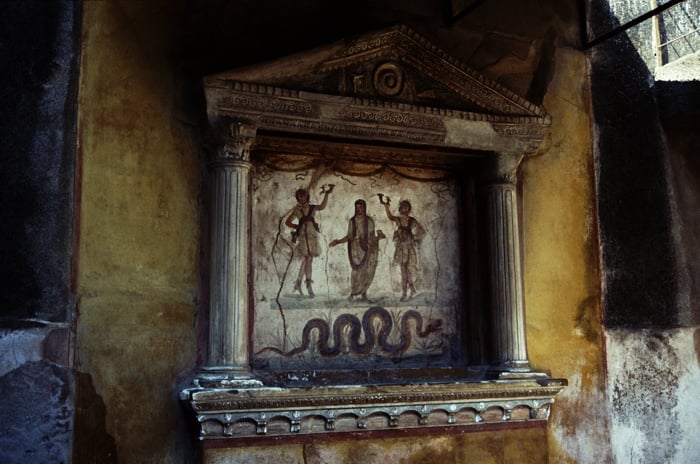
Many of these plants were locally available around Pompeii. That fits with previous discoveries of burnt figs, pine nuts, and other plant offerings found in Pompeian shrines, reinforcing the idea that everyday vegetation played an important role in household religious practice.
Only one of the censers preserved chemical traces of a special resin, but it’s a big deal – not only because we know what it smells like even today, but because of what it reveals about the extent of the trade networks in ancient Rome.
The researchers showed that the resin came from the same botanical family as frankincense, but was probably elemi, sourced from the far reaches of the trade networks that connected to the Roman empire.
The imported resin also offers a glimpse of Pompeii’s place in a vast ancient trading network.
The authors suggest that aromatic resins from Arabia, tropical Africa, and Asia were transported north through the Red Sea before passing through Alexandria and on to Italy, where they eventually reached households like those in Pompeii.
While it’s well recorded in written sources, this is the first direct archaeological evidence that imported aromatic resins were burned in Pompeian domestic worship – that they went to such trouble for a specific scent shows how important it was.
The same censer also contained possible chemical signatures of grape products, perhaps wine or vinegar. The authors stress that these traces should be interpreted cautiously because modern contamination cannot be excluded, but if genuine, they would fit remarkably well with Roman religious customs.
Ancient texts describe preliminary sacrifices in which worshippers poured wine while simultaneously burning incense, suggesting that these humble ash deposits have preserved the chemical remnants of rituals carried out almost 2,000 years ago.
That something as ephemeral as a smoky scent was so important to the people of Pompeii, and that we can reconstruct it today, is as close to a real-life time machine as we can probably get.
Research published in the journal Antiquity.
This article was fact-checked by Rachel Garner and edited by Peter Dockrill. While we pride ourselves on our process, we are only human. If you spot a mistake, please let us know.


