Судлаачид сэтгэл зүйн шинж чанар болон тархины бүтцийн өөрчлөлтийн хоорондын уялдаа холбоог тогтоохоор судалгаа хийжээ.
Петер Пиперхофф болон түүний багийнхан 2025 оны тавдугаар сарын 29-нд European Archives of Psychiatry and Clinical Neuroscience сэтгүүлд 39 эрэгтэй хүний тархины бүтцийн судалгааны үр дүнг нийтэлжээ. Судалгаанд сэтгэцийн эмгэгийн оношлогооны PCL-R сорилоор 20 ба түүнээс дээш оноо авсан, 18-60 насны герман хэлтэй, баруун гартай эрэгтэйчүүдийг хамруулж, тэдний тархины MRI дүрслэлийг ижил насны хяналтын бүлгийнхэнтэй харьцуулсан байна.
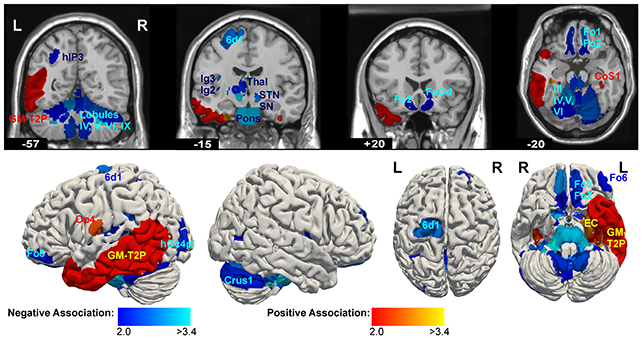
Шинжилгээгээр сэтгэцийн эмгэгтэй бүлгийн нийт тархины эзлэхүүн хяналтын бүлгээс 1.45 хувиар бага байгаа нь тогтоогджээ. Үүнээс гадна сэтгэцийн эмгэгийг зан үйлийн болон нийгмийн эсрэг шинж чанараар нь хоёр ангилан судалж үзэхэд, нийгмийн эсрэг шинж чанар нь тархины бүтцийн тодорхой өөрчлөлтүүдтэй илүү хүчтэй хамааралтай болох нь ажиглагдсан байна.
Тодруулбал, нийгмийн эсрэг шинж чанар өндөртэй хүмүүсийн тархины таламус, субталамусын цөм, тархины ишний зарим хэсэг болон суурь зангилааны эзлэхүүн багассан байв. Судлаачид эдгээр өөрчлөлт нь зан үйлийн хяналтад оролцдог тархины хэлхээ холбоотой холбоотой байж болзошгүй гэж үзэж байгаа ч энэ нь шууд шалтгаант холбоо бус, харин ажиглагдсан хамаарал гэдгийг онцолжээ.
Судалгааны явцад өгөгдлийг өөр өөр MRI төхөөрөмж ашиглан цуглуулсан, мөн танин мэдэхүйн чадвар болон бодисын хэрэглээ зэрэг хүчин зүйлсийг бүрэн хянах боломжгүй байсан зэрэг хязгаарлалт байсныг дурдсан байна. Цаашид тархины бүтэц дэх эдгээр өөрчлөлт нь удамшлын болон хүрээлэн буй орчны аль хүчин зүйлээс үүдэлтэй болохыг тогтоохын тулд нэмэлт судалгаа шаардлагатай гэж үзжээ.
Дэлгэрэнгүйг эх сурвалжаас харах
↓Эх сурвалжийг нээх ↓
The men had already been assessed for psychopathic traits. Their brain scans raised a different question: whether those behavioral differences were accompanied by measurable differences in brain structure.
Researchers examined MRI data from 39 German men with Psychopathy Check-List-Revised scores of 20 or higher, comparing regional brain volumes with those of age-matched controls. They also separated psychopathy into two dimensions to see whether different traits followed different structural patterns.
The clearest pattern appeared among men who scored higher on the impulsive and antisocial dimension of psychopathy. Higher scores were predominantly linked to smaller volumes across several cortical and subcortical regions, and the psychopathy group as a whole had 1.45% lower total brain volume than the controls.
Peter Pieperhoff and colleagues reported the findings in a study published in the European Archives of Psychiatry and Clinical Neuroscience on May 29, 2025.
Antisocial Traits Produced the Clearest Pattern
The Psychopathy Check-List-Revised, or PCL-R, divides the traits examined here into two broad dimensions. Factor 1 covers interpersonal and affective characteristics. Factor 2 measures lifestyle and antisocial behavior.
When the two were examined separately, factor 2 showed the stronger structural pattern.
Higher factor 2 scores were predominantly associated with lower volumes in areas including the thalamus, subthalamic nucleus, parts of the brainstem, basal ganglia, orbitofrontal and dorsolateral frontal regions, insular cortex and parts of the cerebellum.
Some of those associations weakened after correction for the large number of statistical comparisons. Differences involving the subthalamic nucleus, left anterior thalamus, mesencephalon and pons remained significant.
The authors linked that pattern to frontal-subcortical circuits that could be involved in behavioral control, while keeping the interpretation limited to an association rather than a causal explanation.
Factor 1 produced a less consistent result. Interpersonal and affective traits were associated with both higher and lower regional brain volumes, and none of the individual factor 1 findings remained significant after correction for multiple testing.
Total Brain Volume Was 1.45% Lower
The difference extended beyond individual regions.
After accounting for study site, age and intracranial volume, total brain volume was 1.45% lower in the psychopathy group. The reduction was similar on both sides of the brain: 1.50% on the left and 1.40% on the right.
Broader differences in the right telencephalon and cerebral cortex also passed the study’s multiple-testing threshold.
More localized differences appeared before that correction was applied, including parts of the frontal, parietal and temporal cortex, the right insula and areas of the hippocampal formation.
A Neuroscience News report on the brain-structure findings singled out the right subiculum, part of the hippocampal formation, as a notable localized difference. But detailed regional group differences such as this did not remain significant after correction for multiple testing, unlike the broader reduction in brain volume.
The scans therefore did not produce one sharply defined anatomical feature shared by every participant. Regional differences varied substantially from person to person.
Three German Cohorts Supplied the MRI Data
The 39 men in the psychopathy group came from three German cohorts involving the University Hospital in Göttingen, Forschungszentrum Jülich and the Medical Faculty of RWTH Aachen University.
Participants with psychopathy were recruited through forensic hospitals and local parole offices. Controls came from public advertisements. All participants were German-speaking, right-handed men aged 18 to 60.
The team used structural MRI and deformation-based morphometry to estimate differences in the volume of anatomically defined brain regions. The analysis relied mainly on the Julich-Brain Atlas, supplemented with regions from the AAL3 atlas.
Because the data came from several cohorts, the scans were collected on different MRI machines and under different acquisition protocols. The comparisons were adjusted for study site, age and intracranial volume.
Other limitations remained. Cognitive ability was not measured in every group, and substance use could have affected some of the results.
The clearest distinction was between the two psychopathy dimensions: impulsive and antisocial traits were more consistently associated with reduced regional brain volumes than interpersonal and affective traits. The authors said further research is needed to determine how much of the observed structural variation may be heritable and how much may be associated with environmental factors.
Enjoyed this article? Subscribe to our free newsletter for engaging stories, exclusive content, and the latest news.

