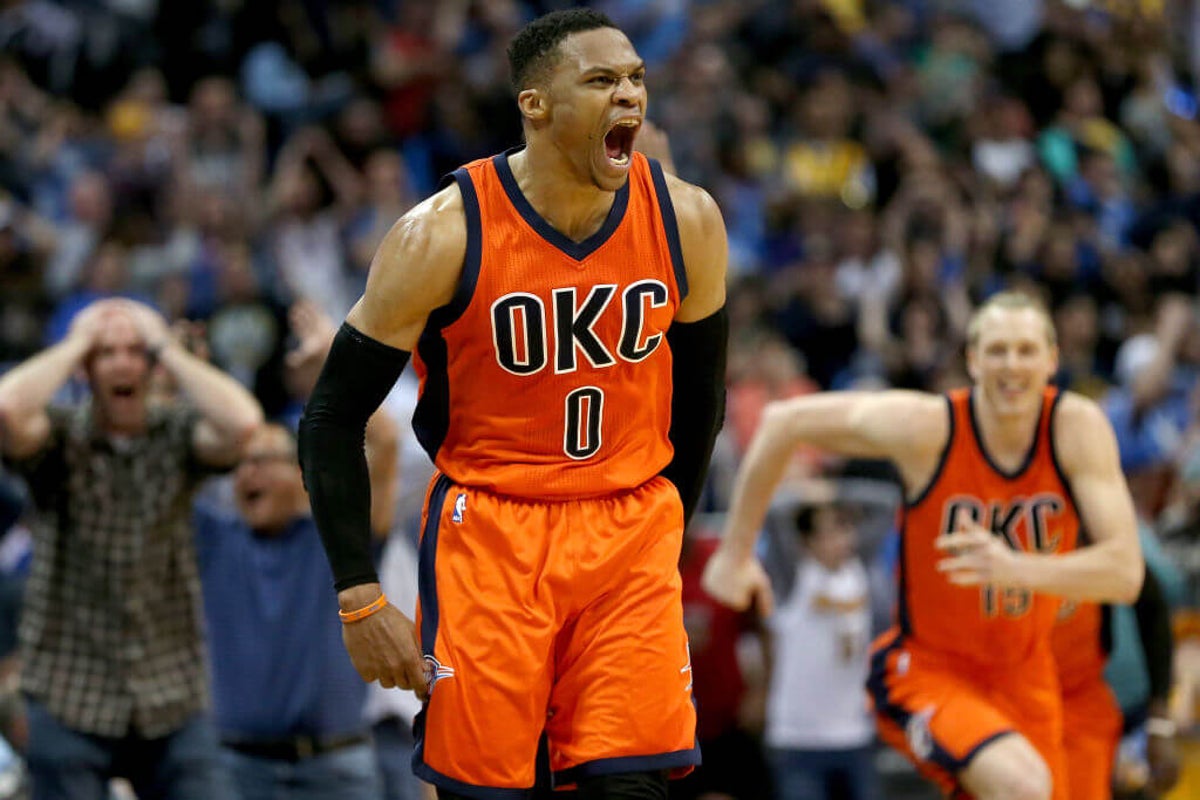
NBA-ийн түүхэн дэх хамгийн шилдэг тоглогчдын нэг Рассел Уэстбрук 18 улирлын карьераа өндөрлүүлж байгаагаа албан ёсоор зарлалаа.
Рассел Уэстбрук 37 насандаа мэргэжлийн сагсан бөмбөгийн замналаа өндөрлүүлж байгаагаа лхагва гарагт нийтэлсэн бичлэгээрээ дамжуулан мэдэгдлээ. Тэрээр 3.5 минутын турш үргэлжлэх тус бичлэгтээ ямар ч үг дуугараагүй бөгөөд өөрийн карьерын онцлох мөчүүдийг харуулсан нь түүний талбай дээрх ширүүн өрсөлдөөн, уйгагүй хөдөлмөрийг илтгэх мэт байв.
Түүний карьерын туршид үзүүлсэн амжилт нь олон хүний хувьд маргаан дагуулдаг ч тэрээр NBA-ийн түүхэнд 209 удаа triple-double хийсэн амжилтаар тэргүүлдэг. Уэстбрук triple-double хийсэн тоглолтуудад түүний баг 153 хожил, 56 хожигдол буюу 73.2 хувийн хожлын хувьтай байсан нь түүнийг зөвхөн хувийн статистик хөөгч гэх шүүмжлэлийг няцааж байна.
2008 онд Оклахома Сити Тандерт ирснээсээ хойш тэрээр Кэвин Дуранттай хамт тус хотыг NBA-ийн газрын зурагт оруулсан юм. Тэрээр 2017 оны MVP шагналыг хүртэж, хоёр удаа улирлын онооны аварга, гурван удаа дамжуулалтын аварга болж, есөн удаа бүх оддын тоглолтод шалгарсан билээ. Уэстбрук спортын замналынхаа туршид хэвлэл мэдээлэлд ярилцлага өгөхөөс илүүтэй талбай дээрх үйлдлээрээ өөрийгөө илэрхийлэхийг эрхэмлэдэг байсан бөгөөд ийнхүү чимээгүйхэн зодог тайлж байна.
Дэлгэрэнгүй эх сурвалжийг харах
Эх сурвалжийг нээх ↓
It is fitting Russell Westbrook left without saying a word.
In a video with Oscar-worthy, short-story nominee production values — unless someone else has Michael B. Jordan narrating their retirement — Westbrook called it a career Wednesday, after 18 NBA seasons.
He didn’t say “I’m retiring.” In fact, he didn’t utter a word in the 3 1/2-minute video. Westbrook left it to us to fill in the gaps, say what needed to be said about his illustrious career, one highlighted by his triple-doubles and a testament to his absolute furnace of a competitive gene, both of which propelled him and (most of) his teams to incredible heights.
His career was laid out, painstakingly, the way Westbrook became an NBA superstar and a model for the spectacular, never-dull outfits he’d wear into arenas, essentially inventing the tunnel walk. His game was all gas, no brakes. Like the character in the underrated film “Gattaca,” Westbrook challenged his chief rivals each night to swim races of endurance, never saving anything for the trip back to shore.
It is hard, then, to imagine Westbrook ever saying, as a matter of record, “I can’t play in the NBA any more.”
Amid August, though, the 37-year-old was still a free agent, a man without a team. And while there were potential matches here and there, it seemed clear no one was going to come way out of pocket to sign him for next season. This has also clearly been on his mind for a while. Watching the video, with him walking through a set, watching highlights of his career while Jordan “interviews” him, Westbrook didn’t wake up Wednesday morning, hit MBJ on speed dial and say, “Hey, you busy today?”
Westbrook was a force — a whirlwind of shoulders and legs — who propelled himself at the rim, night after night, challenging anyone who got in his way. Yet, he also passed the rock, night after night, and attacked the glass, proving particularly adept at offensive rebounds despite standing 6 feet 4. He couldn’t shoot from deep, at least not well, or for long. And yet, in a league that came to all but demand anyone handling the ball bow at the Altar of Steph Curry and spend a summer making a thousand 3s a day in practice, Westbrook still mattered, as he helped the Oklahoma City Thunder become winners.
“His mind did not distinguish between gaps and non-gaps,” the author Sam Anderson wrote in the book “Boom Town,” a history of Oklahoma City, with the Thunder a major part of its modern times.
“This was part of his power,” Anderson wrote. “Westbrook filled everything, everywhere, all the time.”
Westbrook and Kevin Durant put Oklahoma City on the map as an NBA town, soon after the franchise’s move from Seattle in 2008. (This is not a slight against James Harden, also present for most of the creation. But Harden left OKC for Houston in 2012 precisely because he felt pigeonholed as a sixth man with the Thunder and wanted to run his own show.)
In a sport where many fall over themselves to make their every utterance and action seem relevant, Westbrook didn’t make his most virtuous acts known, or ever care to explain himself to anyone in the media. His sneers at reporters’ questions in the Thunder locker room were the only parts of him that went viral. Otherwise, he would quietly fund projects such as “Tulsa Burning,” the 2021 documentary highlighting the destruction in 1921 of the Greenwood District in Tulsa, Okla., including the town’s famed Black Wall Street.
In 2016-17, when he became the second person to average a triple-double for a full NBA season, last done by Oscar Robertson 55 years prior, Westbrook gave not a single extended interview to anyone. Never cared to share what it meant to him to reach a plateau only one other player in league history ever reached. What it meant about him, and who he was, and the work he’d put in to reach that mark. He was loud in his refusal to speak, if that makes any sense.
Because his words mattered only to those for whom he cared the most.
His actions would have to do for the rest of us. Beating everyone (well, not Durant; we’ll call it a tie) to practice most days to get up shots and run the dreaded “17s” wearing weight vests. He had maniacal attention to film detail, telling young teammates they couldn’t just watch their own man on tape; they had to know what everyone else on the floor was doing, too. Taking young prospect Rui Hachimura under his wing in Washington during the COVID season of 2020-21, and teaching him what competing every night really meant, as Westbrook willed the Wizards to an improbable playoff spot.
He will make the Naismith Hall of Fame, and this will make so many people so very angry — people who took seeming delight in deconstructing Westbrook’s game and his impact on winning. No one’s career was more “well, actuallied” than Westbrook’s. His triple-double records, 2017 MVP award, two scoring titles, three assist crowns and nine All-Star appearances all fed into the wood chipper of scorn of a large segment of NBA fans and analysts, who found them all wanting, numbers created out of whole cloth, self-aggrandizement.
Which is when I, again, retort.
Westbrook has an NBA-record 209 triple-doubles. In those 209 such games, his teams had a cumulative record of 153-56. That’s a win percentage of .732. It is hard to square the circle of “Westbrook is a selfish stat hunter” with “.732.” When he got a triple-double, his team won 73.2 percent of the time. If you’re telling me an NBA team wouldn’t want a .732 win percentage in a season … well, I’d like to introduce you to the 2025-26 Detroit Pistons, whose 60-22 record produced, exactly, a win percentage of … .732.
Nonetheless, Westbrook needed allies. If not for Troy Weaver, the longtime NBA executive, and the Thunder’s assistant general manager in 2008, arguing passionately Westbrook could play the point despite never doing so in college — and that the young Thunder should use a precious top-five pick on him, a guy almost no one had as a top-five prospect entering the fall of 2007, Westbrook’s second and final season at UCLA — Westbrook may have never been fully seen. Or, at least, it may have taken him much longer, or perhaps being on another team.
So, too, did he have the good fortune of playing for a coach in Scott Brooks who let him loose, even as OKC put up loss after loss in Westbrook’s rookie season, which started out with a 3-29 record. As he and Durant grew as players, there were associated growing pains, on and off the court. But they played eight seasons together before Durant left for Golden State. Afterward, Westbrook stayed, matched Robertson’s achievement, and saw a retooling of the team through, with various co-stars such as Paul George and Carmelo Anthony.
“For me, it’s gratifying,” Brooks said in 2017, during Westbrook’s MVP season. “Russell was, they were saying things that were, to me, unfair. And they were killing me for being the world’s dumbest coach playing him at point guard — he can’t make point-guard decisions … he averaged 15, 5 and 5 as a rookie! Five rebounds. And there were only like four other players who’d ever done that at the time. But people forget about that.”
Westbrook made but a single Finals appearance, in 2012. But that can’t be the sum of what his nearly two decades in the Association were about. He created himself, flaws and all, and made himself into an all-time great. And if it was that easy to re-create what he brought to the court, we’d have seen a half-dozen other guys impact the game the way he did. You can speak up in dissent, of course, but Westbrook’s already left the building, having said all he wants to say.


