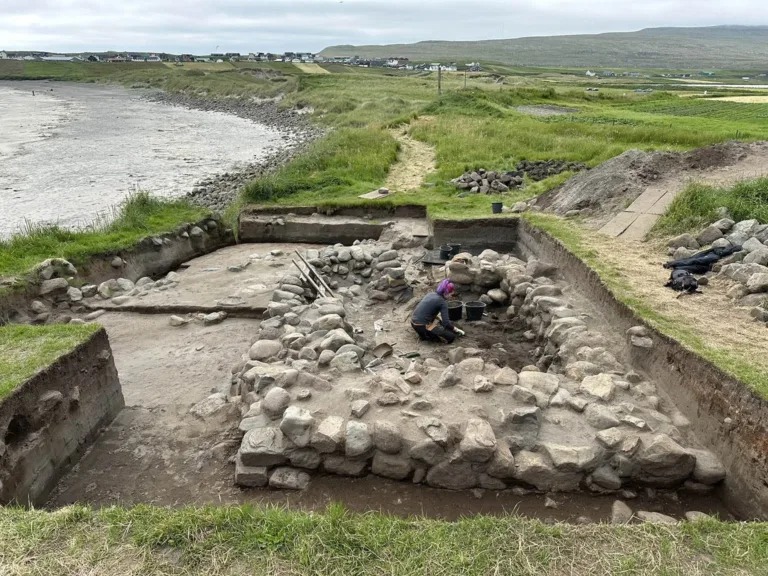
Археологичид сүм хийдийн шалан доороос хуучин норвеги хэл дээрх бичээстэй эртний хөшөөг илрүүлэн судалж байна.
Фарерын арлуудын Сандой араг дахь А Сондум археологийн талбайд хийсэн малтлагаар дундад зууны үед хамаарах, руни бичээстэй чулуун хөшөө олдсон байна. Фарерын арлуудын Үндэсний музей, Орхусын их сургууль болон Данийн Моесгаард музейн судлаачдын хамтарсан баг энэхүү олдворыг сүм эсвэл мөргөлийн жижиг байшингийн шалнаас олжээ.
Хөшөөний гадаргуу олон зууны турш элэгдэж гэмтсэний улмаас бичээсийн ихэнх хэсэг тодорхойгүй байна. Гэсэн хэдий ч анхны шинжилгээгээр хуучин норвеги хэл дээр “Энд амгалан нойрсоно…” гэх утга бүхий үгс бичигдсэн байж болзошгүй хэмээн таамаглаж байгаа нь уг хөшөөг оршуулга эсвэл дурсгалын зориулалттай байсныг илтгэж байна.
Судлаачид уг олдворыг хамгаалах зорилгоор Фарерын арлуудын Үндэсний музейд шилжүүлж, бичээсийг нарийвчлан судлахын тулд 3D сканнер ашиглан дижитал загвар гаргахаар бэлтгэж байна. Мөн малтлагын үеэр Виржин Мариа болон бяцхан Есүсийн баримал, тосон дэнлүүний хэлтэрхий зэрэг эртний христийн шашны холбогдолтой эд зүйлс олдсон нь тус барилгыг мөргөлийн зориулалттай байсныг гэрчилж байна.
Руни бичээс бүхий хөшөө нь тус бүс нутгийн дундад зууны түүх, шашны зан үйлийг ойлгоход чухал ач холбогдолтой олдвор юм. Одоогоор мэргэжилтнүүд бичээсийн үлдэгдэл хэсгийг тайлж унших, мөн хөшөөний ягшмал зориулалтыг тодорхойлох судалгааг үргэлжлүүлж байна.
Дэлгэрэнгүйг эх сурвалжаас харах
↓Эх сурвалжийг нээх ↓
A centuries-old runestone discovered beneath the floor of a ruined medieval chapel in the Faroe Islands has given archaeologists a new mystery to investigate. The stone appears to contain an Old Norse inscription, but much of the message remains unread.
The runestone’s discovery was made at the Á Sondum archaeological site on Sandoy during excavations led by the Faroe Islands National Museum in partnership with Aarhus University and the Moesgaard Museum in Denmark. The site has already helped researchers better understand the history of human settlement across the islands.
Located in the North Atlantic between Iceland and Scotland, the Faroe Islands have a long medieval past shaped by Norse settlers and the arrival of Christianity. Even with this rich history, surviving runic inscriptions from the islands are uncommon, making the newly found stone a rare archaeological discovery.
The runestone was found embedded in the floor of a building believed to have been a medieval chapel or small prayer house. After centuries exposed to natural wear, the surface of the stone is damaged, leaving researchers with only part of the original inscription.
A Hidden Inscription Waiting To Be Decoded
The first analysis of the stone revealed what researchers believe could be the beginning of a message carved in Old Norse. The words “Her hvílur…” appear to translate as “Here lies…” or “Here rests…”, suggesting the stone may have been linked to a person’s burial or a memorial.
The National Museum of the Faroe Islands described the find as an important addition to the limited collection of runic evidence from the archipelago. The museum noted that the rarity of such inscriptions makes the find valuable for studying medieval life on the islands.
The rest of the inscription remains difficult to understand because several sections are broken or missing. Archaeologists have therefore asked a rune specialist to join the research team and examine the remaining markings in greater detail.
The stone has since been moved to the Faroe Islands National Museum to protect it from further damage. Researchers are also preparing a 3D scan that will create a detailed digital version of the artifact and help preserve the inscription for future analysis.
Ancient Chapel Objects Reveal Christian History
The runestone was discovered alongside several other objects that provide clues about the building’s role. Archaeologists found fragments of a small statue depicting the Virgin Mary holding baby Jesus, as well as a kola, a type of small oil lamp. These discoveries support the idea that the structure was used as an early Christian worship site. The layout of the building also matches medieval religious architecture, with an east-to-west orientation and an entrance on the western side.
The Faroese broadcaster KVF reported that the stone will undergo 3D scanning as part of the ongoing investigation. The digital model will allow researchers to examine the inscription closely while reducing the need for repeated handling of the fragile artifact.

Archaeologists believe the building was likely a medieval oratory, a small place dedicated to prayer. Similar structures have been identified elsewhere in the Faroe Islands, including the oratory at Bønhúsberg on Mykines, Bønhústoft in Leirvík, and the ruins at Bakki in Velbastaður.
A Medieval Secret Unearthed On Sandoy
The find at Á Sondum offers another piece of the story of medieval communities on Sandoy. The combination of the runestone, Christian objects, and the remains of the building gives researchers new material to study how people lived and worshipped in the Faroe Islands centuries ago.
The unfinished inscription remains the site’s greatest mystery. Experts are still trying to understand whether the stone marked a burial place, commemorated an individual, or had another religious or symbolic purpose.

The ongoing examination of the artifact could eventually reveal more about the people who carved the message and the role this small religious site played in the medieval history of the Faroe Islands.
Enjoyed this article? Subscribe to our free newsletter for engaging stories, exclusive content, and the latest news.

