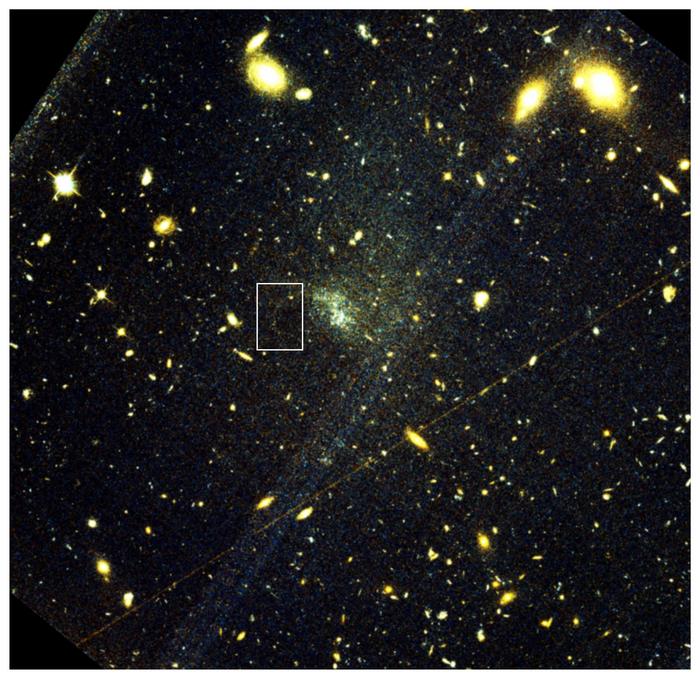
Эрдэмтэд дэлхийгээс 115 сая гэрлийн жилийн зайд орших галактикаас оддын урсгалыг илрүүлж, түүний тусламжтайгаар харанхуй материйн тархалтыг хэмжих шинэ аргыг боловсрууллаа.
Судлаачид UGC 9050-Dw1 хэмээх хэт сийрэг галактикаас бөмбөлөг хэлбэрийн оддын бөөгнөрлөөс салбарлан гарсан нарийн, муруй зурвас оддыг олж илрүүлжээ. Уг бүтэц нь Сүүн зам галактикийн таталцлын нөлөөгөөр оддын бөөгнөрлөөс тасран үүсдэг урсгалтай төстэй боловч ийм үзэгдлийг манай галактикийн гаднаас анх удаа ажиглаж байгаа нь энэ юм. Судалгааны үр дүнг 2026 оны наймдугаар сарын 12-нд Nature сэтгүүлд нийтэлжээ.
UGC 9050-Dw1 галактик нь оддын нягтрал маш багатай тул уг урсгал нь харанхуй дэвсгэр дээр тод ялгарч харагдсан байна. Нортвестерний их сургуулийн судлаач Тжитске Старкенбургийн тайлбарласнаар, оддын урсгалын дагуух хөдөлгөөн нь галактикийн таталцлын хүчээр тодорхойлогддог тул энэхүү хөдөлгөөнийг загварчлах замаар галактикийн нийт массыг тооцоолох боломжтой аж. Ийнхүү харагдах материйн массыг хассанаар үлдэх хэсэг нь харанхуй матери болохыг тогтоох боломжтой юм.
Копенгагены их сургуулийн судлаач Жюли Киел Холмын тэмдэглэснээр, энэхүү шинэ арга нь өмнөх судалгаануудтай нийцэж байгаа бөгөөд галактикийн гаднах харанхуй материйг судлахад үр дүнтэй болохыг харууллаа. Hubble Space Telescope-ийн архивын өгөгдлүүдээс олж илрүүлсэн энэхүү нээлт нь цаашид Nancy Grace Roman Telescope зэрэг дараагийн үеийн хүчирхэг дурангуудын тусламжтайгаар илүү олон ийм урсгалыг нээх үүд хаалгыг нээж байна.
Дэлгэрэнгүйг эх сурвалжаас харах
Эх сурвалжийг нээх ↓
Scientists have discovered a rare star formation hidden in a distant galaxy, unlike anything seen before beyond the Milky Way. What’s more, the discovery offers a brand new way to measure the distribution of dark matter in distant galaxies.
The newly observed stellar stream consists of a thin, curved band of stars, unravelling off a globular cluster like a thread from a ball of yarn. Structures like these have been observed before within our own galaxy, where the rotation of the Milky Way tugs at dense clusters of stars and strips some of them away to form long streams of escaping stars. But formations like these are usually too faint to be seen in distant galaxies, so although they were assumed to exist elsewhere, they’d never actually been observed outside the Milky Way until now.
What made this particular observation possible is that the galaxy in question, known as UGC 9050-Dw1, is an ultra-diffuse object, with a very sparse population of stars. That meant the stellar stream stood out against an unusually dark background, making it visible despite the 115 million light-years between it and Earth.
The results were published in Nature on August 12, 2026, where the authors went beyond merely observing the formation. They also used it to measure dark matter in UGC 9050-Dw1.
“The stars in a stellar stream all travel along nearly the same orbit, and that orbit is shaped by the galaxy’s gravity,” said Tjitske Starkenburg of Northwestern University, who coauthored the study. “By modelling that gravity, we can estimate the galaxy’s total mass. We already know roughly how much of that mass comes from visible matter like stars, so the rest must be dark matter.”
Dark matter is an unknown substance in the universe that does not seem to interact electromagnetically with light or with ordinary matter, making it completely invisible except by its gravitational effects. Understanding the nature of dark matter remains one of astronomy’s greatest open problems.
The newly discovered extragalactic stellar stream gave astronomers a unique opportunity to test more orthodox measurements of dark matter, and their results jived with the older methods.
Artist’s impression of stellar streams within the Milky Way. NASA/JPL-Caltech/R. Hurt (SSC/Caltech)
“Our results are consistent with previous studies and what they have shown about dark matter in this ultra-diffuse galaxy,” said Julie Kiel Holm of the University of Copenhagen, co-lead on the paper. “We are measuring it with a completely new tool for this type of galaxy, demonstrating that this method also works beyond our own galaxy.”
The co-authors believe that this discovery won’t be the last extragalactic stellar stream to be found. It was identified amongst archival data from the Hubble Space Telescope, and with new, next-generation telescopes coming online, the likelihood of finding more is high. The authors are particularly excited by the prospects of the Nancy Grace Roman Telescope, which will have a field of view 100 times larger than Hubble.
Kiel Holm et al., “Evidence for the first globular cluster stellar stream beyond the Milky Way,” Nature 2026.


