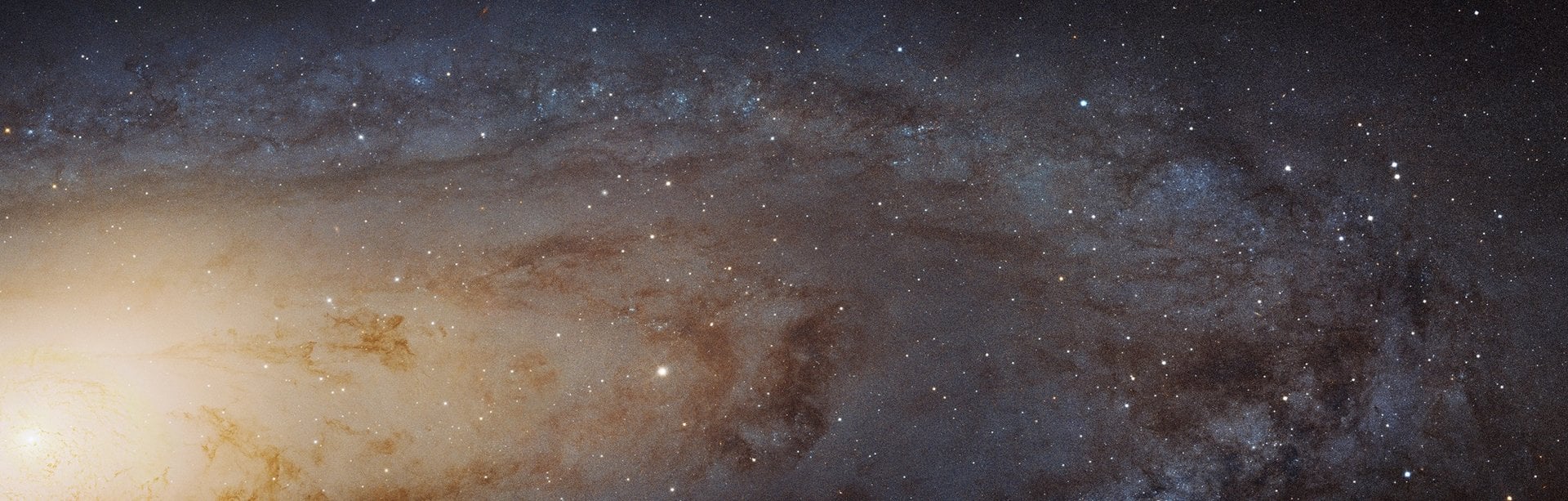
NASA-гийн Хаббл сансрын дуран авайг ашиглан хийсэн шинэ судалгаагаар бидэнд хамгийн ойр орших том галактикуудын нэг Андромедагийн од үүсэх үйл явц эрчимтэй буурч байгааг тогтоожээ.
Вашингтоны их сургуулийн судлаачид PHAT болон PHAST судалгааны хүрээнд цуглуулсан өгөгдлүүдийг нэгтгэн Андромеда галактикийн оддын хувьслын түүхийг нарийвчлан судалсан байна. “The Astrophysical Journal” сэтгүүлд нийтлэгдсэн үр дүнгээс үзвэл, тус галактикийн од үүсэлт сүүлийн 500 сая жилийн турш буурч байгаа бөгөөд сүүлийн 40 сая жилд энэ үйл явц улам хурдасчээ. Одоогоор од үүсэлтийн хурд нь жилд нэг нарны масстай тэнцэх хэмжээний бодис од болж хувирдаг байсан түвшнээс тав дахин багассан байна.
Судлаачид галактикийн дискийг 300 гэрлийн жилийн хэмжээтэй олон мянган хэсэгт хувааж, тус бүрийн од үүсэлтийн түүхийг тодорхойлжээ. Од үүсэлтийн энэхүү бууралт нь галактикийн төвөөс 32,000 гэрлийн жилийн зайд орших од үүсгэгч цагираг бүтцэд илүү тод ажиглагдсан байна. Энэ нь шинэ од үүсгэх материал дууссанаас бус, харин галактикийн идэвхжил жам ёсоороо намжиж байгаатай холбоотой байж болзошгүй гэж эрдэмтэд таамаглаж байна.
Түүнчлэн Андромедагийн дагуул галактик болох M32-ын нөлөөллийг судалсан боловч одоогоор тодорхой хамаарал тогтоогдоогүй байна. Гэсэн хэдий ч хоёр галактикийн хоорондох бүсэд 60 сая жилийн өмнөөс од үүсэлт буурч эхэлсэн нь M32-той холбоотой байж болох хамгийн магадлалтай хувилбар гэж судлаачид үзэж байна. Цаашид NASA-гийн Nancy Grace Roman сансрын дуран авайг ашигласнаар Андромеда галактикийг илүү өргөн хүрээнд, нарийвчлалтайгаар судалж, эдгээр асуултад илүү тодорхой хариулт олох боломж бүрдэнэ.
Дэлгэрэнгүйг эх сурвалжаас харах
Эх сурвалжийг нээх ↓
The Andromeda Galaxy, one of the Milky Way’s closest cosmic neighbors, is a fascinating subject for astronomers. Located about 2.5 million light-years away, Andromeda is visible to the naked eye (where light conditions permit), allowing astronomers to examine its stellar populations in detail. Moreover, this galaxy is around twice the size of the Milky Way (200,000 light-years) and has five times the population – roughly one trillion stars.
As such, Andromeda allows astronomers to better understand the evolution of our own galaxy while also providing insight into some of the largest galaxies in the Universe. In a new study using data from two surveys conducted by NASA’s Hubble Space Telescope, a team led by researchers at the University of Washington has found that star formation in the Andromeda Galaxy is winding down.
The results, which were published in The Astrophysical Journal, indicate that star formation has been in decline over the past 500 million years, with an even steeper drop in the last 40 million. Star formation within a galaxy’s disk is driven by several factors that can be divided into internal and external categories. Internal mechanisms include molecular clouds gaining mass through gravity, magnetic fields, or shockwaves and other forces that push gas and dust together until gravitational collapse occurs.
The Andromeda Galaxy is also a LINER spiral galaxy. Even though it’s close in astronomical terms, it’s still very distant and difficult to study. Image Credit: NASA/ESA/Hubble
Meanwhile, external forces include galactic mergers, which compress gas and dust from the two galaxies, triggering the birth of new stars. Galactic regions that have experienced recent star formation tend to have a larger fraction of bluer stars (O, B, and A-type), because they are more massive and short-lived. Less massive stars, like M-type red dwarfs, are dimmer and have much longer lifespans (up to trillions of years).
As a result, regions with less recent star formation tend to have redder populations. Calculating the rate of star formation requires astronomers to measure the mass of gas and dust converted into stars per year. The results are expressed in solar masses, each one being equivalent to the mass of our Sun: 2 x 1030 kg, or 2 x 1027 metric tons (2.2 x 1027 U.S. tons).
For their study, the researchers combined data from the Panchromatic Hubble Andromeda Treasury (PHAT) and the Panchromatic Hubble Andromeda Southern Treasury (PHAST). While the PHAT survey mapped roughly a third of M31’s star-forming disk (100 million stars) from the ultraviolet through the near-infrared spectrum, PHAST followed up by resolving 90 million stars in the optical near-ultraviolet bands.
Together, these surveys have mapped about two-thirds of Andromeda’s disk in extreme detail, providing a detailed picture of Andromeda’s past activity. The team began by dividing the Andromeda images into thousands of squares, each measuring 300 light-years on each side. From these, the research team determined the history of star formation within each square to gain a comprehensive understanding of stellar evolution in Andromeda’s disk.
“We need to measure the individual stars because they are the fossil record of the galaxy’s formation,” said study co-author Ben Williams, an astronomer at the University of Washington. “Hubble is the only telescope that can give you high enough spatial resolution over a large enough area to be able to do that in Andromeda.”
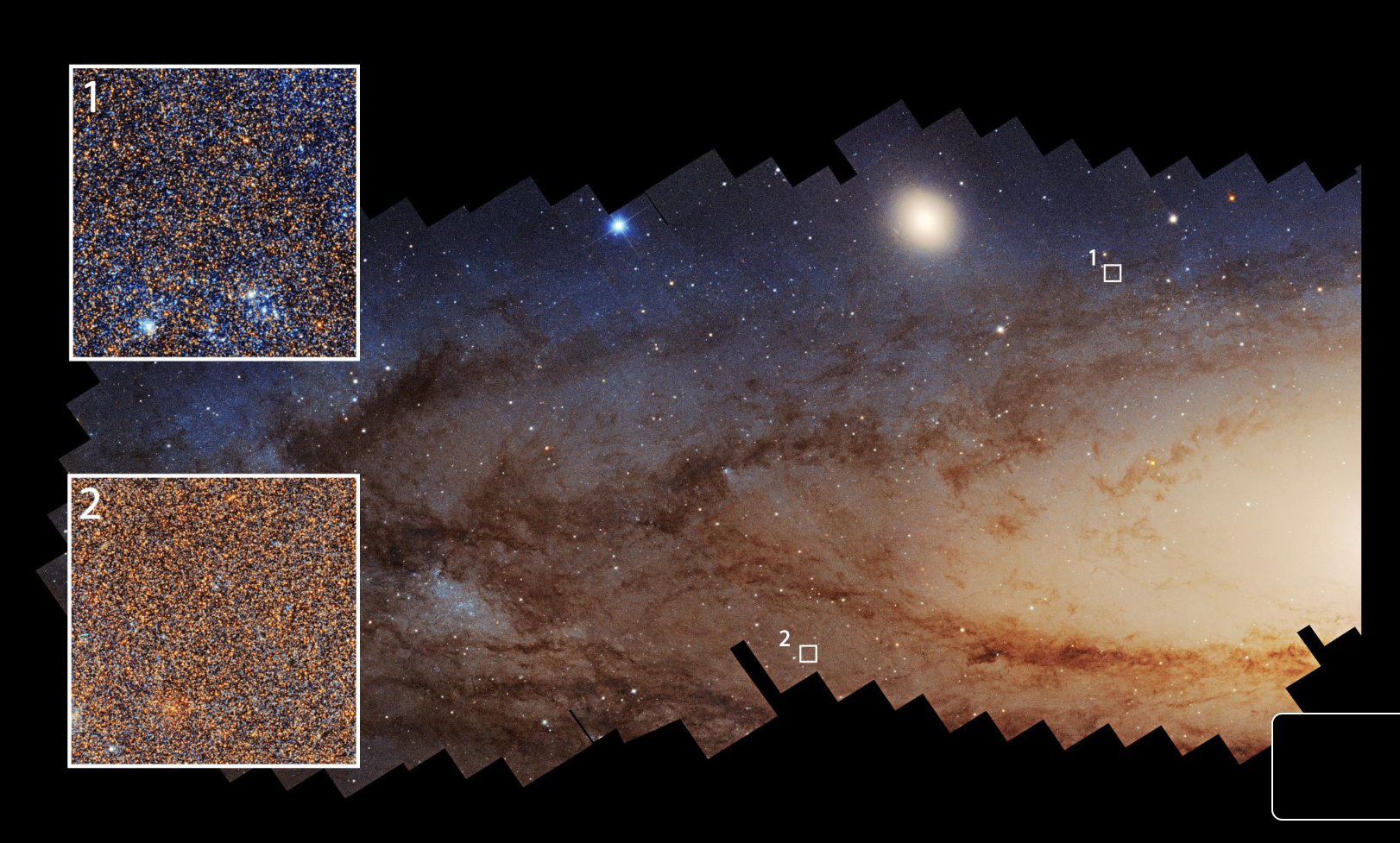 Hubble image of the Andromeda galaxy, showing the bluer regions that have experienced recent star formation (1) and redder regions with less recent star formation (2). Credit: NASA/ESA/UWashington/Northwestern/STScI
Previous studies have shown that Andromeda experienced a burst of star formation about 2 billion years ago, possibly due to a galactic merger, but then began to decline. The research team calculated that 500 million years ago, Andromeda formed stars at a rate of about one solar mass per year, which fell to about half that by 40 million years ago. The current rate, they found, has declined even further to about one-fifth of a solar mass per year.
The team also found that much of the recent star formation occurred in a star-forming ring about 32,000 light-years from the galaxy’s center, rather than being consistent across the entire galaxy. This demonstrated that much of the decline they noted is driven by decreasing activity within the ring structure. They hypothesize that this is likely to be a natural winding down from its previously more active state, rather than the result of reduced material for new stars.
The team also investigated if this decline in star formation might be connected to Andromeda’s proximity to M32. About 16,000 light-years separate this satellite galaxy from Andromeda, and astronomers are unsure if and when it interacted with Andromeda in the past. Addressing this question was one of the major motivations of the PHAST survey, which allowed the team to study the history of star formation between the two galaxies. This showed that the area between the two galaxies also began to experience decreased star formation roughly 60 million years ago.
The timing of this decrease could help astronomers resolve the mystery of possible past interactions. “We can’t explicitly say that we are seeing a decrease in star formation because of M32. But it’s right there, and it’s definitely the most likely suspect,” said Wainer. The team plans to continue analyzing Andromeda’s star-formation history by combining Hubble data with ground-based observations to gain further insights. Astronomers will learn even more when NASA’s Nancy Grace Roman Space Telescope launches, which is scheduled for no sooner than Aug. 30th.
With its massive field of view, at least 100 times that of Hubble at near-infrared wavelengths in a single observation, astronomers will be able to map the Andromeda galaxy in even greater detail. NASA has already approved an observation program that will image Andromeda’s full disk and surrounding areas, allowing astronomers to measure hundreds of millions of stars. These studies will shed light on stellar evolution in Andromeda, as well as in our galaxy.
Further Reading: NASA

