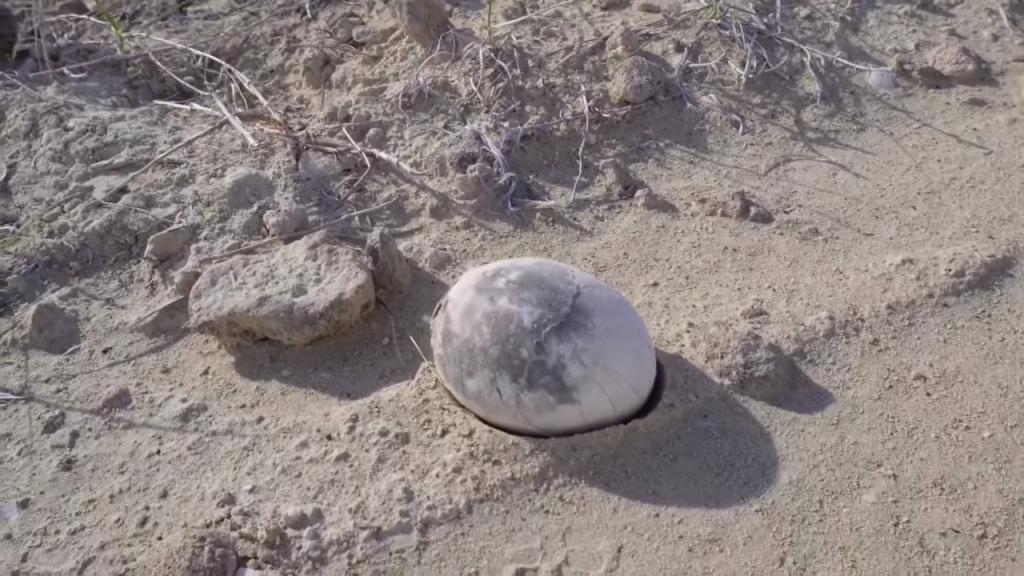
Судлаачид махан идэшт үлэг гүрвэлийн бүрэн бүтэн байж болох энэхүү олдвор нь үр хөврөлтэй эсэхийг тогтоохоор ажиллаж байна.
Аргентины Патагоны бүс нутгийн Аллений тогтоцоос палеонтологчид 70 сая жилийн настай, бараг бүтэн хадгалагдсан үлэг гүрвэлийн өндгийг илрүүлжээ. Энэхүү олдвор нь Өмнөд Америкт олдсон махан идэшт үлэг гүрвэлийн хамгийн бүрэн бүтэн өндөг байж болзошгүй юм. Аргентины Байгалийн шинжлэх ухааны музейн дэргэдэх Харьцуулсан анатоми ба сээр нуруутан амьтдын хувьслын лабораторийн эрдэмтэн Федерико Агнолин, Матиас Мотта нарын удирдсан баг малтлагын үеэр уг олдворыг нээсэн байна.
Олдворын гаднах бүрхүүл нь зууван хэлбэртэй байгаа нь үүнийг шувууны өвөг болох теропод бүлгийн үлэг гүрвэлийнх байх магадлалтайг харуулж байна. Судлаачид уг өндгийг тодорхойлохын тулд бүрхүүлийн микро бүтцийг нарийвчлан судлахаар төлөвлөж байгаа бөгөөд одоогоор тодорхой төрөл зүйлд хамааруулахад эрт байна гэж үзэж байна. Өмнө нь таамаглаж байсан зарим зүйлийн үлэг гүрвэлийн өндөгтэй харьцуулж үзэхэд гадаргын хээ нь тохирохгүй байгаа тул энэ нь шинжлэх ухаанд хараахан танигдаагүй зүйл байж болзошгүй юм.
Эрдэмтэд олдворыг микро-CT сканнерын тусламжтайгаар гэмтээлгүйгээр шинжилж, дотор нь үр хөврөл хадгалагдан үлдсэн эсэхийг тогтоохыг зорьж байна. Хэрэв үр хөврөл олдвол энэ нь маш ховор тохиолдол болох бөгөөд өмнө нь Аргентинд зөвхөн урт хүзүүт сауропод үлэг гүрвэлийн үр хөврөлийн олдвор илэрч байсан түүхтэй.
Уг олдвор олдсон газраас өндөгний хальсны хэлтэрхий болон үүрний үлдэгдэл илэрсэн нь махан идэшт үлэг гүрвэлийн үүрлэх зан үйлийг судлах ховор боломжийг олгож байна. Эрдэмтдийн үзэж буйгаар үлэг гүрвэлийн яс нь амьтны нийгмийн зан үйл, үр төлөө хэрхэн асрах зэрэг мэдээллийг өгч чаддаггүй бол үүр нь тухайн үеийн амьтдын амьдралын хэв маягийг ойлгоход чухал ач холбогдолтой юм.
Дэлгэрэнгүйг эх сурвалжаас харах
↓Эх сурвалжийг нээх ↓
Argentine paleontologists have uncovered a nearly intact 70-million-year-old fossilized egg in Patagonia that may represent the first complete egg from a carnivorous dinosaur ever found in South America. The fossil could become even more significant if researchers confirm that an embryo is still preserved inside.
The egg was discovered in the Allen Formation in Argentina’s Río Negro Province during Cretaceous Expedition I, a research campaign that was streamed live online. Led by paleontologist Federico Agnolín and his colleague Matías Motta, the team kept the discovery secret before revealing it during the broadcast, allowing the public and fellow researchers to witness the moment together.
The importance of the find goes beyond the fossil itself. Eggs can reveal details that dinosaur skeletons cannot, including possible nesting habits, reproductive behavior, and interactions with offspring. According to researchers from the Laboratory of Comparative Anatomy and Evolution of Vertebrates (LACEV) at the Argentine Museum of Natural Sciences, the expedition had already uncovered several important fossils before the egg was found, including duck-billed dinosaurs, a long-necked dinosaur, and small prehistoric mammals.
A Fossil Too Perfect To Be Real
The condition of the egg immediately made it stand out. After spending millions of years exposed to natural processes, the shell had turned white. Federico Agnolín said he initially found it difficult to believe the object in front of him was actually a fossil.
Researchers believe the specimen could be the most complete and best-preserved carnivorous dinosaur egg discovered so far. It may also belong to a species that has not yet been identified by science. Its shape provided an early clue about its possible owner. Unlike the rounder, thicker-shelled eggs associated with long-necked sauropods, this fossil has an oval shape closer to that of modern birds. That feature points researchers toward a theropod dinosaur, the group that includes carnivorous dinosaurs and the ancestors of birds.
The discovery came during a successful expedition that had already produced several important finds. Before the egg was revealed, the team had uncovered fossils believed to represent two types of duck-billed dinosaurs, a long-necked dinosaur, and tiny prehistoric mammals.
Searching For The Egg’s Owner
Identifying the animal behind the fossil remains one of the biggest questions surrounding the discovery. Scientists initially considered Bonapartenykus, a small carnivorous theropod known from the region during the Late Cretaceous. That possibility was later rejected after researchers compared the egg with previously known shell fragments.
The surface ornamentation did not match, suggesting that the fossil belonged to another type of carnivorous dinosaur. Agnolín stated that the egg may have come from a species whose adult form has not yet been discovered.
“We believe we’re looking at another kind of carnivorousdinosaur— perhaps one whose adult form is not yet known,” he added, confirming its identity will require a detailed study of the shell’s microscopic structure.

The team plans to examine the fossil using micro-CT scanning, a technique that can reveal internal structures without damaging the egg. Researchers also hope the scan will show whether an embryo remains inside.
A preserved embryo would be an extremely rare discovery. Dinosaur embryos have been found in different parts of the world, but Argentina’s previous embryo discoveries have involved only sauropods, not carnivorous dinosaurs. Agnolín has said he is hopeful about finding remains inside the egg, while also acknowledging that the chances are low.
A Dinosaur Nest May Reveal Ancient Behavior
The egg was not found alone. Near the fossil, researchers discovered additional eggshell fragments and eroded pieces that appear to form part of a nest. The same area also contained remains of Rocasaurus muniozi, a titanosaur species associated with bird-like respiratory features.
If confirmed, the nesting site would represent the first documented carnivorous dinosaur nest in South America. The find could provide rare evidence about how predatory dinosaurs reproduced shortly before the end of the Cretaceous Period.
“A skeleton doesn’t tell you any of that,” he adds. “It doesn’t reveal whether the animal cared for its offspring, or whether it was social or solitary. A nest, on the other hand, does. And that’s what’s fascinating. It lets us glimpse the behavior of animals that lived 70 million years ago. That’s the true value of this discovery,” stated Agnolín.
Theropods occupy a key position in that evolutionary story. Their descendants include birds, which build nests, incubate eggs, and care for their offspring. Studying ancient theropod eggs and nests may help scientists understand how these behaviors developed over millions of years.
Enjoyed this article? Subscribe to our free newsletter for engaging stories, exclusive content, and the latest news.

