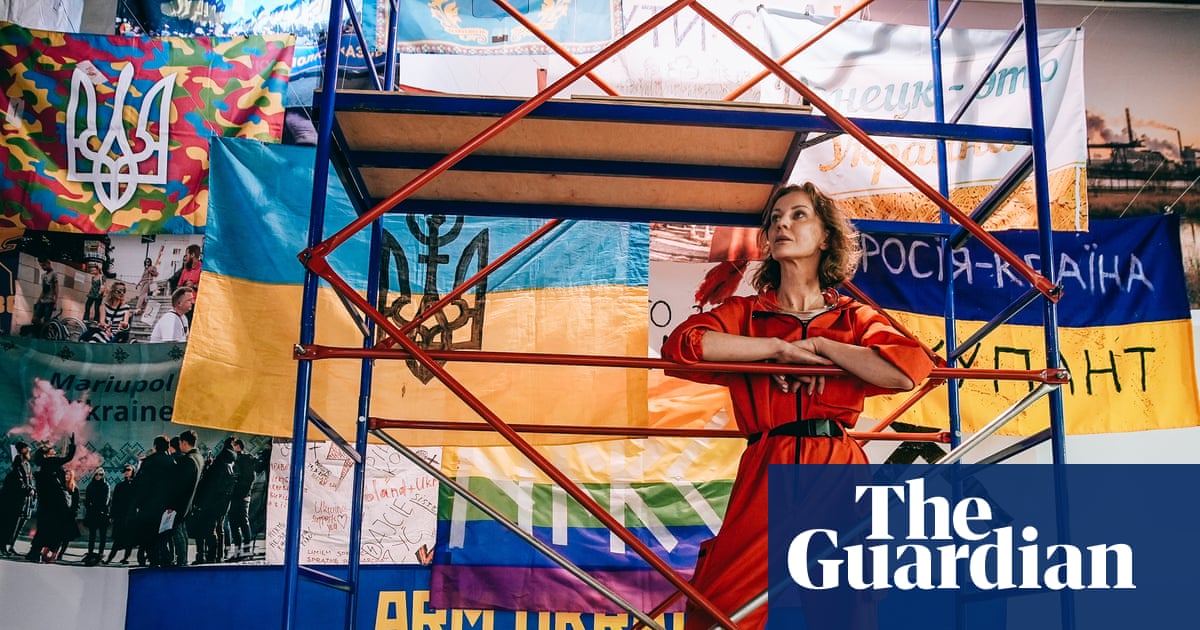
Зохиолч Шарлотта Хиггинс дайны үеийн Украйны нийгмийн амьдрал, уран бүтээлчдийн өөрчлөлтийг харуулсан шинэ бүтээлээ танилцууллаа.
Харьков хотод хийсэн айлчлалынхаа үеэр Хиггинс дайны хүнд нөхцөл байдалд ч уран бүтээлээ үргэлжлүүлж буй хүмүүсийн амьдралыг судалжээ. Тухайлбал, фронтын шугамд дрон оператороор ажиллаж байгаад 2025 онд амь үрэгдсэн Мархарита Половинка болон армид дрон удирдаж буй кино зураглаач Ярослав Пилунский нарын жишээгээр дамжуулан уран бүтээлчдийн дайны талбар дахь өөрчлөлтийг харуулсан байна.
ОХУ-ын пуужин болон дроны довтолгоо Украйны бүх нутаг дэвсгэрийг дайны фронт болгон хувиргаж байгааг зохиолч тэмдэглэжээ. Үүний улмаас олон уран бүтээлч зэвсэгт хүчинд нэгдэж, дайн тэдний уран бүтээл болон сэтгэлгээнд гүнзгий ул мөр үлдээж байна.
Украйны соёлын зүтгэлтнүүд Оросын түрэмгийллийн эсрэг өөрсдийн түүх, соёлыг хамгаалах тэмцэлд нэгдэж, орос хэлийг хэрэглэхээс татгалзах хандлага хүчтэй байна. Хэдийгээр дайны аймшигт үр дагавар, амь үрэгдэгсдийн тоо өсөж байгаа ч уран бүтээлчид дайны дараах дурсамжийг бүтээх, хайр сэтгэлээ хадгалахын төлөө тэмцсээр байгааг уг номд онцолжээ.
Дэлгэрэнгүйг эх сурвалжаас харах
↓Эх сурвалжийг нээх ↓
Towards the end of her subtly piercing book about art in wartime, Charlotte Higgins recounts an autumn visit to Kharkiv, Ukraine’s second city, in the north-east of the country, a short drive from the Russian border. In a tranquil park, she sees a man standing in a stream, making stones balance on top of each other in a teetering tower – “a metaphor of life in that city,” she writes, “that would have seemed too obvious for a novel”.
Still, as a good novelist would, Higgins doesn’t seem to beg telling details from a place so much as have them leap to her open eye and ear. The cartoons a boy is watching that fall silent in a power cut, allowing the distant boom of explosions on the frontline to be heard. A cityscape tattooed on a young poet’s arm that cuts off suddenly where skin from his leg was grafted after he was torn up by shrapnel. Cataracts of larkspur, as Higgins describes them, in a field in the frontline Donbas region, “pouring down the hill, pooling at the bottom into a great lake of blooms … Larkspur thrives on ground where there has been recent disturbance.”
This last leads Higgins on to a story her driver tells her about stopping to pee in a roadside ditch and looking down to see the face of a dead Russian soldier staring up at him. The image of the soldier becoming one with the land he was sent to conquer makes her think in turn of a viral video from the early days of the Russian invasion of 2022, in which an old Ukrainian woman thrusts a packet of sunflower seeds on a Russian soldier, urging him to put them in his pockets so that when he is killed, sunflowers will sprout from his body to adorn the Ukrainian soil.
One of the artist heroes of Higgins’s book, Anna Zvyagintseva, designs a bodysuit impregnated with seeds as a piece called Sustainable Costume for an Invader. Another, Marharyta Polovinko, killed in action in 2025 while serving as a drone operator, made macabre pencil drawings about the war, latterly using her own blood as a medium. One of her pictures shows dogs eating a dead Russian soldier. The image, Higgins says is “gruesome, horrific”; she recalls Achilles’s taunt to Hector in The Iliad before he kills him that he will let his body become dog food. “In Polovinko’s hands you sense the image is less about such crude triumphalism and more about the idea of flesh transformed into something else.”
These Ovidian metamorphoses lean into the ancient Greek strand of the book, where Higgins, a classicist as well as the Guardian’s chief culture writer, aligns Greek myth and the characters drawn by Homer and Aeschylus with the present-day choices and agonies of mortal Ukrainians. But such explicit transformations are subsidiary to her main matter, the metamorphoses of artists and art itself under conditions of war.
In a city near the frontline she meets Yaroslav Pilunskiy, a cinematographer from the Kyiv-based film collective Babylon 13, now working drones for the army. Little remains for him of his art. Once in a while, when there’s a nice sunset, he flies a drone to a lake where explosions are guaranteed, just for the visuals, but otherwise he’s been transformed into a 21st-century drone soldier. On the eve of the invasion, he was in Rome, editing a film; by the time Higgins meets him, 19 months later, he can’t remember what it was. “Sometimes,” Higgins writes, “he felt he had imagined it all.”
Higgins quotes Diana Berg, a cultural manager and activist twice forced to flee from eastern Ukrainian cities: “Until the war is over, the best conceptual artists in Ukraine are the army.” And the still bleaker words of the poet Halyna Kruk: “There is no place for poetry when you spend several days standing next to the collapsed basement of a high-rise building, hearing your children and grandchildren screaming under the rubble, and you cannot rescue them.” She regretted, she concluded, that poets could not take their verse to battle as literal weapons. “I’m sorry that poetry doesn’t kill.”
Higgins undergoes her own metamorphosis, from arts correspondent to something like a war correspondent interviewing artists, as her curiosity takes her much closer to the actual fighting than she expected in the beginning. Russia’s promiscuous use of missiles and drones against Ukrainian cities, anyway, means that the whole of Ukraine is a frontline and, like most visitors to Kyiv, Higgins gets caught up in air raids. For much of the book the war is noises off stage, but the violence is so deep and wide that every so often a small parenthesis drops with force: the building where 50 people were killed, the conductor shot dead because he refused to take part in an occupation concert. Most devastatingly, one of the writers Higgins grows closest to is killed in a Russian missile attack.
Higgins, present but not obtrusive in her account, says that her time in Ukraine “unanchored” her. “It altered and enlarged the way I saw things, as if I had been given different eyes.”
Part of the change she imposes on herself is learningUkrainian, at a time when Ukrainians are struggling with the fact that for many loyal anti-Putin Ukrainians, Russian is still their first language. Thebacklash against Russian culture in free Ukraine is fierce. Statues of Pushkin, once common enough,arenow deemed signs of a hostile power marking itsterritory. Higgins quotes an essay by the writer andeditor Sasha Dovzhyk: “Russian is my mothertongue and liberation means ripping it out of my throat.”
Despite Berg and Kruk’s rageous words, Higgins findsthat the artists, poets, diarists, novelists and film-makers she meets still find ways and reasons to create.Indeed, she writes, “the argument of this book is that the literature and art made by these people, someof whom have lost their lives, will shape the war’smemory”. It’s a strong claim, in a world where thememe makers and clip aggregators often seem tohave usurped even the historian and the balladeer, let alone the writer and artist. But the impression leftbyHiggins’s vivid and hopeful book is one of a multitude of creative ripples spreading and overlapping through Ukrainians’ wartime consciousness. There is solace in art; here are ways to describe the incomprehensible; here is, if not your memory, at least my record.
after newsletter promotion
“For me, there is no sense in writing about war,” Artur Dron’, the poet and wounded soldier with the interrupted tattoo, tells Higgins. “But it’s very important to write about people. That’s my focus: not trenches or shelling, not rockets, bullets or guns. I went through it; I don’t want to write about it. The main thing is to write about how we can save our sense of love in the trenches.”
Never, writes Higgins, has she seen people listening with such intensity to poetry as she did in a (literally) underground bar in Kharkiv in 2025. “The people in the audience were straining forward, caught up in the deeply felt present, of communal listening, and the sense of inchoate emotions being articulated. When the famous Kharkiv novelist, poet and now soldier Serhiy Zhadan read his work, I saw a woman in the audience mouthing the words along with him, because she knew his poems by heart.”


