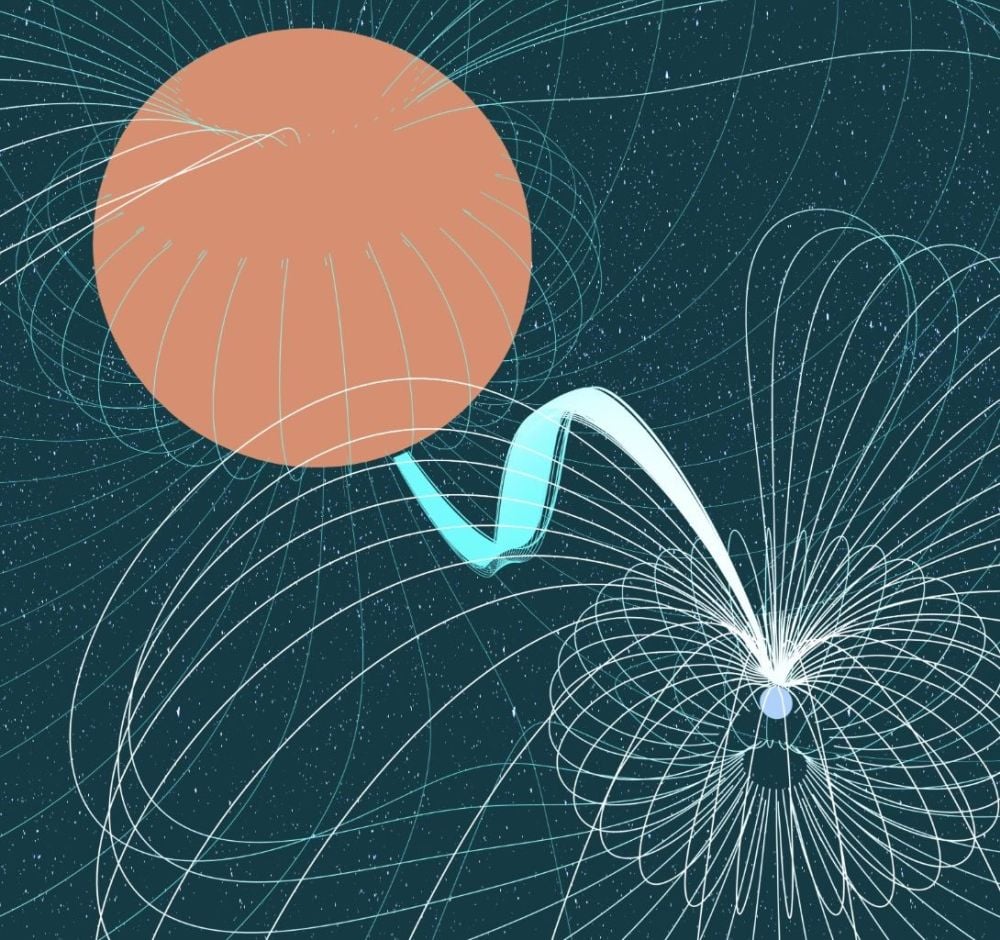
Шинэ судалгаагаар манай галактик дахь нууцлаг радио дохионууд нь хос одны систем дэх цагаан одой одны идэвхтэй үйл ажиллагаатай холбоотой болохыг баталлаа.
Удаан хугацаат радио түр зуурын үзэгдлүүд (LPT) гэгддэг эдгээр дохио нь хэдэн минут эсвэл хэдэн цагийн давтамжтайгаар давтагддаг, өндөр туйлширсан радио долгионы тэсрэлт юм. Nature Astronomy сэтгүүлд нийтлэгдсэн судалгаагаар эрдэмтэд ASKAP J174508.9-505149 буюу J17 хэмээх шинэ эх үүсвэрийг илрүүлж, түүний физик шинж чанарыг тайлбарлажээ. Энэхүү систем нь соронзон чанар өндөртэй цагаан одой од болон түүнийг тойрон эргэх дагуул одноос бүрдэх “катастрофик хувьсагч” (cataclysmic variable) төрлийн хос од болох нь тогтоогдсон байна.
J17 системийн хувьд цагаан одой од нь дагуул одныхоо материалыг өөртөө татаж, улмаар хоёр одны харилцан үйлчлэлцэх соронзон орон нь радио тэсрэлтийг үүсгэдэг байна. Мөн дагуул одны материал цагаан одой одны гадаргуу дээр хуримтлагдаж халах үед рентген туяаны цацраг ялгардаг ажээ. Судлаачид радио болон рентген туяаны дохионууд нь системийн тойрог замын хөдөлгөөнтэй холбоотой боловч нэгэн зэрэг оргил утгад хүрдэггүй нь тэдгээр нь өөр өөр бүсэд үүсдэг болохыг харуулж байна.
Энэхүү нээлт нь олон жилийн турш судлаачдын тааврыг тайлж, LPT-ийн гарал үүслийг ойлгоход чухал ач холбогдолтой “Розетагийн чулуу” болж байна. Судлаачид энэ систем нь соронзон орон ба таталцлын хүч ихтэй нөхцөлд матери хэрхэн төлөвшдөгийг судлах байгалийн лаборатори гэж үзэж байна. Гэсэн хэдий ч эдгээр процесс нь бүх төрлийн LPT-ийн шинж чанарыг бүрэн тайлбарлах эсэхийг тогтоохын тулд цаашид илүү нарийвчилсан загварчлал болон шинэ ажиглалтууд шаардлагатай юм.
Дэлгэрэнгүйг эх сурвалжаас харах
Эх сурвалжийг нээх ↓
Long period radio transients (LPTs) are mysterious signals coming from objects inside our galaxy. They’re highly polarized, coherent radio bursts that repeat regularly, with periods ranging from a few minutes to a few hours. Scientists detected hints of the first LPT in 2005, and now they know of many more of them.
So far, an explanation has lagged behind their detections, but new research has an explanation for at least one of them. The research is titled “Periodic radio and X-ray emission from an accreting white dwarf binary,” and it’s published in Nature Astronomy. The lead author is Kovi Rose, a PhD student from the University of Sydney’s School of Physics and CSIRO.
“Little is known about the physical origins of these systems,” the authors write. “Astronomers have proposed magnetars that rotate slowly and white dwarfs that rapidly orbit with a companion star as potential explanations.”
Recent examples of LPTs support the idea that white dwarfs with a companion are responsible for LPTs. But the actual mechanism that creates them has remained unclear.
In this work, the researchers present the discovery, and explanation, of a new LPT named LPT ASKAP J174508.9-505149. The new LPT, referred to as J17 in this article, has a 1.3 hour orbit, and “exhibits orbitally modulated X-ray emission and radio bursts,” the authors write. “These elliptically polarized radio bursts drift in emission frequency, potentially due to a longer beat period, and turn off for several hours at a time.”
J17’s radio signal switches off for hours at a time, a wrinkle that’s a clue to the mechanism behind the LPT. The pulse frequencies also drift up and down over a longer beat period. “ASKAP J1745-5051 exhibits pulse properties not previously observed in LPTs, providing valuable insights into the progenitor system,” the authors write. J17’s signal is dynamic in other ways, too.
The researchers say that the LPT is coming from a magnetic cataclysmic variable (CV), a binary star where one is a highly magnetized white dwarf, and the other is a donor star.
“For the first time we have pinpointed the origin of these signals, confirming the source to be a ‘cataclysmic variable’, or an accreting white dwarf star,” lead author Rose said in a press release. “Long-period radio transients have puzzled astronomers for years,” Rose added. “We’ve only found about a dozen, and their origins have been unclear. Now, we’ve been able to show that the source for one of these transients comes from a white dwarf actively pulling material from a companion star.”
Binary stars where one is a white dwarf drawing material from a donor star are responsible for Type 1a supernova explosions. In those cases, the white dwarf accumulates so much material from its partner that it eventually explodes, obliterating the star.
But in cataclysmic variables, things play out differently. And while LPTs might seem similar to pulsars, they’re distinctly different.
“The pulsing that we see is not coming from a spin. We think it’s coming from an orbit,” said study co-author David Kaplan, Professor of Physics and Astrophysics at the University of Wisconsin Milwaukee . “In order for (these binary stars) to orbit once every 80 minutes, they have to be both very small and very close together. In fact, they’re probably so small and so close together that some material from one star is spilling out onto the other star, and that gives rise to a particular signature that we saw in some observations that really ties it to this class of cataclysmic variables (which have been widely studied for the past hundred years).”
The CV in this work includes a white dwarf about the size of Earth, but with a mass about the same as the Sun. The companion star is a red dwarf with about 1/10th of the Sun’s mass. The pair orbit very close to one another, completing an orbit in a little more than an hour.
There’s an x-ray component to J17, and that comes from donor star material that gathers on the white dwarf’s surface and heats up, emitting x-rays. But the radio bursts don’t emanate from that. Instead, they’re generated by the stars’ interacting magnetic fields.
“These emissions are all tied to the orbital motion of the system,” Rose said. “But interestingly, the radio and X-ray signals don’t peak at the same time, which tells us they’re being produced in different regions of the system.”
This figure from the research shows some of the signals received from ASKAP J1745−5051. There’s a lot her for non-scientists to decipher, but the main takeaway is that it correlates emissions with phases in the cataclysmic variable. ATCA, MKT, and ASKAP are all radio telescope arrays. The y-axis shows radial velocity, and it’s always zero during phase 2 and phase 4, a clue to the nature of the emissions. Image Credit: Rose et al. 2026. NatAstr.
J17’s intermittent signals and pulses arise from the system’s plasma and magnetic fields. “Varying conditions in the local plasma density and magnetic field interaction may explain the intermittency and unique pulse morphologies in the observed radio pulsations from ASKAP J1745-5051,” the authors write. “Our observations of ASKAP J1745-5051 demonstrate that magnetically driven accretion plays a key role in the generation of emission across the electromagnetic spectrum in magnetic CVs, including coherent radio pulses and variable X-ray emission.”
There have been hints that binary stars are behind LPTs, but this study presents the best evidence yet. The authors say that J17’s modulated radio and x-ray emissions are associated with its orbital period, and that it “clearly establishes that accreting CVs make up at least part of the population of LPTs.”
“Some similar objects had been linked to binary systems before, but this is the first one where we can clearly see both stars and the accretion process in action,” said co-author Tara Murphy, Professor in the University of Sydney’s School of Physics.
J17 can be an important reference point in the study of LPTs, according to the researchers. “This system gives us a way to decode these signals. It could help us determine whether other long-period transients are more like pulsars or like white dwarf systems, acting like a stellar Rosetta stone,” lead author Rose said.
J17 is also important in another way, one that it shares with other high-energy astrophysical objects. “These systems are natural laboratories,” Mr Rose said. “They allow us to test our understanding of how matter behaves in strong magnetic fields and under intense gravitational forces.”
The question now is, can these cataclysmic variables explain the entire class of LPTs, or are their multiple sources?
“Determining if these processes can explain the properties of the entire emerging class of LPTs will require detailed simulations and modelling, as well as the discovery and investigation of new LPTs,” the authors conclude.


