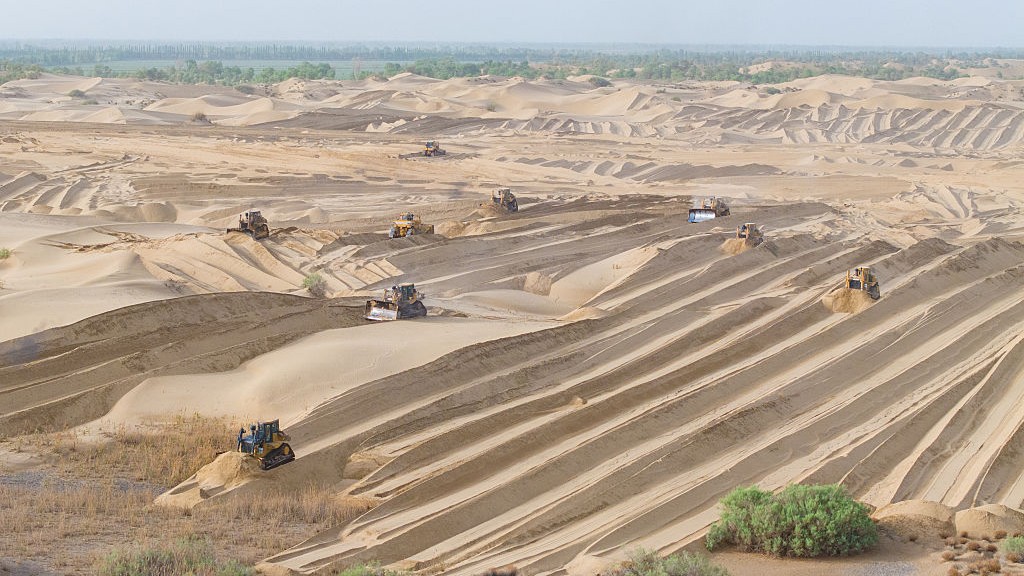
Хятадын баруун хойд хэсэгт олон арван жил хэрэгжүүлсэн ойн төсөл эрс тэс уур амьсгалтай бүс нутгийн нүүрстөрөгчийн эргэлтэд нөлөөлж байгааг шинэ судалгаагаар тогтоожээ.
PNAS сэтгүүлд нийтлэгдсэн судалгаагаар 1978 оноос эхэлсэн “Гурван хойд” хамгаалалтын бүсийн хөтөлбөрийн хүрээнд Такла-Макан цөлийн захын бүсэд тарьсан мод, ургамал нь агаар мандал дахь нүүрстөрөгчийн давхар ислийг (CO2) шингээх үйл явцыг идэвхжүүлж байгааг тогтоосон байна. Сүүлийн 25 жилийн хугацаанд хийсэн хиймэл дагуулын ажиглалт болон газар дээрх хэмжилтүүд нь цөлийн захад фотосинтезийн үйл ажиллагаа эрчимжиж, тус бүс нутаг нүүрстөрөгч шингээгч болж хувирсныг харуулжээ.
Судлаачдын тооцоолсноор, цөлийн захын таримал ой нэг га талбайгаас жилд дунджаар 1.74 тонн нүүрстөрөгчийн давхар ислийг шингээж байна. Ялангуяа долдугаар сараас есдүгээр сар хүртэлх чийглэг улиралд хур тунадасны хэмжээ нэмэгдэхийн хэрээр ургамалжилт сайжирч, агаар дахь нүүрстөрөгчийн давхар ислийн концентраци буурдаг болох нь тогтоогдсон.
Калифорнийн Технологийн институтийн профессор, NASA-гийн Тийрэлтэт хөдөлгөөний лабораторийн эрдэмтэн Юк Л. Юнгийн тэмдэглэснээр, энэхүү төсөл нь хүний оролцоотойгоор эрс тэс хуурай орчинд ч нүүрстөрөгч шингээх боломжтойг харуулж буй загвар юм. Гэсэн хэдий ч цөлийн ихэнх хэсэг нь салхинд нүүдэллэдэг элсэн манхан хэвээр байгаа бөгөөд ойн төслийн үр дүн нь усны менежментээс шууд хамааралтай хэвээр байна.
Цаашид энэхүү экологийн инженерчлэл нь цөлжилтийг бүрэн зогсоож чадах эсэх, мөн гүний усны түвшин моддыг тэтгэхэд хангалттай байх эсэх нь цаг хугацааны явцад тодорхой болох юм. Одоогоор судалгааны үр дүн нь зөвхөн цөлийн захын бүсэд хийгдсэн ойжуулалтын нөлөөг л харуулж байгаа бөгөөд бүхэл цөлийг нүүрстөрөгч шингээгч болгох боломжтой гэсэн таамаглал нь онолын тооцоолол төдий байна.
Дэлгэрэнгүйг эх сурвалжаас харах
↓Эх сурвалжийг нээх ↓
For Decades, tree planting projects surrounding China’s Taklamakan desert have altered the carbon cycle in what is considered one of earth’s most arid regions; a recent scientific investigation demonstrates that plants in this area are increasingly taking up co2 from the atmosphere.
PNAS recently released research findings which demonstrated increased photosynthetic activity and carbon uptake at the periphery of the desert for the last 25 years due to expansion of vegetation into those areas. According to researchers, these results demonstrate that through large scale ecological restoration, an otherwise hyper-arid environment may be turned into a carbon sink (i.e., absorb more co2 from the atmosphere than emit).
Trees Change the Desert’s Edge
Although the majority of the Taklamakan remains a dune field (sand moving due to wind), researchers were unable to determine that all or even the majority of the desert had been vegetated.
The Taklamakan desert is approximately 337,000 km2 located within China’s Xinjiang province and is bounded by mountain ranges that severely limit moisture laden air entering the desert. Over 95% of the desert is comprised of sand dunes that shift due to winds. Due to its arid nature, the desert has long been characterized as biologically barren or nearly so.
However, changes are occurring to this landscape around the periphery. A major ecological engineering project undertaken by the chinese government, the three-north shelterbelt program began in 1978. This massive undertaking was initiated to stem desertification in northern China and consisted of numerous efforts designed to plant trees and other vegetation types in areas being degraded by encroaching sand dunes.
The primary goals of the program were stabilization of soils in threatened areas, protection of agricultural lands and infrastructure from continued loss due to desertification, and reduction of desertification impacts on local economies. However, because of the role plants play in removing atmospheric co2 during photosynthesis, secondary benefits include removal of co2 from the atmosphere.
Their results showed a long-term increase in vegetation and photosynthetic activity along the Taklamakan’s margins. The timing and geographic concentration of those changes corresponded with the development of the shelterbelt program.
A Belt Nearly Five Decades in the Making
China completed a continuous 3,000-kilometer green belt around the Taklamakan in November 2024, ending a 46-year campaign to encircle the desert with vegetation, according to Reuters.
Workers planted the final 100 meters of the belt on the desert’s southern edge. Across the broader shelterbelt program, more than 30 million hectares of trees had been planted by that point.
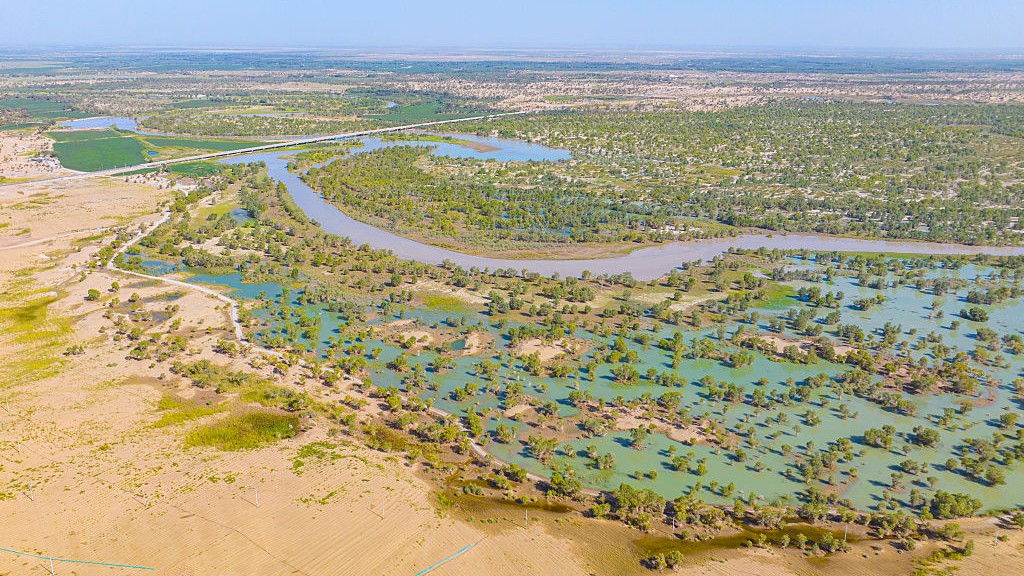
The project has not been free of criticism. Reuters reported that tree survival rates in the arid northwest have sometimes been low, while the program’s effectiveness in reducing sandstorms has also been questioned. Authorities have experimented with different plant species to determine which can survive the region’s difficult conditions.
China has continued planting around the Taklamakan even after completing the continuous belt. Officials said poplar forests on the desert’s northern edge would be restored using diverted flood water, while new forest networks were planned to protect farmland and orchards to the west.
Carbon Uptake Peaks With Rain
The new study found that the carbon effect changes considerably with the seasons.
During the July-to-September wet season, average precipitation reaches about 16.3 millimeters per month, roughly 2.5 times the level during the dry season. That additional moisture increases vegetation cover, greenness and photosynthesis along the desert margins.
Atmospheric carbon dioxide concentrations over the region were about three parts per million lower during the wet season, falling from roughly 416 parts per million in the dry season to about 413 ppm during the wetter months.
The researchers also analyzed net ecosystem exchange, a measure of the balance between carbon dioxide absorbed by an ecosystem and carbon released back into the atmosphere. A negative value indicates that the ecosystem is taking up more carbon than it emits.
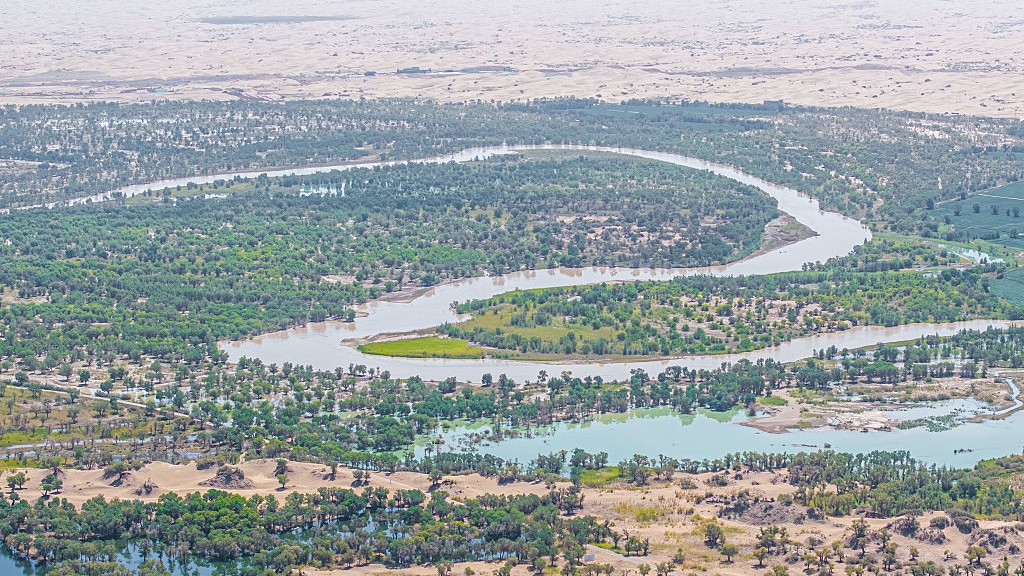
Along the planted green shelterbelt at the desert boundary, the study calculated average annual uptake equivalent to about 1.74 metric tons of carbon dioxide per hectare. The researchers also found a long-term strengthening in carbon uptake alongside expanding vegetation and greater photosynthetic activity.
The study included a much larger theoretical estimate. If vegetation with the same average carbon uptake could be extended across the entire Taklamakan, the researchers calculated that the biosphere could remove about 58.7 million metric tons of carbon dioxide each year.
That number is an extrapolation, not a measurement of how much carbon the current project removes. The study states that the afforestation effort has so far been implemented only along the desert’s rim.
Study co-author Yuk L. Yung, a professor of planetary science at Caltech and senior research scientist at NASA’s Jet Propulsion Laboratory, told Live Science that the results showed human intervention could increase carbon sequestration even in an extreme arid environment. He described the planted rim as a potential model for other desert regions, while acknowledging that the project’s ability to halt desertification remained less certain.
Water Sets a Hard Limit
The Taklamakan findings do not mean that simply planting trees across deserts will reliably create large carbon sinks.
In an environment with extremely low rainfall, water management remains a basic constraint on how much vegetation can survive. The study’s own seasonal results show how closely plant activity and carbon uptake are tied to increases in precipitation.
China’s continued use of diverted flood water to restore vegetation also illustrates how maintaining planted ecosystems can require active management in such dry conditions.
The researchers nevertheless found a measurable biological change along a desert boundary that was once overwhelmingly associated with shifting sand. Satellite observations, ground measurements and carbon models all showed vegetation increasing around the rim, accompanied by stronger photosynthesis and carbon uptake.
Most of the Taklamakan remains desert. What has changed is the thin but extensive zone around its perimeter, where nearly five decades of ecological engineering have created enough persistent vegetation to alter part of the region’s carbon cycle.
Enjoyed this article? Subscribe to our free newsletter for engaging stories, exclusive content, and the latest news.

