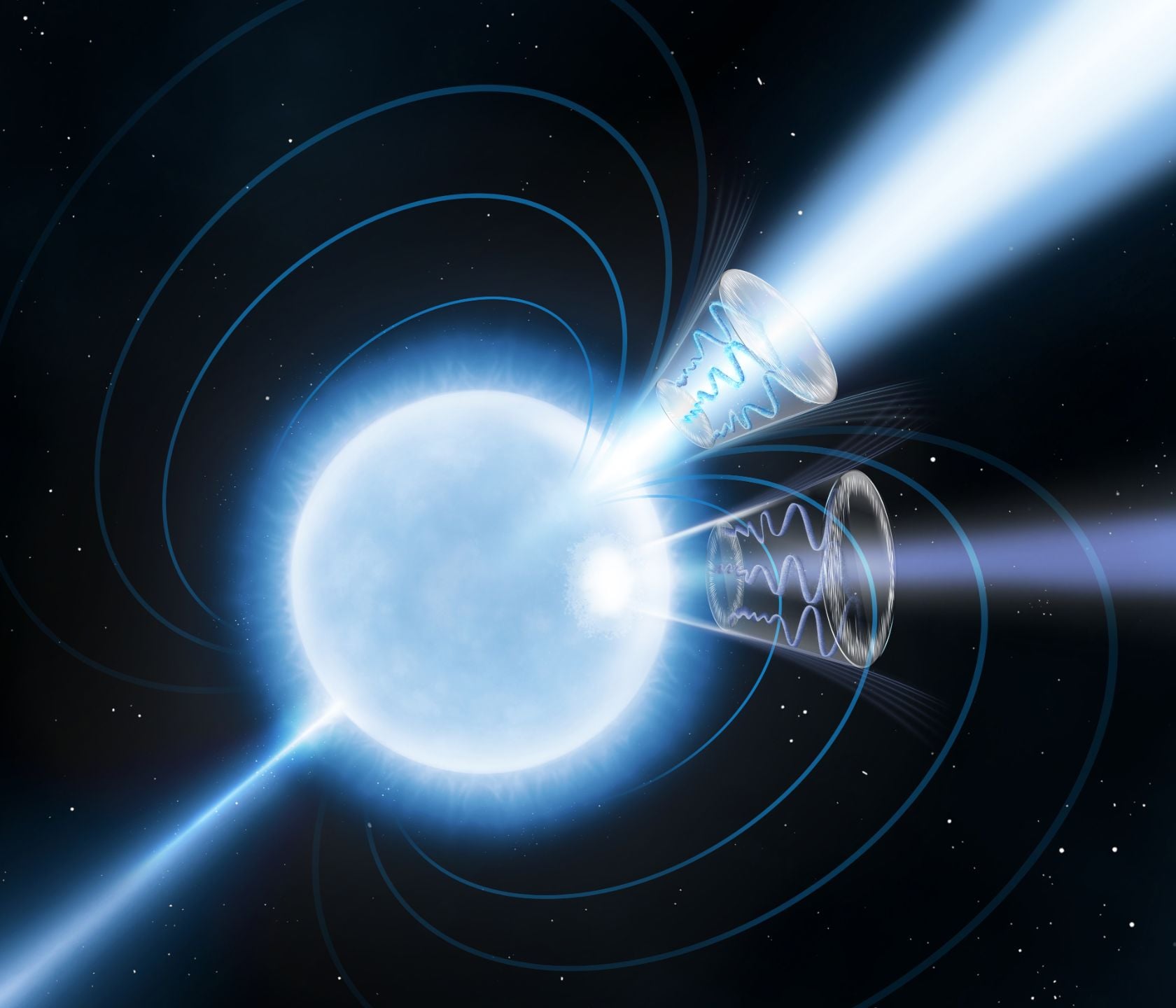
Эрдэмтэд сансрын хамгийн хүчтэй соронзон орон бүхий магнетараас “вакуумын хоёр хугарал” хэмээх квантын эффектийн анхны нотолгоог илрүүлжээ.
Вернер Хайзенбергийн 90 орчим жилийн өмнө дэвшүүлсэн вакуумын хоёр хугарлын онолоор бол хоосон орон зай нь “виртуал бөөмс”-өөр дүүрэн байдаг бөгөөд тэдгээр нь гэрлийн шинж чанарыг өөрчилдөг байна. Гэвч энэхүү үзэгдлийг дэлхий дээрх туршилтын төхөөрөмжүүдээр батлах боломжгүй байсан тул эрдэмтэд сансрын хамгийн эрс тэс орчин болох магнетарт анхаарлаа хандуулжээ. Магнетар нь Дэлхий дээр үүсгэж болох хамгийн хүчтэй соронзон орноос 100 сая дахин илүү хүчтэй соронзон оронтой, квантын физикийн судалгаанд нэн тохиромжтой байгалийн лаборатори юм.
Рэйчел Э. Стюартаар удирдуулсан олон улсын эрдэмтдийн баг 1E 1547.0–5408 (1E1547) хэмээх магнетарт судалгаа хийжээ. Тэд CSIRO-ийн Murriyang радио дуран болон NASA-ийн IXPE, NICER сансрын дурангуудын өгөгдлийг нэгтгэн, магнетараас ялгарах рентген болон радио долгионы туйлшралын төлөвийг хянасан байна. Судалгаагаар тус магнетараас гарч буй рентген туяаны туйлшрал нь соронзон оронтой нь нягт холбоотой болохыг тогтоосон нь вакуумын хоёр хугарал явагдаж буйг илтгэх гол шинж тэмдэг гэж үзэж байна.
Эрдэмтэн Маркус Лоуэр тэргүүтэй багийнхан энэхүү үр дүн нь Хайзенбергийн таамаглалыг батлах чухал алхам болсныг тэмдэглэв. Гэсэн хэдий ч энэхүү үзэгдлийг бусад үйл явцаас ялгаж салгахын тулд нэмэлт өгөгдөл цуглуулж, компьютерийн симуляцийг улам сайжруулах шаардлагатай байгаа юм. Цаашид энэхүү нээлт нь квантын физикийн онол сансрын эрс тэс нөхцөлд хэрхэн хэрэгжиж байгааг ойлгоход шинэ боломж нээж өгөх юм.
Дэлгэрэнгүйг эх сурвалжаас харах
Эх сурвалжийг нээх ↓
The principle of vacuum birefringence, a quantum effect first predicted almost 90 years ago by Werner Heisenberg, states that empty space can alter the behavior of light. As Heisenberg theorized, even a perfect vacuum should be teeming with “virtual particles” that rapidly pop in and out of existence. Despite everything scientists have learned from nuclear research since the 1930s and decades of experiments with particle accelerators, the effect remained unconfirmed until now.
But in keeping with the idea that the Universe contains the most powerful and effective laboratories, a team of scientists may have finally confirmed this theory. Using the properties of a magnetar – a rare type of neutron star with the strongest magnetic fields in the Universe – the team uncovered what could very well be the first evidence of vacuum birefringence. Their findings could lead to new opportunities for scientists engaged in the exploration of the quantum realm.
The study team included researchers from the Center for Space Sciences and Technology, the South African Radio Astronomy Observatory (SARAO), the Los Alamos National Laboratory, NASA’s Marshall Space Flight Center, the Center for Research and Exploration in Space Science & Technology (CRESST) and the Astrophysics Science Division at NASA’s Goddard Space Flight Center, and universities worldwide. Rachael E. Stewart, a Graduate Student of Physics at George Washington University, led the study, which recently appeared in Nature.
Scientists have predicted that, in the presence of an extremely powerful magnetic field, a sea of Heisenberg’s virtual particles would refract light in specific ways to produce VB. However, the only magnetic fields powerful enough to achieve this quantum effect (to the point it would be visible) are found in the rare magnetar. Dr. Marcus Lower, an Australian Research Council DECRA Fellow at the Center for Astrophysics and Supercomputing (CAS) at the Swinburne University of Technology.
The only magnetic fields powerful enough to test Heisenberg’s theory of vacuum birefringence belong to magnetars. Credit: NASA’s Goddard Space Flight Center/S. Wiessinger
“Detecting vacuum birefringence requires a magnetic field that is over 100 million times stronger than any we’ve ever made on Earth,” said Lower. “Thankfully, nature has provided us with magnetars, which are the perfect cosmic laboratories to go looking for this effect.” Dr. Lower led the observations of magnetar 1E 1547.0–5408 (1E1547) made with CSIRO’s Murriyang (aka. Parkes) radio telescope, followed by an analysis using Swinburne University’s Ngarrgu Tindebeek supercomputer
These were combined with data from NASA’s Imaging X-ray Polarimetry Explorer (IXPE) and the NICER X-ray telescope on the International Space Station. While monitoring 1E1547’s radio emissions, the team tracked the direction of their oscillations (their “polarization state”) as the magnetar rotated. This revealed that its magnetic and rotational axes were nearly aligned and that it is visible almost pole-on. This magnetic and viewing geometry makes 1E 1547 ideal to look for vacuum birefringence.
The team found that X-rays produced by the magnetar (and detected by IXPE) had extremely high polarization, and that the polarization direction was locked to 1E 1547’s magnetic field, the same as its radio waves. These are both considered indications that vacuum birefringence is taking place around the magnetar. Said Lower:
Because of the magnetic field’s strength, Heisenberg’s virtual particles become aligned with the direction the field is pointing. By carefully tracking the direction the radio waves and X-rays oscillate as the magnetar rotates, the team found that the alignment of 1E1547’s magnetic and rotational poles was ideal for detecting vacuum birefringence. With these future data on hand and our updated simulations, we may finally be able to complete the quest started by Heisenberg nearly 90 years ago.
These findings could soon benefit from additional data and improved computer simulations that will help differentiate the indications of vacuum birefringence from other processes. If confirmed, the team’s findings will pave the way for understanding how our theories of quantum physics work in one of the most extreme environments in our Universe.
Further Reading: Swinburne University, Nature


