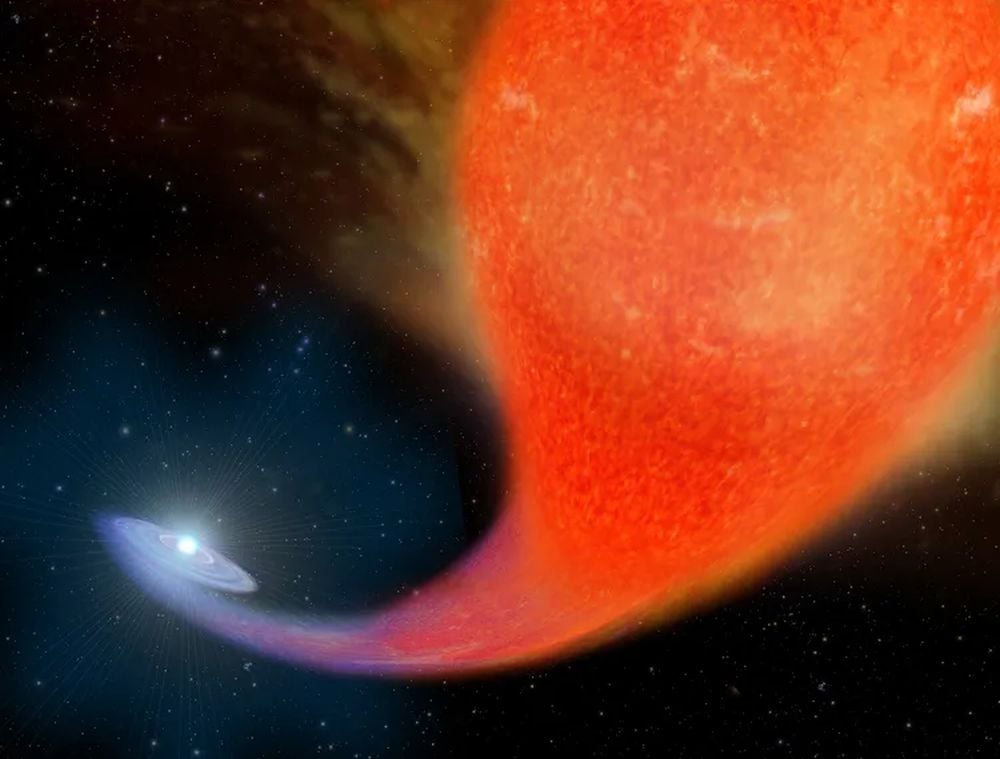
Эрдэмтэд оддын гадаргуу дээрх химийн ул мөрийг шинжлэх замаар хос оддын системээс масс хүлээн авсан ганцаарчилсан оддыг таних шинэ аргыг боловсруулжээ.
Ихэнх масс ихтэй одд хос системийн бүрэлдэхүүнд төрдөг бөгөөд хувьслын явцад тэдгээрийн хооронд масс шилжих эсвэл нэгдэх үйл явц түгээмэл тохиолддог. Гэвч энэхүү харилцан үйлчлэлийн дараа үлдсэн одд нь ганцаарчилсан мэт харагддаг тул тэдний өнгөрсөн түүхийг тогтооход бэрхшээлтэй байдаг. Макс Планкийн Астрофизикийн хүрээлэнгийн судлаачид Харим Жин болон Норберт Лангер нар одын гадаргуу дахь гели, нүүрстөрөгч, азот, хүчилтөрөгчийн харьцааг шинжлэх замаар энэхүү түүхийг сэргээн тогтоох аргыг Nature Astronomy сэтгүүлд нийтлүүлжээ.
Судлаачид одын дотоод бүтэц ба гадаргуугийн химийн найрлага ялгаатай байдгийг ашиглан масс шилжилтийн үед үүсэх өвөрмөц хэв шинжийг тодорхойлсон байна. Масс хүлээн авагч оддын гадаргуу дээр донор одны цөмөөс ирсэн материал хуримтлагддаг тул CNO (нүүрстөрөгч-азот-хүчилтөрөгч) диаграм дээр бусад оддоос ялгардаг аж. Энэхүү арга нь оддын масс, шилжсэн материалын хэмжээ болон үйл явцын үр ашгийг нарийвчлан гаргах боломжийг олгож байна.
Энэхүү шинэ аргыг ашиглан 1050 гэрлийн жилийн зайд орших Gamma Columbae одыг судалснаар, уг од нь өмнө нь таамаглаж байсанчлан бүрхүүлээ алдсан од бус, харин өөр одноос масс хүлээн авсан “масс хүлээн авагч” болохыг тогтоожээ. Мөн SN 1987A супернова дэлбэрэлтийн түүхийг сэргээн судалснаар нэгдэх үйл явцын үеэр ялгарсан массын хэмжээг нарийвчлан тодорхойлох боломжтой болсон байна. Ирээдүйд WEAVE болон 4MOST зэрэг томоохон судалгаануудын мэдээлэлд уг аргыг хэрэглэснээр оддын хувьсал ба галактикийн хөгжилд масс шилжилтийн үзүүлэх нөлөөг илүү гүнзгий ойлгох боломж бүрдэнэ.
Дэлгэрэнгүйг эх сурвалжаас харах
Эх сурвалжийг нээх ↓
Mass transfer between stars isn’t rare. Most stars, including massive ones, are born in binary pairs, and this situation is ripe for mass transfer between the stellar siblings. Since stars expand as they age and evolve, it makes interactions between stellar pairs almost certain.
Mass transfer can have a profound effect on stars. They can merge, or even trigger a supernova explosion. The surviving star can look like it was solitary forever, with no clear indication that mass transfer had occurred. No clear indication that their evolution is forever altered.
But researchers from the Max Planck Institutes have developed a technique for identifying lone stars that, at one time in their past, gained mass from a long-gone partner. The key is in a star’s metallicity. But not the overall metallicity; just the abundance of some elements near the star’s surface.
This new method and first results are in a paper titled “Chemical fingerprints of binary mass transfer in massive stars.” It’s published in Nature Astronomy, and the authors are Harim Jin and Norbert Langer. Lead author Jin is from the Max Planck Institute for Astrophysics and Langer is from the Max-Planck-Institute for Radioastronomy.
“It’s like finding a fingerprint at a crime scene – once you know what to look for, you can reconstruct the entire sequence of events, even if the original suspects are long gone.” – Harim Jin, Max Planck Institute for Astrophysics
“The majority of massive stars are born in close binary systems,” the researchers explain. “As stars expand when they age, mass transfer or even a merger with their companion is inevitable. However, most binary interaction products appear as single stars, such that the main evidence of their exciting past is lost.”
About 70% of massive stars have a companion close enough for mass transfer to be inevitable. But mass transfer happens quickly, taking place in less than 0.1% of a star’s lifetime. There’s very little chance of observing it. “At the same time, it takes far too long for hydrodynamic models to assess it entirely,” Jin and Langer write.
Astrophysicists want to know more about the mass transfer process, including how stable it is. They also want to know how efficient it is, meaning what percentage of mass stripped from the donor star actually accretes onto the primary star.
“Binary mass transfer changes the evolution and fate of the involved stars drastically, even often leading to a merger of both components, or changing whether and how the stars explode, and what final remnants they produce,” the authors write. These changes affect our overall understanding of stellar behaviour, including the feedback from massive stars, which shapes the evolution of galaxies.
In this work, the researchers examined what they call a “comprehensive grid of detailed massive binary evolution models.” They uncovered patterns or trends in this grid of models that focuses on the surface abundance of elements like helium, carbon, nitrogen, and oxygen.
The basic idea behind this is that the elemental composition of stars is different on the inside than on the surface. A star’s outer layers are more pristine, while its core’s composition is shaped by fusion. The core is richer in nitrogen and helium, while being depleted of carbon and oxygen.
When mass transfer happens, the accreting star receives material from the donor star’s core and from its surface. These accreted materials gather solely on the accretor’s surface, though, and that makes them observable. The authors say that stars that have received mass in this way follow a predictable pattern on a CNO abundance diagram.
The CNO diagram plots two ratios: nitrogen to carbon, and nitrogen to oxygen. On the diagram, the mass gainers stand out from donors and solitary stars.
This figure is packed with information, but the pertinent part is where mass gainers appear. Take note of the appearance of the star Gamma Columbae (γ Columbae) near the upper left. This unusual star has puzzled astronomers, but this new method has revealed its true nature as a former mass gainer. Image Credit: Jin and Langer 2026. NatAstr.
“We’ve found that the surface chemistry of massive stars is not just a byproduct of their evolution – it’s a record of their story,” lead author Jin said in a press release. “For the first time, we can read that story in detail, even when the stars appear alone in the sky.”
Their method lets them reconstruct stellar history, including both the amount of material accreted by the gainer, and the composition of that material. That, in turn, lets them find out the masses of both stars and how efficiently material was accreted.
“This method gives us a direct window into the hidden lives of stars,” Jin added. “It’s like finding a fingerprint at a crime scene – once you know what to look for, you can reconstruct the entire sequence of events, even if the original suspects are long gone.”
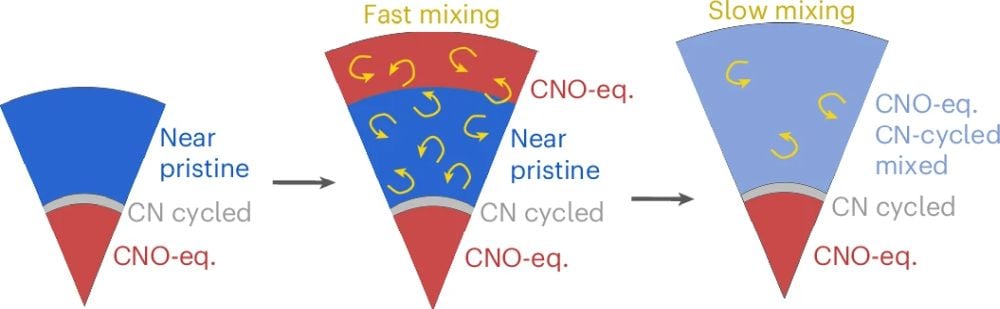 This figure shows three stages of the mass transfer process in the accreting star. Left is before mass accretion, middle is immediately after mass accretion but just before fast mixing, and right is during slow mixing in the subsequent nuclear-timescale evolution. The radial direction of each slice represents the encompassed mass. Image Credit: Jin and Langer 2026. NatAstr.
The researchers have already used this method to de-mystify a star named Gamma Columbae (γ Columbae.) It’s about 1050 light years away, has about six solar masses, and is about 24 million years old. Astronomers thought that γ Columbae is the remnant core of a star that had its outer layers stripped away.
But that’s not the case, according to Jin and Langer. “For γ Columbae, suggested to be an envelope-stripped star, we show that it is a mass gainer instead, whose companion star probably formed a stripped-envelope supernova,” the authors write. The star’s surface chemistry shows a high nitrogen-to-carbon ratio, a moderate nitrogen-to-oxygen ratio, and helium enrichment. This is exactly what the team’s work says the star should have if it’s a mass gainer.
The researchers say that γ Columbae is about 17% stripped matter. “… we find that, based on its CNO fingerprint, its envelope material shows nearly undiluted CN-equilibrium abundances,” they write.
But the method’s power extends beyond the mass gainer to the donor star as well. If γ Columbae has six solar masses, and it accreted 0.8 solar masses, then its initial mass can’t have exceeded 5.2 solar masses. This means that the donor star must have had 0.8 solar masses in its H/He-gradient region. This region is a chemical boundary zone that marks a transition between a star’s hydrogen-depleted, helium-rich interior to a pristine hydrogen exterior.
According to models, this means that the donor star can’t have had a mass less than 14 solar masses.
The results also shed light on other massive stars like supergiant stars and runaway stars. It also extends to supernovae, and the researchers examined one particular supernova in their work.
SN 1987A exploded in the Large Magellanic Cloud as a Type II supernova. It’s a well-studied SN, the first one that was exposed to serious astronomical study. A long-standing consensus is that it was the product of a merger.
“We can now confidently reconstruct the masses of both stars before the merger and demonstrate that a significant amount of mass was ejected during the merger process,” explained Langer.
Understanding mass transfer involving massive stars in binary relationships will plug some holes in our understanding of not only stars, but how they shape the galaxies they reside in. A pair of large-scale surveys—WEAVE and 4MOST—will deliver accurate data on thousands of massive stars.
By using this method to understand these stars, a whole new picture of how mass transfer shapes stars and galaxies will begin to emerge.


