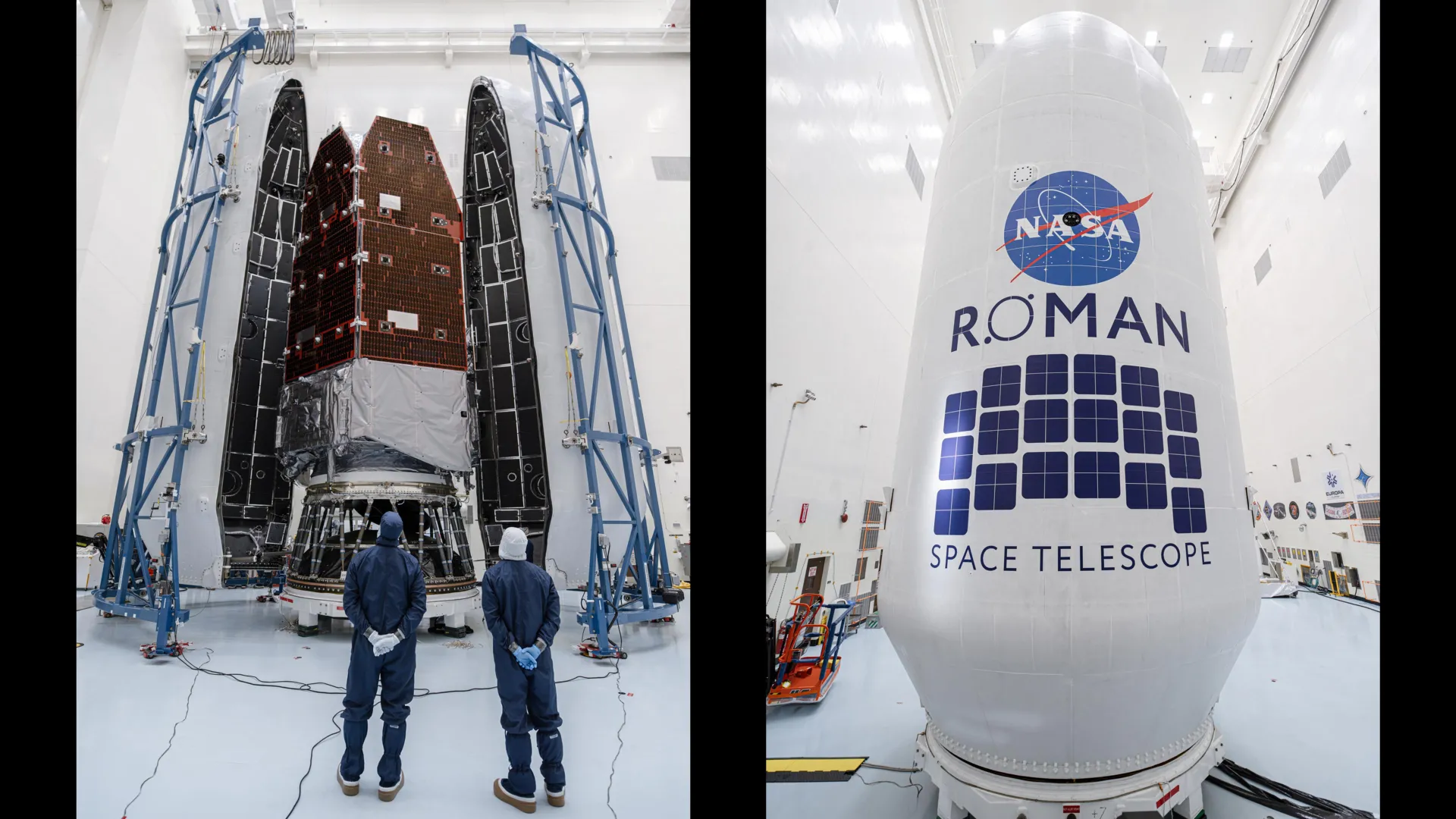
NASA-гийн шинэ дуран авай нь олон мянган экзопланетийг илрүүлж, орчлон ертөнцийн тэлэлтийн нууцыг тайлахад хувь нэмэр оруулах юм.
NASA-гийн Нэнси Грэйс Романы нэрэмжит сансрын дуран авайг (Nancy Grace Roman Space Telescope) SpaceX компанийн Falcon Heavy пуужингийн хамгаалалтын бүрхүүлд байрлуулснаар хөөргөхөд бэлэн боллоо. Флорида муж дахь Кеннедийн нэрэмжит сансрын төвд хийгдсэн энэхүү алхам нь дуран авайг хөөргөх үеийн хүчтэй дууны долгион, агаарын даралт болон халалтаас хамгаалах чухал үе шат юм. Пуужин сансарт гарсны дараа хамгаалалтын бүрхүүл салж унах бөгөөд дуран авай нь Нар-Дэлхийн Лагранжийн 2-р цэг (L2) рүү чиглэнэ.
Уг дуран авайг наймдугаар сарын 30-ны өглөөний 07:26 цагаас өмнө хөөргөхөөр төлөвлөж байна. SpaceX компани пуужингийн хамгаалалтын бүрхүүлийн хоёр хэсгийг эх дэлхий дээр буцаан авч, дахин ашиглахаар бэлтгэж байна. L2 цэгт байрлах нь дуран авайд орчлон ертөнцийг тасралтгүй, тогтвортой ажиглах таатай нөхцөлийг бүрдүүлэх юм.
Романы нэрэмжит дуран авай нь манай нарны аймгаас гаднах олон мянган экзопланетийг илрүүлэх зорилготой. Энэхүү өргөн хүрээний судалгаа нь өөр өөр төрлийн гаригийн системүүд хэр түгээмэл болохыг тогтооход туслах юм.
Түүнчлэн, орчин үеийн сансар судлалын хамгийн том нууц болох харанхуй матер болон харанхуй энергийн шинж чанарыг судлах болно. Харанхуй матер нь галактикуудын бүтцийг бүрдүүлдэг бол харанхуй энерги нь орчлон ертөнцийн тэлэлтийг хурдасгагч хүчин зүйл гэж үздэг. Энэхүү судалгаа нь орчлон ертөнц хэрхэн хувьсан өөрчлөгдөж, тэлэлт нь яагаад хурдассан болохыг ойлгоход чухал ач холбогдолтой юм.
Дэлгэрэнгүйг эх сурвалжаас харах
↓Эх сурвалжийг нээх ↓
NASA’s Nancy Grace Roman Space Telescope is now one major step closer to liftoff. On Aug. 21, teams enclosed the observatory inside the protective fairing of its SpaceX Falcon Heavy rocket at the Payload Hazardous Servicing Facility at NASA’s Kennedy Space Center in Florida.
The fairing is the large shell that surrounds a spacecraft at the top of a rocket. Standing 43 feet tall, it protects Roman while the observatory is on the ground and during the most violent early stages of launch. Together with specialized ground support equipment, the fairing also keeps the telescope in a controlled environment as teams move it between facilities.
A Protective Shell for the Ride to Space
Launch exposes spacecraft to extreme conditions. As Falcon Heavy accelerates through Earth’s atmosphere, Roman will experience powerful sound waves, aerodynamic pressure, and significant heating. The fairing is designed to shield the observatory from those stresses.
Once the rocket climbs high enough that the surrounding atmosphere is no longer a threat, the fairing will no longer be needed. A few minutes after liftoff, its two halves will separate and fall away, allowing Roman to continue its journey into space. SpaceX plans to recover both fairing sections after they return to Earth.
Roman will ultimately travel toward Sun-Earth Lagrange point 2 (L2), a location in space where the gravitational influence of the Sun and Earth helps spacecraft maintain a relatively stable position. This region is especially useful for powerful space observatories because it provides a favorable environment for continuously observing the universe.
Final Preparations for Falcon Heavy
Before launch, teams will transport the encapsulated Roman observatory to SpaceX’s hangar at Launch Pad 39A. There, the payload will be attached to the Falcon Heavy rocket.
The fully assembled vehicle will then be moved to the launch pad at Launch Complex 39A. NASA and SpaceX are targeting no earlier than 7:26 a.m. EDT Sunday, Aug. 30, for liftoff.
Thousands of New Worlds Could Be Waiting
Once Roman begins science operations, researchers expect it to discover thousands of exoplanets, which are planets orbiting stars beyond our solar system. Studying such a large population could help astronomers determine how common different types of planetary systems are and whether some distant worlds resemble planets closer to home.
Roman will also investigate two of the biggest mysteries in modern cosmology: dark matter and dark energy. Dark matter cannot be seen directly, but its gravity appears to shape galaxies and large cosmic structures. Dark energy is the name scientists use for whatever is driving the universe to expand at an accelerating rate.
By surveying huge areas of the sky and tracking how matter and galaxies are distributed across the cosmos, Roman could give researchers new clues about both phenomena. Its observations may ultimately help scientists better understand how the universe evolved and why its expansion has sped up over time.


Ямар нэгэн шинэ экзопланетийн олдворыг байнга л хүлээдэг шүү, энэ Roman сансрын дуран ямар шинэ нээлтүүд хийх бол гэж их сонирхол татаж байна. Орчлон ертөнцийн нууц илүү их илрэх шиг байна, та ямар тийм нээлтийг хамгийн их хүлээж байна вэ?