Номхон далайн Курил-Камчаткийн хотгорын 6000 гаруй метрийн гүнээс олдсон өндгөн бүрхүүлүүд нь далайн гүний нөхцөлд хавтгай хорхой үрждэгийг баталлаа
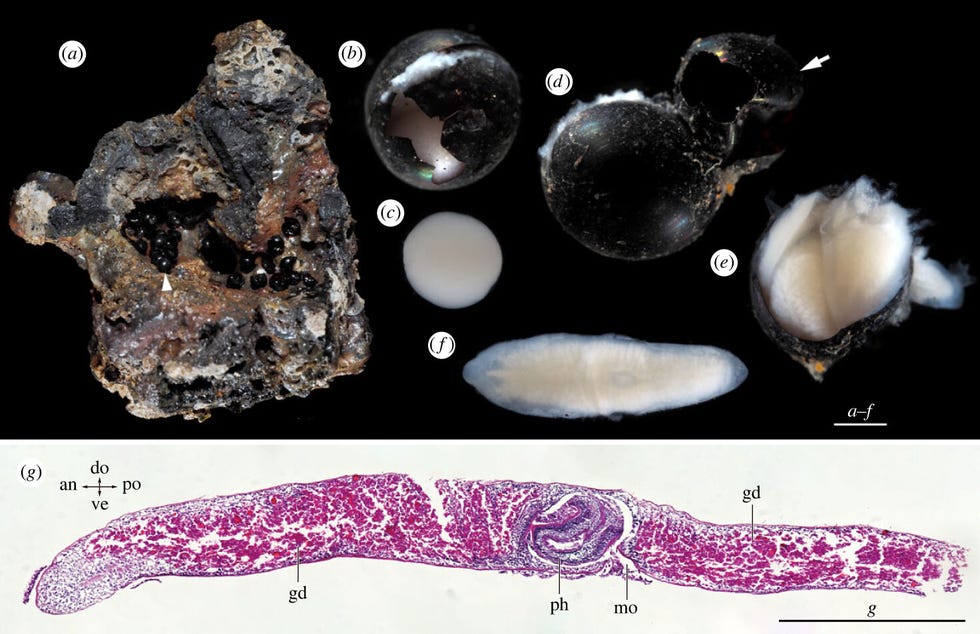
Судлаачид Номхон далайн баруун хойд хэсгийн далайн ёроолоос 6176-6200 метрийн гүнээс хар өнгийн бөмбөлөг хэлбэрийн бүрхүүлүүдийг олжээ. Хоккайдогийн их сургуулийн судлаач Кэйичи Какуй болон Аой Цүюки нарын удирдсан баг 2023 оны есдүгээр сарын 21-нд Hakuho-maru судалгааны хөлөг онгоцны тусламжтайгаар эдгээр олдворыг цуглуулсан байна. “Biology Letters” сэтгүүлд нийтлэгдсэн уг судалгаагаар, эвдэрч гэмтсэн олон бүрхүүлээс гадна дөрвөн бүрэн бүтэн бүрхүүлийг нарийвчлан судалж, дотроос нь хавтгай хорхойн үр хөврөлийг илрүүлжээ.
Судлаачид ДНХ-ийн шинжилгээний тусламжтайгаар эдгээр амьтдыг Tricladida багт хамаарах Maricola бүлгийн хавтгай хорхой болохыг тогтоов. Бүрхүүл тус бүр 3.1-3.3 миллиметр хэмжээтэй бөгөөд дотроо гурваас долоон үр хөврөлтэй байсан нь эдгээр амьтан далайн маш гүн хэсэгт ч үржих чадвартайг харуулж байна. Өмнө нь хавтгай хорхойг хамгийн ихдээ 3232 метрийн гүнээс илрүүлж байсан бөгөөд энэхүү олдвор нь шинэ дээд амжилт тогтоож байна.
Далайн гүний эрс тэс нөхцөл, өндөр даралт, бүрэн харанхуйд амьдарч буй эдгээр хорхойн үр хөврөл нь далайн эрэг орчмын хавтгай хорхойн хөгжлийн үе шаттай ижил төстэй байгаа нь судлаачдыг гайхшруулжээ. Иймээс эдгээр амьтан далайн гүн дэх амьдралд дасан зохицохдоо хөгжлийн үндсэн зарчмаа өөрчлөхөөс илүүтэй физиологи, экологийн шинж чанараа өөрчилсөн байх магадлалтай гэж үзэж байна. Судлаачид далайн ёроолын чулуурхаг хэсгүүд нь эдгээр амьтдад өндгөө нааж үржих таатай нөхцөлийг бүрдүүлдэг гэж таамаглаж байна.
Дэлгэрэнгүйг эх сурвалжаас харах
↓Эх сурвалжийг нээх ↓
At nearly 4 miles below the Pacific, even basic facts about animal life are difficult to establish. The seafloor is sampled rarely, and fragile animals may never survive the trip to the surface.
Now, direct evidence has come from a handful of black spherical capsules attached to rocks, showing that free-living flatworms reproduce at more than 6,000 meters deep. In a paper published in Biology Letters, researchers described cocoons recovered from the abyssal slope of the Kuril-Kamchatka Trench in the northwestern Pacific, at depths of 6,176 to 6,200 meters.
Against that background, marine biologist Sylvia Earle told EL PAÍS that “we know the surface of Mars better than our ocean floors.” Her point was broader than these worms, but it captures the difficulty researchers face when studying animals living thousands of meters below the surface.
Four Capsules Survived the Trip
At first, most of the capsules were already damaged. Researchers found many dark spherical bodies on rock fragments, but most had been torn open and were empty. Only four intact cocoons were available for close examination.
On Sept. 21, 2023, the rocks were collected during a cruise of the research vessel Hakuho-maru. According to the peer-reviewed account, researchers used a beam trawl to recover the two rock fragments carrying the capsules. That detail matters because some later reports described the samples as having been retrieved by a remotely operated vehicle, an account that does not match the methods section of the paper.
At Hokkaido University, invertebrate researcher Keiichi Kakui, who helped examine the cocoons and embryos, did not initially recognize the objects. He told IFLScience, “I thought they may be protists or something.” Then he opened one: “I cut one of them, and a milky liquid-like thing leaked from it,” Kakui said.
Inside were pale, fragile flatworms.
Working with co-author Aoi Tsuyuki, Kakui found that, where measurements were available, the capsules measured about 3.1 to 3.3 millimeters and each held three to seven embryos; while some embryos were still roughly spherical, others were already shaped like worms, forms the researchers interpreted as earlier and later developmental stages.
DNA Narrowed the Identity
To work out what the animals were, the team extracted DNA from two specimens, one spherical and one worm-shaped. They compared sequences from genes commonly used to reconstruct evolutionary relationships and also prepared one specimen as microscopic sections just 7 micrometers thick.
In the genetic analysis, the worms fell within Maricola, a small group within the flatworm order Tricladida. The paper notes that Maricola contains about 80 described species and that nearly all comparable members represented in genetic databases came from freshwater, brackish or shallow marine habitats. From that pattern, the researchers suggested that the lineage may have expanded from coastal waters into the abyss.

Using DNA, the team also connected the different-looking embryos. The sequences showed only minor variation consistent with members of the same species, supporting the conclusion that the spherical and worm-shaped specimens represented different points in development rather than different kinds of animal. The authors concluded that at least two adults had laid them. On the same rock, genetically distinct individuals appeared among the cocoons.
The Previous Record Was Far Shallower
Before the new specimens were analyzed, the deepest certain record cited for a free-living flatworm was Oligocladus voightae, collected at 3,232 meters. That’s a long way down. The species was described in a 2006 Zootaxa paper on deep-sea polyclad flatworms from the North Pacific.
Although researchers had reported a possible flatworm from sunken wood at more than 5,200 meters, that record was uncertain because the animal itself was not firmly established as a flatworm and the wood could have carried an organism downward after sinking.
Cocoons fixed to rocks at abyssal depth provide stronger evidence that the newly examined worms were actually reproducing there.
An Ordinary Start in Extreme Water
More unexpectedly, the embryos themselves showed “no obvious differences” from developmental stages already known in other triclads, the authors wrote, despite living under enormous pressure in permanent darkness.
From that comparison, Kakui and Tsuyuki proposed that adapting to the abyss may have involved physiological or ecological changes more than fundamental changes to early development. Their shallow-water relatives also enclose embryos in capsules attached to hard surfaces, and the deep-sea specimens appear to follow much the same basic plan.
As the sampling gear operated, video showed a muddy seabed scattered with rocks and gravel. The researchers suggested those hard surfaces could provide places for the flatworms to attach their cocoons, including the rock fragment that returned to the surface carrying seven late-stage embryos.
The next clues are likely to arrive the same way: attached to whatever researchers manage to bring back from the abyss.
Enjoyed this article? Subscribe to our free newsletter for engaging stories, exclusive content, and the latest news.

