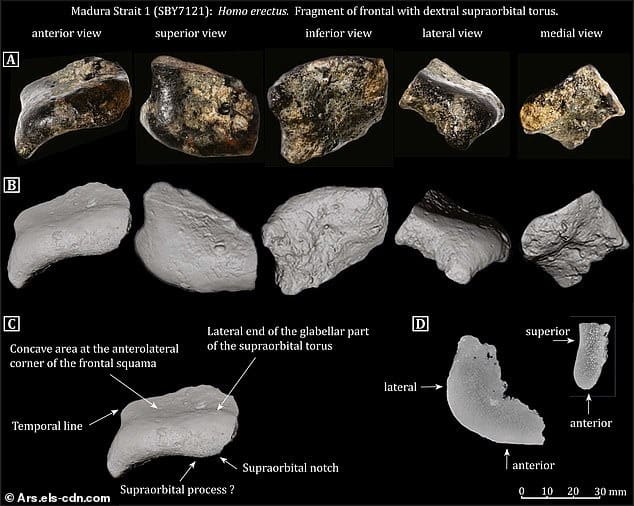
Судлаачид Индонезийн Мадура хоолойн гүнээс “Homo erectus”-ийн гавлын ясны хэлтэрхий болон эртний амьтдын чулуужсан олдворуудыг илрүүлжээ.
Индонезийн Гресик хотын ойролцоох тэнгисийн ёроолоос элс соруулах явцад олдсон энэхүү 6,000 гаруй сээр нуруутан амьтны үлдэгдлийг Лейдений их сургуулийн археологич Харолд Бергхуис тэргүүтэй баг судалжээ. Олдворуудын дунд заан, хирс, усны үхэр, Комодо луу зэрэг 36 төрлийн амьтны зүйл багтаж байгаа нь тухайн бүс нутагт 140,000 жилийн тэртээ өвсөрхөг тал, гол мөрөн бүхий хуурай газар байсныг гэрчилж байна. Гэрэлд мэдрэмтгий он цаг тогтоох (OSL) аргыг ашиглан хийсэн шинжилгээгээр эдгээр олдворыг 140,000 орчим жилийн өмнөх үед хамаарна гэж тогтоожээ.

Судлаачид яст мэлхий болон том хөхтөн амьтдын ясан дээрх зүсэлтийн ул мөрийг үндэслэн “Homo erectus” нь ан агнуур хийдэг байсан байж болзошгүй гэсэн таамаглал дэвшүүлж байна. Ялангуяа олдоц дахь амьтдын насны бүтэц нь санамсаргүй сэг зэмээр хооллохоос илүүтэйгээр сонгон агнадаг байсныг харуулж буй боловч энэ нь одоогоор батлагдаагүй таамаг хэвээр байна. Судлаачдын үзэж буйгаар энэхүү зан үйл нь Азийн эх газрын хойд хэсгийн бусад хүн төрөлхтний бүлгүүдтэй харилцаа холбоотой байсны илрэл байж болох юм.

Энэхүү нээлт нь “Homo erectus”-ийн тархацын хүрээг өмнө нь тогтоогдсон бүсээс илүү өргөн байсныг харуулж байна. Тухайн үед далайн түвшин одоогийнхоос 100 орчим метрээр доош байсан тул Ява арал нь Зүүн Өмнөд Азийн эх газартай илүү нягт холбогдож, “Сундаланд”-ын нэг хэсэг болж байжээ. Олдсон хүн төрөлхтний үлдэгдэл нь Ява арлын хожуу үеийн “Homo erectus”-ийн популяцитай дүрс хэлбэрийн хувьд төстэй байна.

Одоогийн байдлаар олдсон яснуудыг Бандунг хотын Геологийн музейд хадгалж байна. Археологийн энэхүү судалгаа нь тэнгисийн ёроолд дарагдсан эртний голын хөндийнүүд болон тал нутгууд нь хүний түүх, нүүдлийн үйл явцыг судлах өргөн цар хүрээтэй талбар болохыг нотолж байна.

Дэлгэрэнгүйг эх сурвалжаас харах
↓Эх сурвалжийг нээх ↓
The Indonesian archipelago’s waterways are now a boundary separating many of the country’s landmasses. However, this was not always the case. Approximately 140,000 years ago, the area off northern eastern Java which is today beneath the sea, had dried up and the rivers flowed across the area where humans then lived and also had large mammals.
Human skull fragments have been discovered under the Madura Strait from sediment. These discoveries reveal evidence that Homo Erectus existed on that lost landscape. Thousands of animal fossils from an ancient river system, near today’s city of Surabaya, were found with these fossilized skulls. This pushes the known range of late Javanese Homo Erectus further than previously established at the island’s most well-known fossil sites.
Published in Quaternary Environments and Humans, the research builds upon several years of geological/fossil analysis. Part of those analyses were led by Leiden University archaeologist Harold Berghuis who has reconstructed the original landscape, and interpreted the fossil assemblage.
A River Valley Beneath the Sea
During marine sand dredging in 2014 and 2015, fossil-rich sediment was brought up from the seabed as part of a land reclamation project near Gresik rather than through a conventional archaeological excavation. Researchers eventually examined more than 6,000 vertebrate fossils from the material.
Across the assemblage, researchers identified at least 36 animal species, with elephants, bovids and rhinoceroses appearing alongside crocodiles, hippos and Komodo dragons. River sharks were present as well, and together the remains point to a grass-dominated environment threaded by permanent rivers and strips of riverside forest rather than the marine setting found there today.
When sea levels were low, the landscape formed part of Sundaland, the exposed Sunda Shelf that linked Java more closely with mainland Southeast Asia. At the time represented by the fossils, sea level stood roughly 100 meters below its modern position, according to Leiden University’s account of the work.
Farther east, the Solo River extended across plains that have since disappeared beneath the sea.
Dating a Disturbed Fossil Site
Because dredging removed the fossils from their original positions, archaeologists faced a serious problem. Without an intact excavation layer around each bone, they had to reconstruct the setting from the sediment itself.
To establish an age for the deposits, researchers relied in part on optically stimulated luminescence, or OSL, a dating technique that estimates when grains of sediment were last exposed to sunlight. The deposits were dated broadly to between about 162,000 and 119,000 years ago, with the fossil-bearing material falling within a narrower interval around 140,000 years ago.

In practical terms, researchers dated the sediments surrounding the fossil assemblage, not the human skull fragments directly. That part matters.
Even with that limitation, the geological evidence placed the remains securely within a period when the modern strait was exposed land. The human fossils therefore belonged to a wider terrestrial ecosystem, not an isolated coastal deposit.
Animal Bones Suggest Hunting
The strong evidence for behavior on animal remains was seen in cut marks that were found on freshwater turtle bones and large mammal limb bones indicating a variety of carcass processing and marrow extraction.
The second key piece of information about the behavior of the hunted bovids was provided by the age distribution. Since there was no representation of older animals and most were adults, researchers have interpreted this data as support for selective hunting over just random scavenging.
This is where the certainty leaves off.
Berghuis suggests that such behavior may be a result of contact with other hominin populations existing further to the North on the Asian landmass. It is certainly possible that cultural exchange (or possibly biological) occurred; however, the fossil evidence does not provide an indication of who contacted whom or how they did so.
Additionally, compared to evidence of earlier Homo erectus sites on Java, this apparent evidence of hunting behavior is noteworthy since similar examples have not been identified clearly.
Java Was Part of a Larger World
When the two human fossils were compared with Pleistocene remains from Java and elsewhere in Asia, their shape most closely matched late Javanese Homo erectus. That comparison supports their placement within a population already known from sites such as Sangiran, Trinil and Ngandong.
What changes is the map.
When sea levels fell, these populations were not confined to the Java represented by today’s coastline but could move through surrounding lowlands exposed across the Sunda Shelf. Rivers offered water and food across terrain that may have been substantially easier to cross than the modern geography suggests.
More broadly, the fossils reinforce how much of the region’s Pleistocene record may now be underwater. Beneath the present coastline lie former plains and river valleys, including terrain once crossed by the eastward extension of the Solo River.
At the Geological Museum in Bandung, the human remains are now held while the drowned landscapes around Java have become part of a much larger archaeological search area.
Enjoyed this article? Subscribe to our free newsletter for engaging stories, exclusive content, and the latest news.

