
АНУ-ын Тэнгисийн цэргийн хүчин RIMPAC сургуулилалтын үеэр USS Essex хөлөг онгоцон дээр дроны эд анги үйлдвэрлэж, угсрах туршилтыг амжилттай хэрэгжүүлэв.
“RIMPAC” цэргийн сургуулилалтын үеэр USS Essex хөлөг онгоц Firestorm Labs компанийн “xCell” нэртэй чингэлэгт суурилсан 3D үйлдвэрлэлийн системийг ашиглажээ. Далайд аялж буй хөлөг онгоцны нөхцөлд 1,000 гаруй эд анги хэвлэж, 12 ширхэг “Squall” загварын дроныг угсарсан байна. Энэхүү технологи нь хөлөг онгоцонд шаардлагатай сэлбэг болон туршилтын эд ангиудыг далайн тавдугаар зэрэглэлийн хүчтэй давалгааны үед ч үйлдвэрлэх боломжийг бүрдүүлжээ.
Орчин үеийн цэргийн мөргөлдөөнд өндөр үнэтэй, цөөн тооны системээс илүүтэйгээр хямд өртөгтэй, олноор үйлдвэрлэх боломжтой, дасан зохицох чадвар бүхий зэвсэглэл стратегийн давуу тал болж байна. Пентагон энэ хүрээнд “LCCM” (Low-Cost Containerized Munitions) буюу хямд өртөгтэй, чингэлэгт багтаамжтай пуужингийн хөтөлбөрийг хэрэгжүүлж эхэлсэн. 2026 оны тавдугаар сард АНУ-ын Батлан хамгаалах яам Anduril, CoAspire, Leidos, Zone 5 компаниудтай гурван жилийн хугацаанд 10,000 гаруй пуужин үйлдвэрлэх гэрээ байгуулснаа зарласан юм.
Энэхүү санаачилга нь 2023 онд эхлүүлсэн “Replicator” хөтөлбөрийн үргэлжлэл бөгөөд 2027 оны төсөвт тархмал зэвсэглэлийн системийг хөгжүүлэхэд 130 тэрбум гаруй ам.доллар зарцуулахаар тусгажээ. Ингэснээр зэвсгийн үйлдвэрлэл, хангамжийн сүлжээг фронтын шугамд ойртуулж, тулгамдсан асуудлыг газар дээр нь шийдвэрлэх чадавхийг нэмэгдүүлэх зорилготой байна. 3D хэвлэх технологи нь зэвсгийн шинэчлэл, үйлдвэрлэл, байлдааны ажиллагааны хоорондох хугацааг эрс багасгах стратегийн ач холбогдолтой юм.
Дэлгэрэнгүйг эх сурвалжаас харах
Эх сурвалжийг нээх ↓
During its voyage toward the 2026 iteration of the Rim of the Pacific (RIMPAC) exercise, the USS Essex deployed with a containerized microfactory operated by Firestorm Labs. Using the company’s xCell system, effectively a containerized 3D production line, personnel were able to produce more than 1,000 individual parts and assemble 12 Squall first-person-view drones while the ship was underway. They also printed test components and repair parts for the ship itself, even while the ship battled through Sea State 5 conditions. The technical significance of this is undeniable. The Essex did not deploy with a conventional inventory of complete unmanned aircraft; it carried an organic ability to manufacture them.
Within today’s military environment, that difference matters. As warfare enters an era in which mass, affordability, and adaptability matter more than exquisite individual platforms, production scale, not individual complexity, has emerged as a system’s core strategic advantage. The United States, China, Russia, and many other military powers are increasingly confronting the same uncomfortable reality: a battlefield saturated with cheap autonomous systems can dominate a force that has invested in a small number of extraordinarily expensive platforms.
The idea of the Wunderwaffe, a revolutionary weapon that would transform the battlefield, has long since passed. Tomorrow’s military advantage will belong less to the side with the most technologically advanced individual system, and more to the side capable of producing, replacing, or adapting the largest swarm of simple mass.
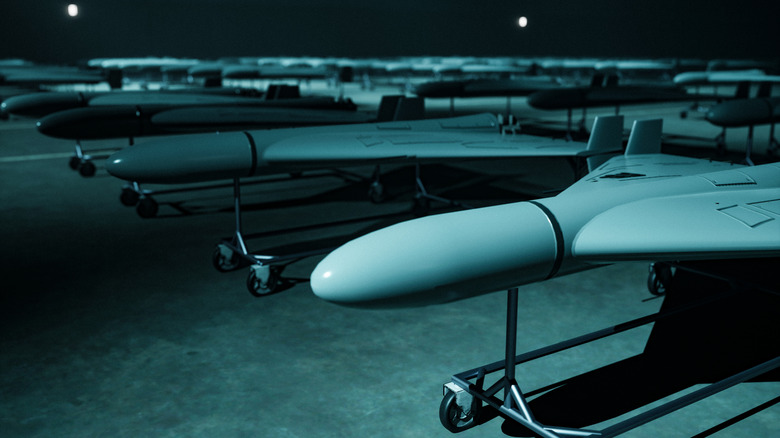
Distributed mass as the future way of war
Gettinthere/Getty Images
This new way of war is widely observable in the Pentagon’s emerging approach to Low-Cost Containerized Munitions, or LCCM. In May 2026, the U.S. Department of Defense announced framework agreements with Anduril, CoAspire, Leidos, and Zone 5 to produce more than 10,000 low-cost containerized missiles over three years. The basic philosophy is straightforward: Use commercial technology, simplified development, and containerized production to generate vast quantities of simple weapons capable of overwhelming an adversary.
This follows as a natural evolution of the Pentagon’s 2023 Replicator initiative, which established the political and strategic case for rapidly producing large numbers of affordable, attritable autonomous systems. Its spiritual successors, including the LCCM, Ground-Based Affordable Mass, and Affordable Cruise Missile initiatives, have become the institutional home for much of that effort. The FY2027 budget request alone proposes over $130 billion for efforts seeking to operationalize distributed mass systems across several major programs.
Ultimately, the goal of these efforts is not simply to buy more drones. It is to remove friction between invention, production, and combat. In modern conflict, logistics routinely emerge as one of the key vulnerabilities of a weapons system. A containerized factory that can rapidly manufacture aircraft, produce munitions, or drive adaptation and innovation at speed can be as strategically important as the weapons themselves.
Putting the factory floor at the tactical edge
Historically, war has favored the side that can identify a problem, develop a solution, and put that solution into action before the opponent can respond. Traditionally, a soldier or unit encountering a technical disadvantage would require a solution to be generated, produced, and delivered, with substantial rear-echelon effort. The requirement could travel through operational commands, acquisition offices, contractors, and testing organizations, all before eventually returning as a new piece of equipment, perhaps years later.
By containerizing and localizing additive manufacturing directly at the front line, militaries can compress that chain. If a unit discovers that a drone needs a different component, or that a particular modification provides a tactical advantage, the time from identifying the problem to producing the solution can be substantially reduced.
The ability to seize and exploit localized technical advantages and to adapt and evolve faster than an adversary forms the basis of the new drone-war era. Structural layouts, modular sensor packages, and modifiable blueprints all have the capacity to be redesigned and manufactured in theater without waiting for an entirely new weapons development program to run its course.
Ultimately, that is the real promise of deployable 3D printing capabilities. The factory is no longer tucked away behind great distances and bureaucratic obstacles. It is sitting on the front line, addressing tactical problem sets, and overcoming technical obstacles in real time. On a drone battlefield defined by rapid adaptation, the side that can move, manufacture, and modify fastest holds the advantage.

