Судлаачид Номхон далайн баруун хэсгийн гүнээс далайн ёроолоор хавч мэт хажуулдан алхаж, бүр арагшаа ухарч чаддаг өвөрмөц загасыг дүрсэнд буулгажээ.
Хятадын эрдэмтэд “Shenhaiyongshi” болон “Haiqin” шумбагч төхөөрөмж ашиглан 350-500 метрийн гүнд ажиглалт хийх явцдаа Scalicus engyceros хэмээх хуягт загасны (Peristediidae овог) хөдөлгөөнийг анх удаа ийнхүү баримтжуулсан байна. Энэхүү загас нь өөрийн хатуу сэлүүрийн тусламжтайгаар ёроолоор сэлүүрдэн алхаж, аюул тулгарсан үед үсрэн хөдөлдөг нь тогтоогджээ. Судалгааны багийн ахлагч, Sun Yat-sen их сургуулийн судлаач Хан Тянийн тэмдэглэснээр, эдгээр загас нь урьд өмнө төсөөлж байснаас илүү нарийн хувьслын дасан зохицол, зан төлөвийг өөртөө агуулдаг аж.
Хуягт загаснууд нь биеэ бүрхсэн ясан ялтас болон сармисан хэлбэртэй мэдрэгч үсүүдээрээ дамжуулан далайн ёроолын саад бэрхшээл, идэш тэжээлийг илрүүлдэг байна. Хэдийгээр тэд харанхуй орчинд амьдардаг ч нүдний хараа нь бүрэн муудаагүй байж болзошгүйг ажиглалтын явцад шумбагч төхөөрөмжийн гэрлийг анзаарсан үйлдлээс нь харж болно. Энэхүү нээлт нь далайн гүний биологийн олон янз байдал болон эрс тэс орчинд амьтад хэрхэн дасан зохицдог талаарх шинжлэх ухааны ойлголтыг шинэ шатанд гаргаж байна.
Эдгээр өвөрмөц загасны зан төлөв нь далайн гүний экосистем дэх амьтдын хувьслын явцад бүрэлдэн тогтсон гайхалтай бүтцийг илтгэж буй юм. Судалгааны үр дүнг Ocean-Land-Atmosphere Research сэтгүүлд нийтэлжээ.
Дэлгэрэнгүйг эх сурвалжаас харах
↓Эх сурвалжийг нээх ↓
The expansive, abyssal darkness of the deep sea mirrors the mystique and grandeur of outer space.
Hauntingly bioluminescent creatures shine like nebulae, ‘marine snow’ full of fish feces glitters like space dust, and alien-ish glowing sharks prowl the depths.
And just like spacecraft, telescopes, and rovers, underwater submersibles can transport us to the oceans’ coldest, darkest depths, revealing the creatures that live there.
Traditional taxonomic studies often observed sea animals that were captured, killed, or washed ashore, but modern submersibles let us see them as they actually are, in their aquatic abodes, without destroying them.
This can deliver some revelatory observations.
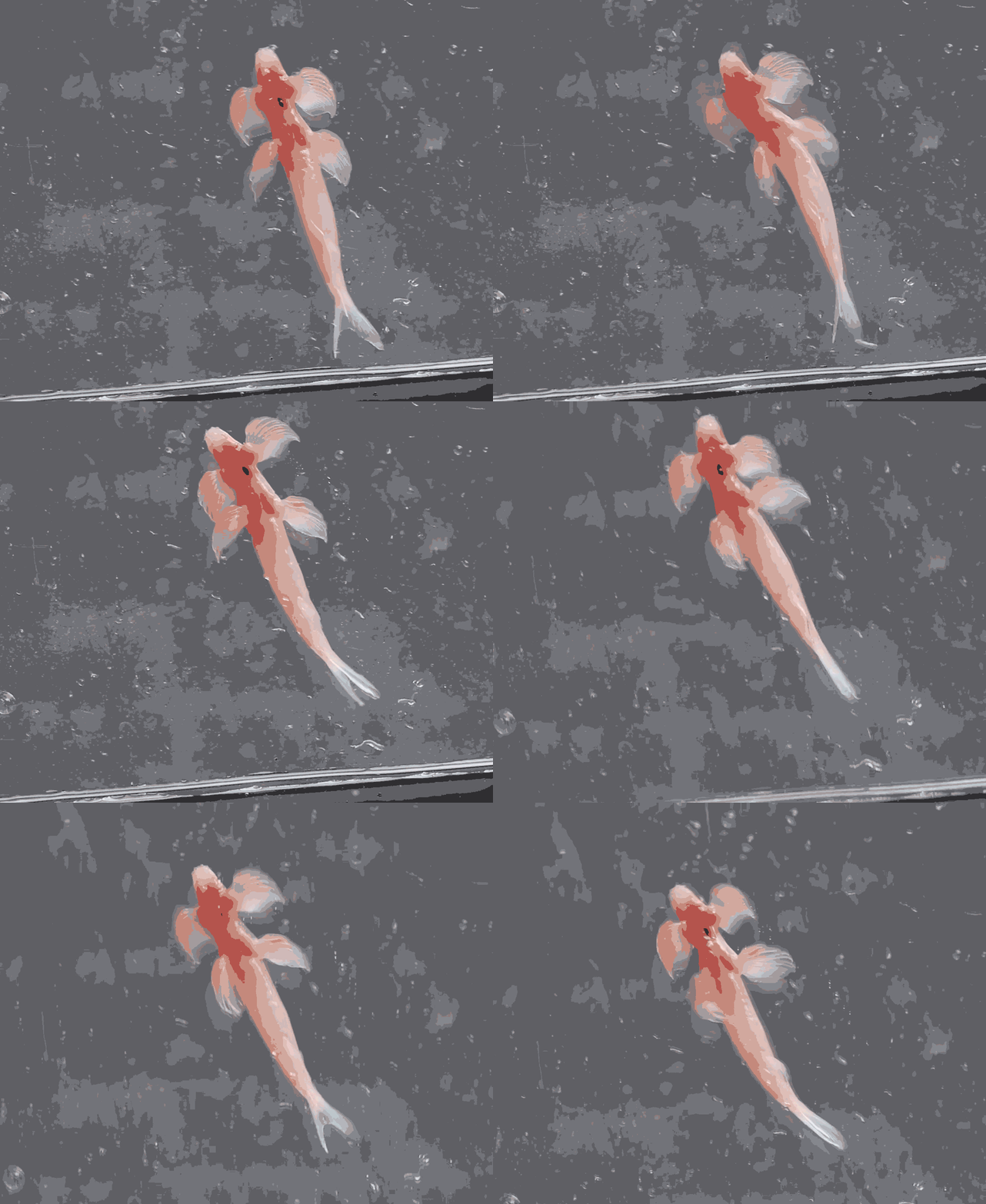
Researchers in China have just filmed a weird shrimp-like fish scuttling sideways along the seafloor like a crab and even ‘moonwalking’ backward – a movement that has never been observed in any other fish.
This dynamic behavior is enabled by a dizzying array of features that the researchers got a better look at in action.
Scalicus engyceros, a species of armored searobin found in the western Pacific Ocean, was first described in 1872 and was already known for its ‘walk’.
The new footage, from the South China Sea, confirms that these fish use their thick, stiffened fin rays to scuttle around like shrimp and even jump in a jerky leap when threatened.
“These walking fish harbor far more novel behavioral and evolutionary adaptations than previously assumed,” says Han Tian, a marine scientist at Sun Yat-sen University and the study’s first author.
In the journal Ocean-Land-Atmosphere Research, the researchers also report observations of two other species of armored searobins (family Peristediidae) that were sighted between 350 and 500 meters (1,148 and 1,640 feet) using the human-occupied vehicle Shenhaiyongshi (meaning deep-sea warrior) and the remotely operated vehicle Haiqin.
“By observing deep-sea animals alive in their surrounding environment, we can gain insight into the adaptation and evolution of the species,” Tian says.
Based on existing taxonomy, the three peristediid fishes share a common ancestor that lived around 60 to 70 million years ago, developing interesting adaptations to handle their extreme environment.
Several hundred meters below the surface, where the searobins were spotted, some 40 atmospheres’ worth of water pressure sits upon one’s shoulders – yes, fish have shoulders, sort of.
Armored searobins are covered in bony plates, hence the “armored” appellation.
They also have branched barbels on their snouts that look like a garden rake and act like whiskers, allowing them to physically and chemically sense food or obstacles as they stroll along the seafloor.
As the researchers observed, S. engyceros sweeps these rake-like appendages across the seabed as it walks, “occasionally touching sediment bumps or rocks”.
Although this may help with ‘sniffing’ out food and navigating obstacles, it “seems awkward because it appears inconvenient for walking”, the researchers note.
To help with that, armored searobins have two pectoral fins that fan out sideways, apparently for balance.
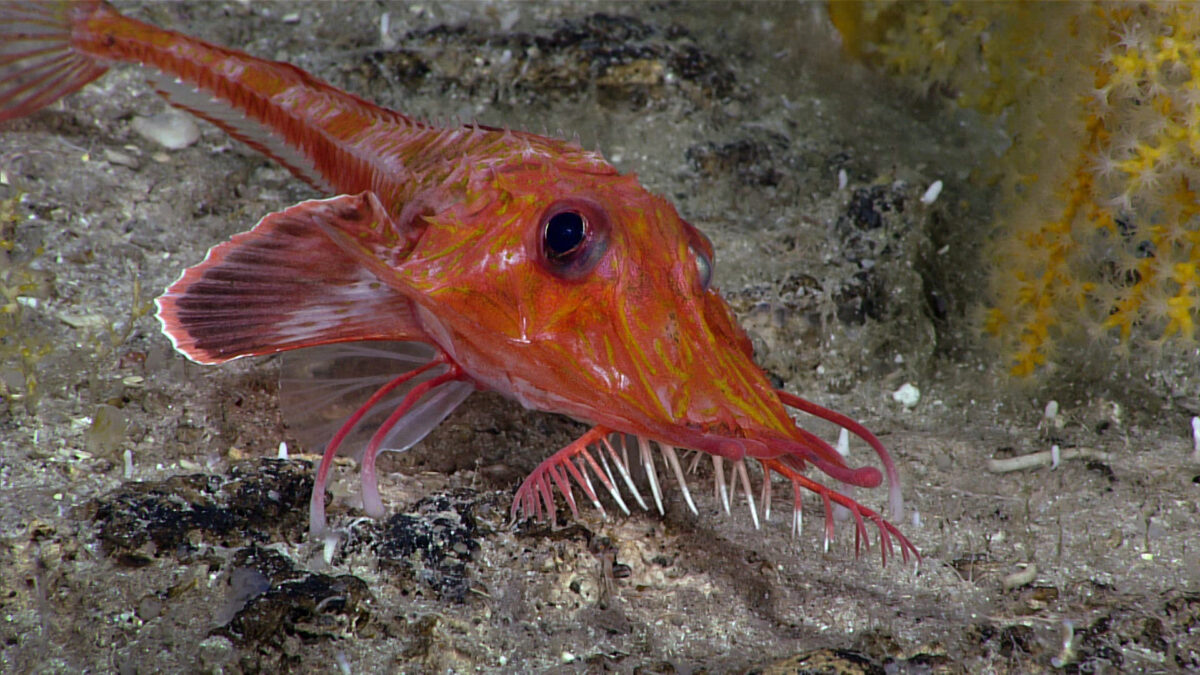
Like other deep-sea creatures, S. engyceros also sports some big peepers – but they may not be so useful. After so long in darkness, their eyesight might be on the way out.
When the researchers approached S. engyceros in their submersibles, the fish didn’t seem to hear or see them coming.
Though one of its eyes did look up at the vehicle’s light beam before the animal swam away, possibly to avoid small talk.
“This raises the question of whether this species has not resided in this dark habitat long enough for complete degradation of light sensing,” the researchers ponder in their paper, “or whether it may still move upward at times, perhaps into the twilight zone.”

As for the other armored searobins observed, the researchers sighted six Peristedion liorhynchus individuals in an underwater canyon, a different habitat to the seamount where S. engyceros was spotted.
S. engyceros ‘ dynamic ambulational abilities certainly set it apart from the dozen or so other fish that have evolved skeletal adaptations for walking on land, including the adorable amphibious mudskipper and the otherworldly, eyeless cave angel fish.
The backward-shuffling, side-stepping S. engyceros may be in a league of its own, but then who knows what else is traversing the seafloor in places humans have never come close to sighting.
Fortunately, the future promises many more spectacular deep-sea discoveries, made possible by increasingly versatile submersible technologies.
So, whether it’s the goosebump-cresting creepiness of underwater ‘backrooms’ or golden orbs left by tentacled, virgin-birthing ‘spaghetti monsters’, the oceanographic Bingo card stretches endlessly.
Related: There Are Fungi in The Ocean, And They May Be Way More Important Than We Realized
“Ultimately, this research will reshape scientific perceptions of deep-sea biodiversity and reveal how extreme marine environments drive the emergence of one-of-a-kind biological structures and behaviors unseen in any other aquatic organism on Earth,” Tian concludes.
This research was published in Ocean-Land-Atmosphere Research.
This article was fact-checked by Clare Watson and edited by Clare Watson. While we pride ourselves on our process, we are only human. If you spot a mistake, please let us know.

