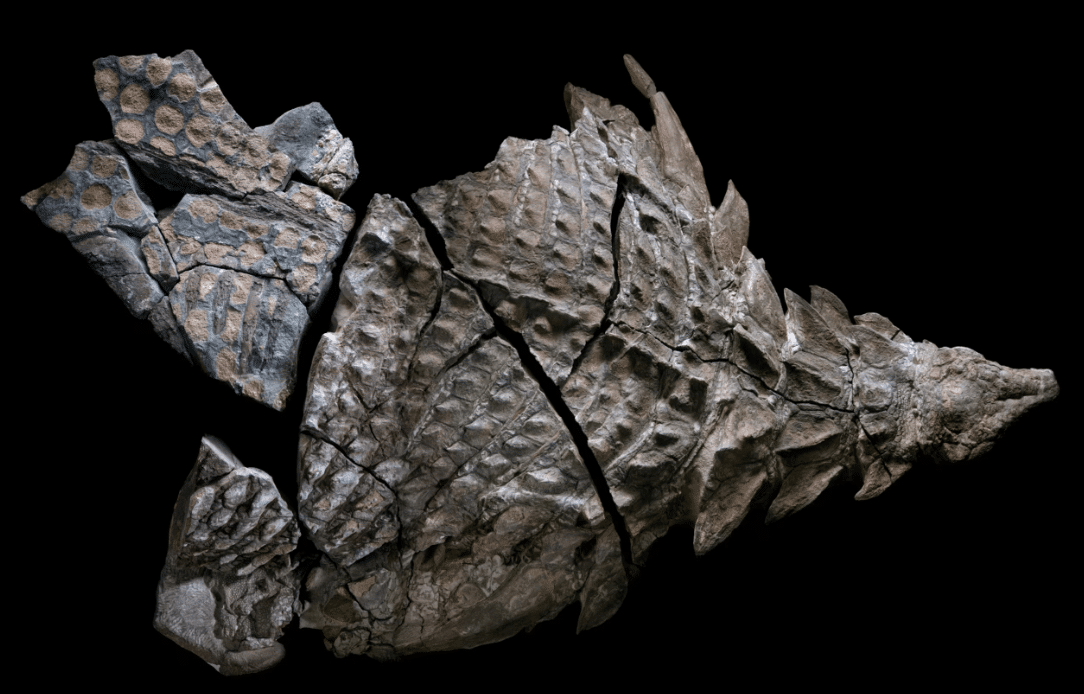
Эртний цэрдийн галавын үед амьдарч байсан нодозавр төрлийн үлэг гүрвэлийн энэхүү ховор олдвор нь амьд ахуй цагийнх нь гадаад төрхийг судлах боломжийг палеонтологчдод олгож байна.
Канадын Альберта мужийн Форт МакМюррей орчмын уурхайгаас 2011 оны гуравдугаар сард олдсон Borealopelta markmitchelli нэртэй энэхүү олдвор нь ердийн чулуужсан яс биш, арьс, эвэрлэг хуяг болон биеийн бүтэц нь гурван хэмжээст хэлбэрээр хадгалагдан үлдсэнээрээ онцлог юм. Уурхайн ажилтан Шон Фанк малтлагын явцад анх илрүүлсэн уг олдворыг Royal Tyrrell Museum of Palaeontology-ийн мэргэжилтнүүд таван жил гаруйн хугацаанд 7,000 гаруй цаг зарцуулан, чулуун давхаргыг цэвэрлэж ялгасан байна.
Судлаачид уг амьтныг далайн эрэг орчмын хурдас давхаргад хурдан булшлагдсаны улмаас зөөлөн эдүүд нь ийнхүү хадгалагдан үлдсэн гэж таамаглаж байна. Олдворын химийн шинжилгээгээр тухайн амьтан улаан хүрэн өнгөтэй байсан байж болзошгүйг харуулсан бөгөөд биеийн дээд хэсэг нь бараан, доод хэсэг нь цайвар өнгөтэй байсан нь амьтны ертөнцөд түгээмэл тохиолддог “эсрэг сүүдэрлэх” буюу өнгөлөн далдлах шинж тэмдэг байж магадгүй хэмээн судлаачид үзэж байна.
Хэдийгээр 1,300 гаруй кг жинтэй, хүнд хуягтай энэ амьтныг махчин амьтдаас бүрэн хамгаалагдсан гэж үздэг байсан ч өнгөлөн далдлах шинж тэмдэг илэрсэн нь түүнийг аюулаас зайлсхийхэд энэхүү бүрхүүл чухал үүрэгтэй байсныг нотолж байна. Гэсэн хэдий ч зарим эрдэмтэд олдвор олон сая жил далайн ёроолд байсан нь химийн найрлагад нь нөлөөлсөн байж болзошгүй тул өнгөний бүтцийн тайлалд болгоомжтой хандахыг сануулж байна.
Энэхүү олдвор нь зөвхөн ясан дээр үндэслэн дүрслэл хийдэг уламжлалт арга барилаас илүүтэйгээр, үлэг гүрвэлийн анатомийн бодит байдлыг судлах ховор боломжийг шинжлэх ухаанд олгож байна. Borealopelta-ийн хүзүү, мөр болон нурууны хэсэгт хадгалагдсан хуяг, эвэрлэг бүрхүүлүүд нь түүнийг амьд байхдаа ямар харагддаг байсныг илүү нарийвчлалтайгаар таамаглах боломжийг бүрдүүлжээ.
Дэлгэрэнгүйг эх сурвалжаас харах
↓Эх сурвалжийг нээх ↓
Most dinosaur fossils leave researchers reconstructing an animal from what is left after almost everything else has vanished. Bones survive. Skin, body contours, color and the coverings over armor usually do not.
In northern Alberta, one dinosaur preserved far more. Preparators could still trace the shape of its body, individual scales and armor as they had sat across the neck, shoulders and back.
The dinosaur was Borealopelta markmitchelli, an armored herbivore preserved in three dimensions with extensive skin and body coverings still associated with its skeleton. A paper in Current Biology described preserved scales, armor plates, horn-like sheaths and organic residues that researchers used to investigate what the animal may have looked like when alive.
What Survived With the Skeleton
Taken literally, calling the specimen a “mummy” gives the wrong impression. The scientific paper does not describe intact internal organs. What makes the fossil unusual is the survival of skin and soft tissues, epidermal scales and keratinous coverings over much of its armor.
About 110 million years ago, during the Early Cretaceous period, the animal lived in what is now Alberta. Its remains were found in March 2011 at the Suncor Millennium Mine near Fort McMurray, where heavy-equipment operator Shawn Funk noticed unusual material while excavating rock.
Borealopelta was a land animal, but the sediments around it had formed in an ancient marine environment. Researchers think the carcass entered the water, floated offshore and eventually sank to the seabed. Rapid burial there helped protect the body from destruction.
At the Royal Tyrrell Museum of Palaeontology, curator Donald Henderson was involved in the recovery and study of the specimen. His research uses computer modeling to examine how extinct animals moved, carried their weight and interacted with their physical environment.
Thousands of Hours in the Rock
Exceptional preservation did not make the fossil easy to recover. As The Atlantic reported, the fossil-bearing block weighed about 15,000 pounds and broke during removal from the mine.
At the museum, technician Mark Mitchell then spent more than 7,000 hours over roughly five and a half years carefully removing surrounding rock. The species name markmitchelli was later chosen in recognition of that work.
The finished specimen looks unlike the flattened skeletons common in museum displays. Much of the animal’s original body shape remains visible, along with individual scales and the arrangement of armor across the neck, shoulders and back.
Put simply, researchers did not have to guess nearly as much.

They could compare individual skin scales with the bony plates beneath them and examine the coverings over larger defensive structures. Prominent shoulder spines also survived, showing the armor as part of the animal’s body rather than as isolated bones laid out after death.
And the preserved exterior held another kind of evidence.
Color Evidence Raised Another Question
Chemical evidence from the fossil pointed to possible reddish-brown pigmentation. Researchers also identified a pattern they interpreted as countershading, with a darker upper body and lighter underside.
In living animals, countershading can make the body appear flatter and less conspicuous by reducing the visual effects of light and shadow. That made the Borealopelta interpretation striking: this was already a heavily armored dinosaur.
The animal weighed more than 1,300 kilograms, or roughly 2,900 pounds, according to the researchers’ estimate. Yet the authors argued that camouflage may still have been useful because large predators posed a serious threat. Armor, apparently, was not the whole story.
Caleb Brown, a Royal Tyrrell Museum researcher involved in interpreting the specimen’s camouflage evidence, told The Atlantic that some scientists had viewed heavily armored dinosaurs as effectively protected from predators. A camouflage pattern would push against that picture, suggesting that even an animal carrying substantial armor could benefit from being harder to see.
Not everyone accepted every part of the color reconstruction. Ancient-molecule researcher Alison Moyer told The Atlantic that some chemical signals could potentially have been affected by the fossil’s marine burial environment. She also questioned how decomposition before burial might have changed the tissues researchers later analyzed.
That is the central difficulty in reconstructing fossil color: researchers have to separate traces of the animal itself from chemical changes that happened after death. In Borealopelta’s case, those traces spent roughly 110 million years in sediments formed on an ancient seafloor.
A Dinosaur Preserved From the Outside In
Even without a final answer on every shade of its original appearance, Borealopelta gives paleontologists an unusually detailed record of armored dinosaur anatomy. Skin scales remain associated with the bony plates beneath them, while larger defensive structures retain evidence of the coverings that once surrounded the bone.
The Current Biology paper also suggested that some larger armor structures may have carried different pigmentation, raising the possibility that they served a visual function as well as a defensive one.
Across the neck, shoulders and back, researchers can still read the arrangement of structures that usually disappear before fossilization has much chance to begin.
Borealopelta is still being read as a body, not merely reconstructed from its bones.
Enjoyed this article? Subscribe to our free newsletter for engaging stories, exclusive content, and the latest news.

