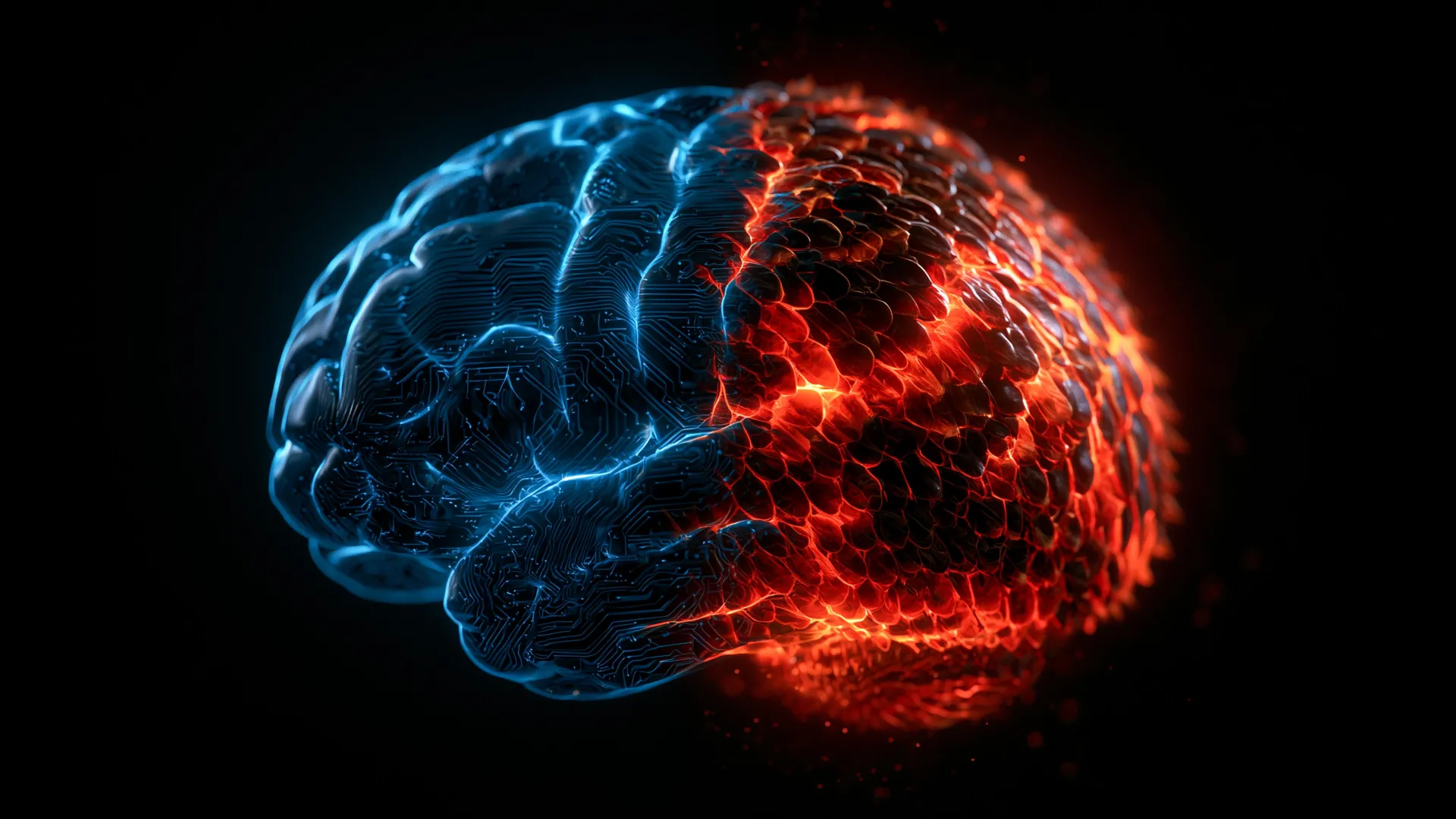
Тархины бүтэц нь үе шаттайгаар давхарлан хөгжөөгүй, харин амьд үлдэхэд шаардлагатай мэдээллийн сүлжээний зохион байгуулалтаар өөрчлөгддөг болохыг шинэ судалгаа харууллаа.
1950-иад оноос хойш тархи нь суурь үүргээс эхлээд сэтгэл хөдлөл, улмаар нарийн төвөгтэй сэтгэлгээ хүртэл үе шаттайгаар хөгжсөн гэх “мөлхөгч тархи” (lizard brain) онол түгээмэл байв. Гэвч Science Advances сэтгүүлд нийтлэгдсэн шинэ судалгаагаар тархины хувьсал нь ийм хялбар бүтэцтэй бус, харин мэдрэлийн сүлжээний зохион байгуулалттай холбоотой болохыг тогтоожээ. Жоржиа Технологийн Институтийн судлаач Набил Имам болон түүний баг биологийн тархи болон хиймэл оюун ухааны сүлжээг харьцуулан судалсны дүнд энэхүү дүгнэлтэд хүрсэн байна.
Судалгаагаар лимбийн систем болон неокортекс нь бие даан хөгждөггүй, харин нэгэн зэрэг зохицуулалттайгаар өргөжин тэлдэг болохыг илрүүлжээ. Неокортекс нь орон зайн зураглал ашиглан мэдээлэл боловсруулдаг бол лимбийн систем нь “штрих код” мэт тархсан сүлжээгээр дамжуулан үнэрлэхүй болон дурсамжийг хадгалдаг аж. Энэхүү ялгаатай зохион байгуулалт нь төрөхөөс өмнө тогтсон байдаг бөгөөд амьтад амьдрах орчиндоо дасан зохицохын тулд тархины хязгаарлагдмал орон зайг эдгээр сүлжээнд хуваарилан ашигладаг байна.
Эрдэмтэд хиймэл оюун ухааны загвар ашиглан туршилт хийхэд, орчин нь үнэрлэхүйг шаардвал лимбийн систем, харин харааг шаардвал неокортекс илүүтэй хөгжиж байв. Энэхүү ололт нь амьтдын тархины бүтэц яагаад харилцан адилгүй байдгийг тайлбарлаж байгаа юм. Тухайлбал, үнэрлэхүйд суурилдаг хуягт амьтад лимбийн системээр давамгайлсан байдаг бол хараанд суурилдаг сармагчингууд неокортексээр илүү хөгжсөн байдаг.
Энэхүү судалгааны үр дүн нь тархины хувьслыг шинэ өнцгөөс тайлбарлаад зогсохгүй хиймэл оюун ухааныг хөгжүүлэхэд чухал ач холбогдолтой юм. Судлаачдын үзэж буйгаар, тархины төрөлхийн энэхүү зохион байгуулалтыг хиймэл оюун ухаанд нэвтрүүлснээр бага хэмжээний өгөгдөл, эрчим хүч зарцуулж илүү үр ашигтай суралцах боломжтой систем бүтээх боломжтой аж. Корнеллийн их сургууль болон Үндэсний шинжлэх ухааны сангийн хамтын ажиллагааны хүрээнд хийгдсэн уг судалгаа нь тархины бүтэц нь байгалийн шалгарлаар бүрэлдсэн нарийн систем болохыг нотолж байна.
Дэлгэрэнгүйг эх сурвалжаас харах
↓Эх сурвалжийг нээх ↓
Many important choices seem to pit reason against emotion. Popular culture often describes that tension as a contest between two parts of the brain: a newer, more advanced center for rational thought and an ancient “lizard brain” that runs on instinct.
But the evolutionary history of the brain appears to be far more complicated than a simple struggle between old and new.
“There was a theory proposed in the ’50s that the brain evolved in layers starting with basic bodily functions, to emotions in the reptilian brain, leading up to sophisticated reasoning in humans,” explains Nabil Imam, an assistant professor in the School of Computational Science and Engineering and a faculty member with Georgia Tech’s Institute for Neuroscience, Neurotechnology, and Society (INNS). “This is not how an evolutionary biologist would think about the problem.”
Research published in Science Advances suggests that brain evolution may be better understood in terms of wiring rather than newer regions being stacked on top of older ones.
By examining the organization of both biological brains and artificial neural networks, Imam and his colleagues found evidence that evolution may involve allocating a limited amount of brain space among competing wiring strategies. Their model describes a computational tug of war between two fundamentally different kinds of neural organization, both of which are established even before birth.
The findings could help explain a long-running puzzle in brain evolution and may also point toward new ways of building AI systems that use less data and energy.
Why the “Lizard Brain” Model Falls Short
Terms such as “logical brain” and “lizard brain” actually refer to groups of brain regions with very different functions. The neocortex, often associated with higher-level thought, forms the outer layer of the brain and is involved in vision, perception, reasoning, and other complex abilities.
The so-called lizard brain is harder to define so neatly.
“The limbic system, sometimes called the ‘reptilian brain,’ controls emotion broadly speaking — but it also has other components with distinct functions,” explains Imam. The system contains separate regions involved in memory, smell, navigation, and emotional regulation. “Why do people group all these different regions into one big system? There hasn’t been a good theory for what is common between these different circuits.”
To explore that question, the researchers compared how these brain systems change across species. Rather than looking at individual regions one at a time, they examined how the limbic system and neocortex vary together over evolutionary history.
A clear pattern emerged. When one part of the limbic system was relatively large, the other limbic regions also tended to be larger. At the same time, the neocortex was generally smaller.
That suggests the regions are not evolving independently.
“Rather,” says Imam, “it’s a coordinated expansion of these regions across species.”
The pattern points to the limbic system behaving more like an integrated network than a collection of unrelated structures. Across evolution, its different components appear to expand and contract together.
The next question was what might cause that coordinated shift.
Two Different Ways to Wire a Brain
Imam’s explanation centers on the way different brain systems are wired before birth.
Neural circuits in the neocortex are arranged as spatial maps. Brain regions that process nearby parts of the body, such as the thumb and index finger, are also located near one another. Similar spatial organization appears in systems that handle sight and sound.
The limbic system is organized differently. Instead of being laid out spatially, its wiring works more like a bar code, with distributed patterns of activity representing particular smells or complex memories.
The researchers used AI models to test whether these differences arise from built-in architecture or are mainly learned through experience.
When an AI network was created with localized, spatial connections, it was naturally well suited to processing vision, sound, and touch. In contrast, distributed “barcode-style” networks were necessary for strong performance on smell recognition and memory.
An Evolutionary Competition for Brain Space
The researchers then investigated why the relative size of these brain systems changes so consistently among species.
The basic idea is that the brain has limited resources. Space and energy are finite, so natural selection may favor whichever wiring system is most useful for survival in a particular environment.
To test this, the team created a multimodal artificial network in which spatial and distributed systems competed for “real estate.”
When the simulated environment rewarded smell, every region within the distributed system expanded while the neocortex became smaller. When vision was favored instead, the pattern reversed.
This trade-off may help explain striking differences between real animals. The nine-banded armadillo, which depends heavily on smell, has a very large limbic system. The squirrel monkey, which relies strongly on vision, has a brain dominated by the neocortex.
Across the 182 species included in the study, the findings suggest that brain evolution is less about adding progressively newer layers of “logic” and more about shifting space between different wiring systems according to what helps an animal survive.
What Brain Evolution Could Teach AI
The same principle may have implications beyond biology.
If engineers can reproduce some of this built-in neural organization in artificial intelligence, they may be able to create systems that learn more like biological brains and require far less training data and energy.
“Today’s artificial neural networks are trained by vast amounts [of] data — it’s about nurture,” says Imam. “But the brain is not a blank slate that gets trained by experience. It is a mix of nature and nurture, and the nature is that pre-wired architecture.”
“We could translate that architecture to AI systems to make it more brain-like, or make it learn or function as efficiently as the brain.”
This work was a collaboration with Cornell University and was supported by the National Science Foundation.

