АНУ-ын Зэвсэгт хүчин Хормузын хоолой дахь худалдааны хөлөг онгоцны аюулгүй байдалд заналхийлсэн Ираны пуужин харвах төхөөрөмжүүдийг агаараас цохилт өгч устгаснаа мэдэгдлээ.
АНУ-ын Төв командлал (CENTCOM) ням гарагт Ларак арал дээр байрлаж байсан Ираны хоёр пуужин харвагчийг устгасан байна. Исламын хувьсгалт гвардийн хүчин эдгээр төхөөрөмжөөр дамжуулан Хормузын хоолой руу далайн мина харвахаар бэлтгэж байсныг АНУ-ын тал ажиглажээ. Энэхүү үйл ажиллагаа нь бүс нутгийн эрчим хүчний тээвэрлэлтийн чухал замд ноцтой аюул учруулах эрсдэлтэй байсан тул урьдчилан сэргийлэх арга хэмжээ авсан гэж албаныхан тайлбарлав.
Шинжээчдийн үзэж буйгаар Ираны зэвсэглэлд байгаа Fajr-5 пуужингийн системийг далайн мина харвах зориулалтаар өөрчилсөн байх магадлалтай байна. Ийм төрлийн зэвсэг нь уламжлалт хөлөг онгоц ашиглахгүйгээр эргээс далайд мина байрлуулах боломжийг олгодог бөгөөд энэ нь АНУ болон түүний холбоотнуудын хувьд шинэ сорилт болж байгаа юм. Хэдийгээр АНУ-ын тал тухайн пуужин харвагчийн нарийвчилсан төрлийг тодорхойлоогүй ч ийм чадавх нь тээвэрлэлтийн аюулгүй байдлыг алдагдуулж, сэтгэл зүйн дарамт учруулах өндөр эрсдэлтэй гэж үзэж байна.
АНУ-ын цохилтын хариуд Ираны тал АНУ-ын цэргүүд байрладаг Иордан дахь агаарын бааз руу найман баллистик пуужин харвасан байна. Иорданы албаны хүмүүсийн мэдээлснээр бүх пуужинг агаарын довтолгооноос хамгаалах системээр амжилттай устгасан бөгөөд ямар нэгэн хохирол учраагүй аж. АНУ-ын Ерөнхийлөгч энэхүү халдлагын хариуд хатуу арга хэмжээ авахаа мэдэгдээд байна.
Хормузын хоолойд мина байрлуулах аюул заналхийлэл үргэлжилсээр байгаа нь тус бүс нутгаар өнгөрөх худалдааны хөлөг онгоцны тоог эрс бууруулжээ. Олон улсын далайн аюулгүй байдлын байгууллагууд усан замын аюулгүй байдлыг хангах хяналтыг чангатгаж байгаа хэдий ч минаны эрсдэл өндөр хэвээр байгааг анхааруулж байна.
Дэлгэрэнгүйг эх сурвалжаас харах
Эх сурвалжийг нээх ↓
For about a month, the United States had refrained from attacking Iranian targets as the Trump administration turned toward economic warfare against the Islamic Republic. However, that changed last night when U.S. Central Command (CENTCOM) struck what it said were Iranian rocket launchers preparing to fire naval mines into the Strait of Hormuz. The problem is that mine-deploying rockets are not a common capability, so much so that the statement seemed bizarre at first glance. But it just turns out that Iran does claim to have just such a system and that system would have a glaring application in the current state of play of the conflict. In fact, it would be absolutely critical to do exactly what CENTCOM did, blowing them up prior to launching, because if they didn’t, the final and very fragile energy lifeline between the Persian Gulf and the world could be severed at the worst possible time.
“I can confirm that earlier today U.S. forces struck two Iranian launchers on Larak Island,” Navy Capt. Tim Hawkins, CENTCOM’s spokesman, told us Sunday evening. “Islamic Revolutionary Guard Corps forces were observed preparing to launch rockets with sea mines into the Strait of Hormuz.”
The U.S. strikes against the launchers on Sunday spurred Iran to respond with ballistic missile attacks on a Jordanian air base housing U.S. troops. Jordanian officials said all eight missiles were intercepted, and no casualties or damage was inflicted.
#JORDAN INTERCEPTS 8 MISSILES
Jordan’s @ArmedForcesJO say air defense systems intercepted eight missiles that entered the Kingdom’s airspace early Monday.
The military said the missiles were destroyed before posing a threat to civilians or property.
Details:
A…
— Dana Zureikat Daoud دانا زريقات (@DanaZkat) August 31, 2026
Hawkins did not specify what the exact type of rocket launcher was struck or whether this was the first time CENTCOM had seen Iran use this type of system to launch sea mines.
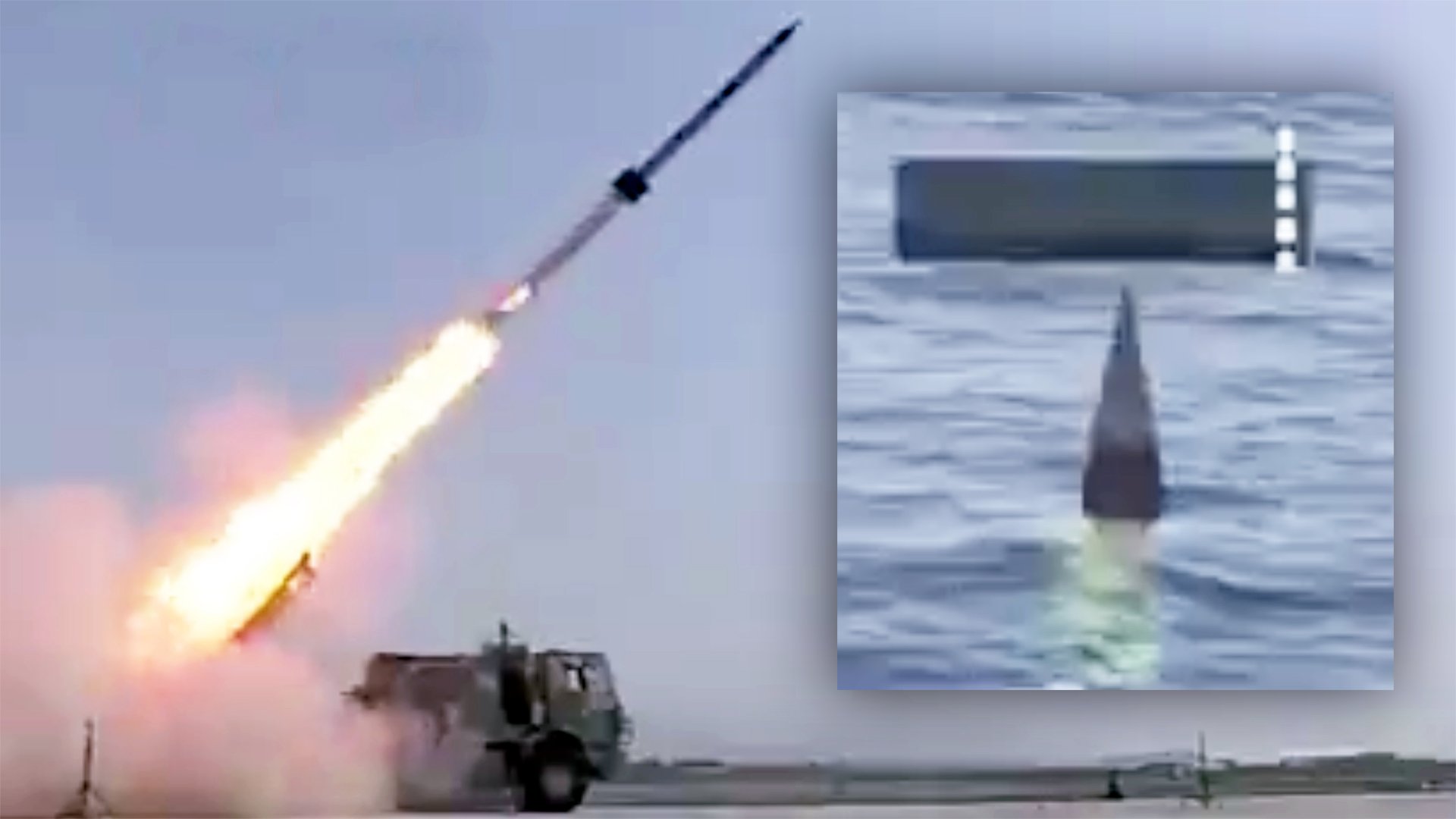
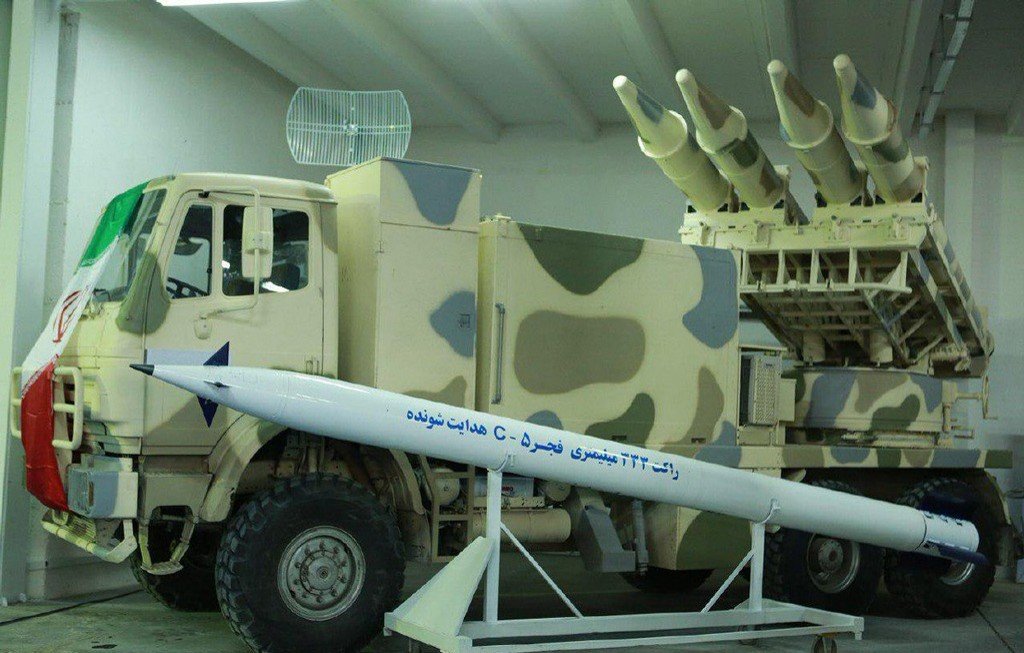
Though CENTCOM won’t comment on what kind of system was attacked, Iran did tout just this kind of a system last year with exactly the kind of range needed to be a huge problem for the U.S. and its allies. This system uses a variant of the Fajr-5 rocket that is converted with a sea mine warhead.
You can see a video of that system below.
The clip shows the rockets being fired from a truck-mounted multiple launch system (MLRS). The video later cuts to nose cone-shaped mines that appear to float on the surface above the spent missile body, however, little is known about the Fajr-5 sea mine warhead conversion process that allows them to be delivered by rocket.
We also don’t know the full extent to which Iran has developed and/or fielded this particular capability, or whether it has other options for similarly deploying naval mines by rocket. Neither Behnam Ben Taleblu, a senior fellow at the Foundation for Defense of Democracies (FDD) think tank, nor the Ambrey maritime security firm has seen any indication that Tehran has used an MLRS to launch sea mines in the past.
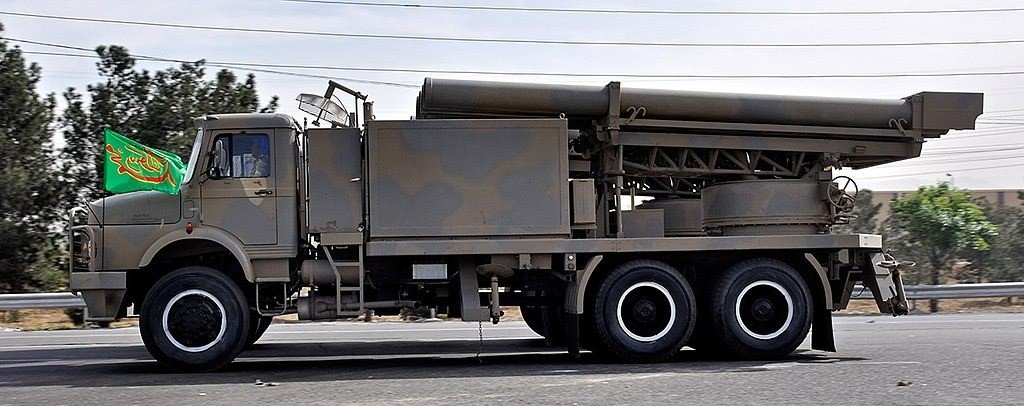
At the same time, “the Fajr-5 is an Iranian calling card, a 333mm caliber rocket that can reportedly travel 75 km carrying between an estimated 90 to 170 kg warhead, depending on the payload,” Taleblu, an expert on Iranian weapons systems, told TWZ.
The Fajr-5 is an established design that traces its roots back to the 1990s and has been evolving since then. “The Fajr class was initially designed as unguided artillery rockets, though Iran claims to have developed a guided version,” Taleblu added.
In general terms, being able to seed naval mines via artillery rockets would offer several advantages for Iran, most immediately by offering an alternative to traditional maritime mine-laying platforms. The destruction of Iran’s naval forces was a top stated objective for the U.S. military during the opening phases of the conflict earlier this year. Iranian vessels, including ones capable of laying mines, were heavily targeted. Still, Iran has retained a large number of its smaller boats that can be used for seeding minefields.
Regardless of what boats they have left, mining the area that actually matters most would be impossible to do as any vessel approaching the southern coast of the Strait of Hormuz would be destroyed. It’s through these tight and complex littorals that a reduced flow of commercial vessels are still traveling, under the kinetic umbrella of the U.S. and its gulf state allies. The Fajr-5, fired from Iranian controlled islands in the strait, has the range to land in these waterways, seeding mines without risking any boat crews or other platforms. If the rocket-delivered mines splash down, the de-mining process would have to begin, which can be arduous and last weeks, potentially shutting down all shipping.
With that in mind, Iran’s weapon is remarkably relevant to the situation, assuming it works. But even if it doesn’t, it could still be a problem if it is allowed to be used due to the risk to mariners not knowing the dangers involved.
Furthermore, being able to turn any launcher for Fajr-5s (and/or potentially ones for other types of artillery rockets) into a naval mine layer rather than having to rely on specialized systems would be a boon unto itself. Artillery rockets and launchers are something Iran had deep stockpiles of before the war with the United States and Israel started earlier this year. How many naval mine rockets Iran might have, and whether it might be possible to convert existing types to that configuration, are open questions.
Using a road-mobile launcher would also give Iranians a ‘shoot-and-scoot’ option for deploying naval mines where the launch could be exposed only for a short period of time. This, in turn, would create additional targeting challenges for U.S. forces. It is possible that, as it does elsewhere, Iran has constructed tunnels under Larak Island to hide these systems, as well.
Overall, the “deployment of naval mines by missile significantly speeds up the deployment process, improves the ability to penetrate airspace, and increases the standoff distance between the minelayer and the field, making it the least risky minelaying method,” a piece published by the Center for International Maritime Security (CIMSEC) think tank last year, which also highlighted Iran’s apparent demonstration of the Fajr-5-based capability, noted.
While the Fajr-5’s estimated payload capacity is “light compared to U.S. or Chinese naval mines,” the mines the rockets could deliver “are still heavier than diver-delivered limpet mines and could conceivably disable a ship if struck by enough mines from the field,” the piece added. “Most importantly, this field could be delivered rapidly and with little warning. Even though the explosive capacity of this mine individually is small, the psychological impact from inflicting minor damage on a small number of merchants could still be enough to force shipping companies to avoid the area.”
“Though it’s a bit unconventional, using a rocket launcher again signals that the regime is sensitive to cost and risk, and is trying to deploy mines in a way that doesn’t put as much personnel at risk as by dropping them overboard,” Taleblu posited. “It was reported in the military exercise over a year ago that the regime had used an MLRS system like the Fajr to deploy these, but I haven’t seen significant video confirmation of this most recent round.”
With all this in mind, the point about “psychological impact” mentioned in the CIMSEC piece could be particularly relevant in this case. By launching the attacks on Larak Island, CENTCOM has in a way given credence to Iran having a real capability to launch mines via rocket into the Strait of Hormuz. That threat by itself could be enough to cause commercial ship crews, their corporate operators, and insurance companies to think twice about attempted transits.
This is exactly the issue that President Trump, among others, has repeatedly sought to downplay, including multiple times just within the past week.
“We’re taking them in,” Trump told Glenn Beck last week. “The mines are gone. You probably saw that, we put it out yesterday, all the mines. We got rid of the mines. But the strait, it’s functioning it’s a functioning strait. Uh, yes, every once in a while, there’ll be a drone or a rocket or something shot, but it is a very functioning strait.”
“Last week, CENTCOM completed clearing sea mines from the strait’s international shipping routes,” Hawkins, the CENTCOM spokesman, told us yesterday. “U.S. forces are monitoring the area closely and remain prepared to protect the free flow of commerce through this essential waterway.”
“The U.S. military has achieved a major milestone in the Strait of Hormuz,” Adm. Brad Cooper, CENTCOM’s commander stated last week. “We have successfully cleared sea mines in the Straits international shipping lanes that were laid months ago by Iran’s Islamic Revolutionary Guard Corps. Internationally recognized transit routes in the Strait are free of Iranian sea mines, thanks to the incredible work of the U.S. military.”
CENTCOM pushed back Monday on Iranian claims that an oil tanker was hit by mines in the command’s preferred transit route.
“CLAIM: Iran’s Islamic Revolutionary Guard Corps (IRGC) claims that a supertanker passing through the southern route of the Strait of Hormuz struck two mines and was brought to a complete stop. This is FALSE,” the command stated on X. “FACT: No ships have hit mines in the Strait of Hormuz. This is yet another IRGC attempt to intimidate regional commercial shipping through disinformation.”
CLAIM: Iran’s Islamic Revolutionary Guard Corps (IRGC) claims that a supertanker passing through the southern route of the Strait of Hormuz struck two mines and was brought to a complete stop. This is FALSE.
FACT: No ships have hit mines in the Strait of Hormuz. This is… pic.twitter.com/spkaogBx81
— U.S. Central Command (@CENTCOM) August 31, 2026
Still, the Joint Maritime Information Center (JMIC) — a group of international navies which provides timely information to the shipping industry) — sees mines as an ongoing risk in the Strait.
“Commercial traffic through the Strait of Hormuz remained at reduced levels, with a modest uptick from recent lows, still far below baseline,” JMIC stated on Sunday. “Independent tracking data indicated suppression with single-digit numbers transiting in both directions. There remained a continued risk of drifting or uncharted mines in and near the TSS, with mine danger areas still active.”
JMIC Advisory Note Update 091
Released by UKMTO on behalf of the Joint Maritime Information Centre.
Click here to view the full advisory note
https://t.co/jHInhBdVRt#MaritimeSecurity #MarSec pic.twitter.com/T6VzzxSdPD
— UKMTO Operations Centre (@UK_MTO) August 30, 2026
The combination of ongoing dangers in the Strait continues to result in reduced traffic, the global trade intelligence firm Kpler noted on X.
“Vessel traffic through the Strait of Hormuz and Bab el-Mandeb declined on 25 August, while the IMO [International Maritime Organization] verified no additional attacks,” Kpler added. “Five vessels crossed the Strait of Hormuz, down 28.6% day on day from seven. All five used the Iranian Unilateral Scheme, with two entering the Middle East Gulf and three exiting. Four were classified as shadow vessels and one as sanctioned.”
The latest flare-up in fighting came after the Trump administration last week unleashed the threat of harsh new sanctions to further isolate Iran. However, that failed to move Tehran to change its position on maintaining control over the Strait of Hormuz, its nuclear ambitions or support for proxies like the Houthis in Yemen and Hezbollah in Lebanon.
Monday morning, Trump told Fox News reporter Trey Yingst that he was going to retaliate for Iran launching ballistic missiles last night after the U.S. strike on Larak Island.
“We’re going to hit them hard,” Trump told the network. “There will be a response.”
Trump and his senior aides “have been considering waging limited strikes in the Strait of Hormuz to prevent Iran from reconstituting its radar and missile capabilities to attack ships,” Axios reported, according to three U.S. officials.
“One U.S. official said the idea behind the plan is to reduce the risk of Iranian attacks on oil tankers, U.S. Navy ships and Air Force aircraft — to ‘mow the lawn,’ as this person put it.”
It is unclear if Iran has used rockets to mine the Strait or how well this system works if it did. However, the fact the U.S. resumed hostilities just to attack sea-mine-launching rocket systems shows the level of concern they engendered and the options Iran may still have to threaten the Strait.
Contact the author: howard@twz.com
The post Iranian Launchers Struck By U.S. Held Exotic And Highly Concerning Rocket-Delivered Sea Mines appeared first on TWZ.

