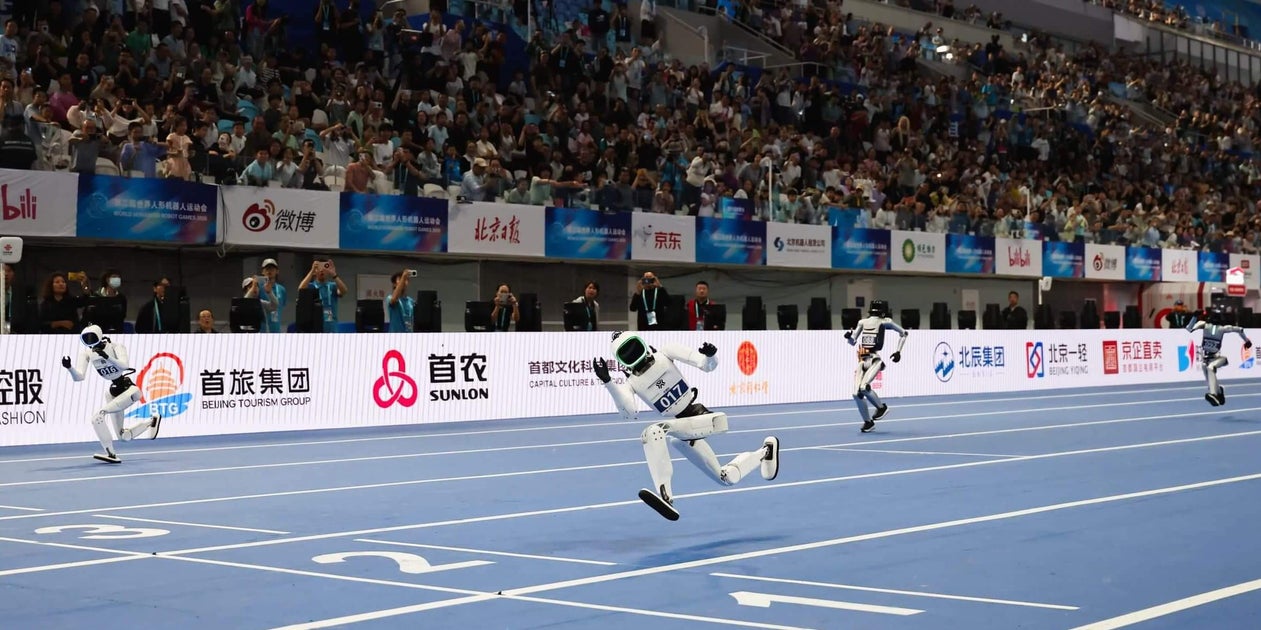
Бээжин хотноо зохион байгуулагдсан “World Humanoid Robot Games” тэмцээний хүрээнд роботууд бокс, хөнгөн атлетик зэрэг спортын төрлүүдэд өрсөлдөж, хүний чадавхыг сорьсон үзүүлбэрүүдийг үзүүллээ.
Наймдугаар сарын 22-ноос 26-ны хооронд үргэлжилсэн уг тэмцээнд 16 орны 2,056 робот оролцсон нь өмнөх жилээс дөрөв дахин их үзүүлэлт юм. 100 метрийн гүйлтийн төрөлд робот 8.64 секундийн амжилт үзүүлсэн нь Усэйн Болтын дэлхийн дээд амжилтаас илүү хурдан байсан бол өндрийн харайлтын төрөлд 2.88 метр өндөрт харайж, дэлхийн рекордыг эвджээ. Гэсэн хэдий ч бокс, хөлбөмбөг зэрэг спортын төрлүүдэд роботууд техникийн алдаа гаргаж, унах, эвдрэх зэрэг хүндрэлүүд гарсан нь хүний биеийн хөдөлгөөн, ур чадварыг бүрэн дуурайхад бэрхшээлтэй хэвээр байгааг харууллаа.
Тамирчид болон шинжээчид роботуудын энэхүү амжилтыг спортын салбар дахь шинэлэг инноваци гэж үзэж байгаа ч хүний оролцоотой спортын мөн чанарыг орлох боломжгүй гэдэгтэй санал нэг байна. Шинжээч Амит Катвала роботууд хяналттай орчинд тодорхой нэг даалгаврыг сайн гүйцэтгэж байгаа ч бодит нөхцөлд хүнийг бүрэн орлох түвшинд хүрээгүй хэмээн дүгнэжээ.
Ирэх жил Бээжинд болох Дэлхийн хөнгөн атлетикийн аварга шалгаруулах тэмцээний өмнө зохион байгуулагдсан энэхүү арга хэмжээ нь спортын статистик мэдээлэл болон бэлтгэлийн арга барилд шинэ боломж нээж магадгүй гэж зарим тамирчид үзэж байна. Роботуудын хөдөлгөөн, хурдны үзүүлэлтүүд нь дасгалжуулагчдад тамирчдынхаа гүйцэтгэлийг сайжруулахад туслах нэмэлт мэдээлэл өгөх боломжтой юм.
Дэлгэрэнгүй эх сурвалжийг харах
Эх сурвалжийг нээх ↓
It was, as always, the Games’ marquee event.
The 100-meter sprint in Beijing’s National Speed Skating Oval brought together the world’s fastest runners, hurtling along at breakneck speed to shrieks of excitement from a captivated crowd. The only difference is that, after this race, some of the competitors collapsed to the floor with sparks flying from their insides while safety officials charged over to attend to them with fire extinguishers.
Welcome to the World Humanoid Robot Games, where the marquee 100m was won in a time of 8.64seconds (almost a second quicker than Usain Bolt’s world record of 9.58s, set in 2009) to bring to a close a five-day event that also featured boxing, soccer, tennis and weightlifting, alongside track and field. In the high jump, one ‘athlete’ leaped 2.88m – 43cm higher than Javier Sotomayor’s world record of 2.45m.
The 2026 edition, held from August 22 to 26, was a step up in quantity and quality from the inaugural Games last year. It saw 2,056 robots from 16 countries across six continents competing — quadruple the number involved in that first event, according to China’s national broadcaster CCTV.
Why, though? Why would Chinese companies invest so much money and time into creating robots that perform such athletic feats (and crash and burn afterwards)?
Safety officials put out one of the 100m competitors in the recent World Humanoid Robot Games (Lintao Zhang/Getty Images)
“I think they want to impress us with the physical capabilities of the machines,” says Amit Katwala, a sports technology writer and author of The Athletic Brain: How Neuroscience Is Revolutionising Sport And Can Help You Perform Better.
Chinese media gave another hint as to the ultimate endgame, with the New York Times reporting a commentary in Xinhua, the state news agency, that read: “A factory robot does not need to win a sprint, nor does a service robot need a medal. But every gain in speed, stability and precision on the competition floor can bring robots one step closer to becoming genuinely useful beyond it.”
But what do athletes think of robots not only encroaching on their turf, but surpassing their achievements?
At first, Morgan Lake — a Commonwealth Games high jump silver medallist for England with a personal best of 2.00m — was amused. Then came the questions.
“With so many things now, you’re like, ‘Oh, that’s so funny’. That’s your initial reaction, but then the other part of it is, like, ‘Is this going to become a thing? Are AI and robots actually taking our jobs? Is that more entertaining than watching athletes?’”
Lake is 29 and has been competing on the international stage for more than a decade —long enough to know that, when there’s money and eyeballs involved, almost anything is possible. She cites the Enhanced Games, where athletes are given cash incentives to take performance-enhancing drugs in pursuit of faster, higher and stronger results and which took place for the first time in Las Vegas this year, as something that felt far removed from the sport she has dedicated her life to, but still provided enough intrigue and entertainment to make it viable as an event.
“We look at it like, ‘Oh, that’s ridiculous’,” she says, switching back to the subject of humanoid robots, “but it’s also gaining traction and media. It’s something that’s just so wild, but stranger things have happened. Will there be a point where you see the Olympics and there’ll be robots competing? Because people would want to see it.”
Norway’s 400m hurdles European champion Karsten Warholm agrees.
“If they made a robot that can run 400m hurdles, we’d love to have a race,” he tellsThe Athletic. Two years ago, Warholm took on pole vault world-record holder Armand Duplantis in an exhibition race over 100m and describes that as “one of the biggest 100m happenings outside major championships”.

The standing high jump event in Beijing (Lintao Zhang/Getty Images)
Racing against a robot could be a similarly “cool” event, he believes, but there are limits to how much a crowd will emotionally engage with it. “I think it’s funny with robots. Horses are racing. Humans are racing. Robots will maybe race. But nothing will ever replace human connection.”
There is also the argument that at a time when there is more competition than ever to win eyeballs, anything which drives attention to the sport beyond athletics aficionados is to be welcomed.
“As a result of that (robot) 100m time, people are going to be interested,” says British sprinter Destiny Ogali. “They’re going to want to know, ‘The robots have run this, what can the human equivalent run?’ And that’s bringing more interest to the sport.”
He believes the exploits of those humanoids which have been designed and created to run fast only serve to highlight the immense achievements of the human athletes whose records they are chasing, and in some cases, beating:
“8.64s is not even a full second quicker than the record itself. It goes to show just how quick the record is. It’s not like they’re smashing it by two and a half seconds, making it look like child’s play. So it in no way demeans the sport or the quality of the athletes because they had to run those times first to give those engineers something to aim for.”
Watch clips from the World Humanoid Robot Games and you will quickly realise that there is a long way to go before the robots represent anything other than novelty value in athletic competition.
From the weightlifting robot which staggered and fell to pieces under the weight of a light barbell…
… to comedic mis-kicks and robotic clashes on the football pitch, there was no shortage of reminders about the difficulty of engineering a machine to replicate the ability of a human to react, anticipate, adjust and recover from misjudgements.
In a controlled environment, where the terrain is predictable and the task very singular (like running from A to B on a smooth, flat running track), it’s far easier for a robot to perform impressively. What might happen if you asked that same robot to run 100m at a school sports day on a bumpy grass field, asks Katwala?
“So, the question is,” he adds, “how useful is that (8.64s 100m) outside of that very specific task?”
For Katwala, the most impressive elements from the Games were the robots playing tennis, seeming to react to the movement of the ball and, in a match featuring robots playing alongside humans in doubles, of their partner, too.
“That’s a much harder thing to do,” says Katwala. “It’s much harder to predict where a ball’s going to go or what a human’s going to do next and then move your body to get into position to play a return shot than it is to just sprint 100m and run head-first into a wall at the end.”
As impressive as these feats are, Katwala doesn’t put them on the same level as the major leap forward in AI that was showcased by two chess matches between world-champion player Garry Kasparov and an IBM supercomputer called Deep Blue in the late 1990s. Kasparov lost the first game of their initial meeting in 1996, but fought back to win 4-2. The Russian grandmaster took on the computer in a rematch the following year, losing 3.5 to 2.5, marking the first defeat of a reigning world chess champion by a computer under tournament conditions.
“That was a seminal moment in the development of AI,” says Katwala, “because it demonstrated that AI could do things that weren’t thought to be possible before. If you’d asked people even 10 years ago, is it theoretically possible to build a robot that could run 100m in under 10 seconds, people would have said, ‘Yeah’. It’s not a massive leap. It’s just linear progress of motors getting faster and lighter and materials getting better and more reliable.”
Is there anything useful for humans in watching these robot exploits ahead of next year’s World Athletics Championships, which are also taking place in Beijing?
“Potentially,” says Ogali. “Different information and statistics around cadence and rhythm could be helpful in terms of how long they’re spending on the floor in each stride and if it’s something that can be replicated, at least to an extent.
“Looking at their splits will definitely be helpful too, especially over the 400m. What did they do over the first 100m? What did they do over the second 200m? Was there any sort of drop-off in their speed all the way around or was it flat-out equal splits? I’m sure there’s going to be information that’s helpful to coaches going forward.
“Even though they’re not human beings, it’s innovation.”

The 100m sprint was the marquee event of August’s World Humanoid Robot Games (Kevin Frayer/Getty Images)
Lake is more sceptical — “They’ve got no muscle structure, so the way their limbs are moving is going to be so different to the muscles firing on a human” — but there is one way she envisages these robots helping flesh-and-blood athletes improve their performances.
“If you need a training partner to run with at a certain pace, you could set the robot at whatever speed you need,” she says. “Especially for distance runners, rather than having their coaches on a bike going around with them, they’ve got this robot they can run with.”
Katwala is equally sceptical about the value in these feats for athletes, remarking that if there was a new way of moving that humans could perform that would unlock extra speed, they would probably have figured it out already.
“When was the last time that there was a massive technical breakthrough, like the Fosbury Flop or something like that?” he asks. “There’s not some new form of sprinting that these robots are doing that humans haven’t adopted yet.”
So what’s the point of building humanoid robots that can perform athletically?
“You want to build machines that can move around a world that’s been designed for humans,” Katwala explains. “But if the robot is not able to do things flexibly, then it’s kind of a moot point. There’s no point building a humanoid robot that’s really good at a specific task and not very good at generalising. So the question of whether building robots that are really, really good at sprinting will help generalise to other tasks is, I think, an open one.”

The technology still requires some work before robots can reliably compete in athletics (Lintao Zhang/Getty Images)
For Ogali, it could involve him taking on robots on the track. “If they’ve done this sort of event, that’s probably the next thing they’re looking at: seeing if they can line up athletes against humanoids.”
How would he feel about that?
“I’d find it interesting,” he says, “but also funny. It’s cool to not have to always take things so seriously. A lot of the competitions I do are obviously very serious. So something like that, I would just do for the fun of it and for the sake of research.”
Being in close proximity with these humanoids is perhaps something the rest of us are going to have to get used to.
“In theory, we’re going to be sharing a space with these machines at some point in the next few decades,” says Katwala. “But I think that they will need to do a lot of work to make them feel more palatable to humans.
“Ironically, what’s so scary about these robots as they are now is that, although they’re humanoid in the fact they’ve got two legs, they’re quite un-human in the way they move.”
Additional reporting: Liam Tharme

