“Amai Proteins Ltd.” компани байгалийн гаралтай уургаас санаа авч, элсэн чихрээс 3,500 дахин илүү амтлаг чадалтай “sweelin” хэмээх шинэ чихэр орлуулагчийг гарган авчээ.
“Food Chemistry” сэтгүүлд нийтлэгдсэн судалгаагаар, энэхүү уураг нь цусан дахь сахарын хэмжээ болон инсулины хариу урвалд мэдэгдэхүйц өөрчлөлт үзүүлдэггүй болохыг тогтоосон байна. Израилын Tel Aviv Sourasky Medical Center-т явуулсан давхар сохор, санамсаргүй түүврийн аргаар хийсэн эмнэлзүйн туршилтад 19 оролцогч хамрагджээ. Туршилтын үр дүнд “sweelin” хэрэглэхэд глюкозын хариу урвал ердийн сахараас 31 дахин, инсулины хариу урвал 81 дахин бага байсан нь тогтоогдсон байна.
Энэхүү шинэ бодис нь Африкийн халуун орны ойд ургадаг “serendipity berry” жимсэнд агуулагддаг уураг дээр суурилсан бөгөөд хиймэл оюун ухааны тусламжтайгаар боловсруулжээ. Цагаан нунтаг хэлбэртэй энэхүү бүтээгдэхүүн нь өндөр хэмд тэсвэртэй тул хоол хүнсэнд элсэн чихрийг 70 хуртэлх хувиар орлуулах боломжтой юм. АНУ-ын Хүнс, эмийн хяналтын газар (FDA) уг бүтээгдэхүүнийг аюулгүй гэж үзсэн бөгөөд одоогоор АНУ, Сингапур, Израилын зах зээлд нэвтрүүлээд байна.
Судлаачид энэхүү ололтыг чихрийн шижин, таргалалттай хүмүүст ач холбогдолтой байж болзошгүй гэж үзэж байгаа ч судалгааны цар хүрээ бага, хугацаа богино байсныг анхаарууллаа. Удаан хугацааны туршид хүн амын дунд үзүүлэх нөлөөллийг тодорхойлохын тулд илүү өргөн хүрээтэй судалгаа хийх шаардлагатай байна. Одоогийн байдлаар “sweelin” нь цусан дахь сахар болон инсулины түвшинд нөлөөлөхгүйгээр амт оруулах боломжтой чихэр орлуулагч гэдгээрээ онцлог юм.
Дэлгэрэнгүйг эх сурвалжаас харах
↓Эх сурвалжийг нээх ↓
Artificial sweeteners might have zero calories, but that doesn’t mean they have zero impact on the body.
Even though some high-intensity artificial sweeteners contain little or no sugar, recent evidence suggests they can still influence natural sugar responses.
For those with diabetes or blood glucose issues, that could be a problem.
Researchers at the biotechnology company, Amai Proteins Ltd., have now designed, developed, and tested a hyper-sweet alternative – 3,500 times as sweet as sucrose by weight.
The key, however, is that it doesn’t change glucose or insulin responses.
In a double-blind, randomized clinical trial, funded by the company and run by its researchers, the novel sweetening product showed no significant impact on either measure.
In fact, their study published in Food Chemistry reports that it produced an overall glucose response 31-fold lower than typical sugar and an insulin response 81-fold lower.
The trial is the first of its kind to investigate the metabolic effects of a ‘sweet protein’.
Sweet proteins are found in some rare tropical fruits, and they are at least 1,000 times sweeter than sugar. They probably evolved to attract primates like us, and now, they are attracting scientists and businesses alike.
The sugary unit developed by Amai was inspired by a naturally occurring fruit in the tropical rainforests of West and Central Africa, called the serendipity berry (Dioscoreophyllum cumminsii), which contains one of the sweetest known proteins on Earth.
The engineered version, refined with the help of AI, is called sweelin.
The novel sweetener comes in the form of a white powder and can be easily dissolved in liquid.
It is so sweet that for a simple serving of iced tea, less than 3 mg of powder is needed.
It can also withstand high heat, and in some food recipes, sweelin can allegedly replace up to 70 percent of required sugar.
Earlier this year, officials at the US Food and Drug Administration reported that they had no questions for Amai regarding its conclusion that the sweetener is considered safe.
Sweelin is now available as a sugar substitute for food, beverages, and confectionery in the US, Singapore, and Israel.
The recent clinical trial, which was funded by Amai and conducted at Tel Aviv Sourasky Medical Center in Israel, may help boost sales and manufacturing.
The experiment was small and short, so it needs to be taken with a grain of salt. Not much can be said of the long-term health impacts of sweelin on a wider population.
But the initial results are promising.
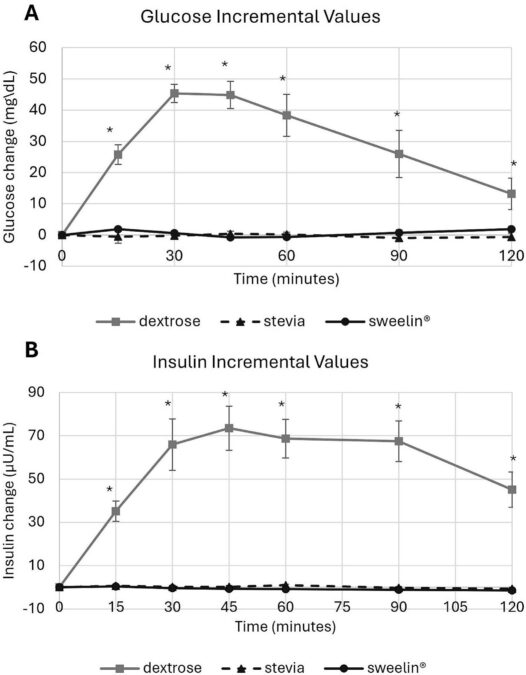
The trial involved 19 participants, whose blood glucose, insulin, and GLP-1 levels were tracked over 120 min after consuming a beverage containing a single ‘high’ dose of sweelin.
In randomized order, and during separate visits a week apart, each participant repeated the trial with a beverage sweetened with stevia and one sweetened with dextrose.

Stevia is a plant commonly used as a calorie-free sweetener and is not known to trigger changes in blood glucose or insulin responses.
Dextrose, on the other hand, is a typical sugar made from corn or wheat that triggers a substantial blood-glucose response.
Trial participants didn’t know what sweetener they were consuming, and all study personnel, including company employees, remained blinded throughout the experiment and analysis.
Across the two-hour trial, sweelin performed similarly to stevia. It produced an overall glucose response 31-fold lower than dextrose, while its insulin response was 81-fold lower.
Interestingly, the trial also found that sweelin did not induce a rise in circulating GLP-1, which is triggered after a meal.
That, the authors note, is “a finding of particular importance for individuals with type 2 diabetes, prediabetes, or obesity, in whom postprandial glucose excursions contribute to long-term cardiovascular and metabolic risk.”
Still, until longer trials are conducted, and these results are verified among larger cohorts, sweelin’s impact on metabolic disorders like diabetes remains speculative.
For now, all we can say is that this alternative sugar bestows sweetness without seeming to change blood or insulin responses.
Related: Artificial Sweetener Can Trick Your Brain Into Feeling More Hungry
“These findings support the potential of sweelin® as a metabolically neutral sugar alternative that can support consumers who are trying to reduce added sugars in their diet,” the authors conclude.
The study is published inFood Chemistry.
This article was fact-checked by Rebecca Dyer and edited by Rebecca Dyer. While we pride ourselves on our process, we are only human. If you spot a mistake, please let us know.

