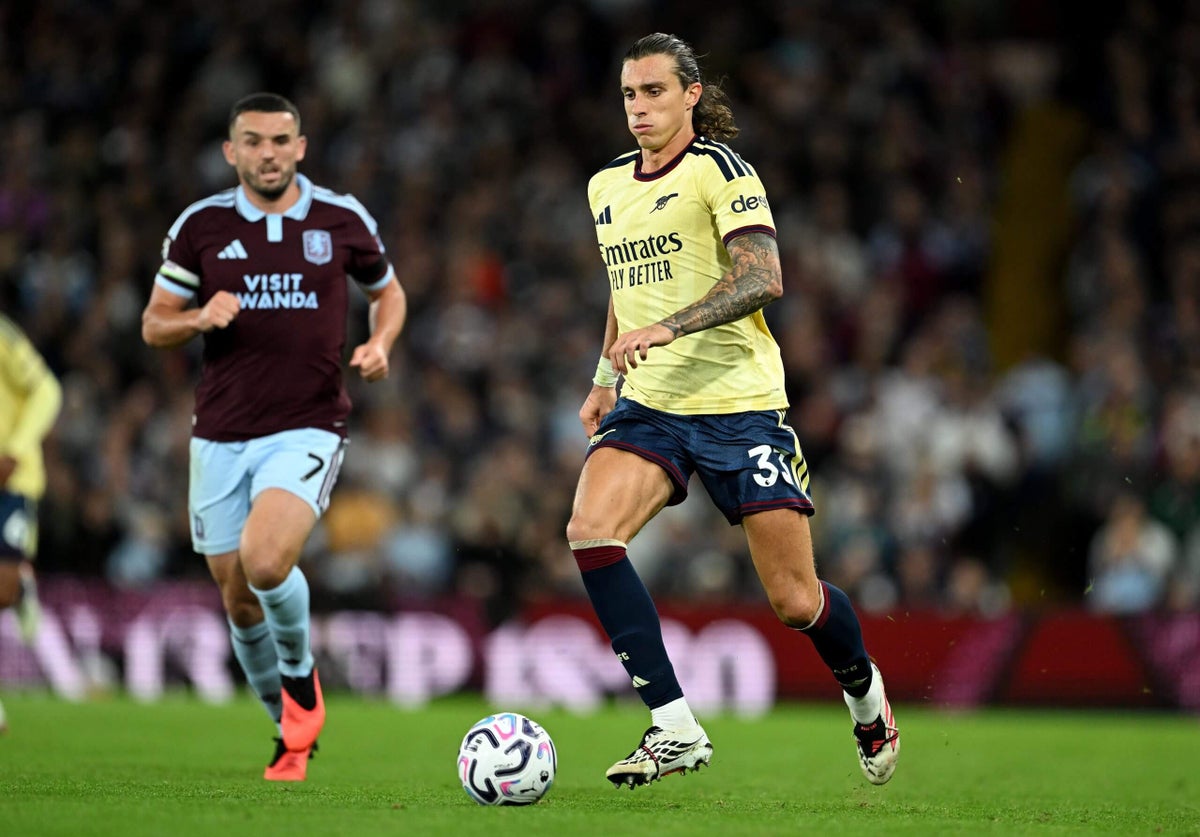
Астон Виллаг 1-0 харьцаатай хожсон тоглолтод Риккардо Калафиорийн тактикийн уян хатан байдал Арсеналын довтолгоонд гол үүрэг гүйцэтгэлээ.
Даваа гарагт болсон тоглолтын үеэр Астон Виллагийн ахлагч Жон Макгинн өөрийн өрсөлдөгч Калафиорийн бие бялдар болон тоглолтын ойлголтод сэтгэгдэл өндөр байгаагаа илэрхийлжээ. Микель Артетагийн баг 4-3-3 хувилбараар талбайд гарсан ч хамгаалагчдын байрлал маш уян хатан байсан бөгөөд Калафиори довтолгоонд идэвхтэй оролцсоноор өрсөлдөгчийнхөө хамгаалалтыг эвдэхэд ихээхэн түлхэц үзүүлэв. Итали хамгаалагч нь зөвхөн хамгаалах төдийгүй талбайн төв болон довтолгооны бүсэд оновчтой шилжилт хийж, тоглолтын хэмнэлийг тодорхойлж байлаа.
Тоглолтын 60 дахь минутын орчимд Арсеналын хийсэн гоолын довтолгоонд Калафиорийн оруулсан хувь нэмэр шийдвэрлэх ач холбогдолтой байв. Эберэчи Эзэ рүү дамжуулсан бөмбөгийн дараа Калафиори чөлөөт бүс рүү гүйж, Мэтти Кэшийг урьтаж бөмбөгийг хаалганы өмнө дамжуулснаар Букайо Сака гоол оруулах боломжийг бүрдүүлсэн юм.
Артетагийн бүрэлдэхүүнд Бен Уайт болон Калафиори нар хамгаалагчийн үүрэгтэй ч талбай дээр байрлалаа байнга сэлгэж, өрсөлдөгчөө төөрөгдүүлж байв. Энэхүү тактикийн шийдэл нь Арсеналд довтолгооны олон хувилбарыг бий болгож, хамгаалагчид нь довтолгооны гол хөдөлгүүр болон хувирах боломжийг олгож байна.
Дэлгэрэнгүйг эх сурвалжаас харах
↓Эх сурвалжийг нээх ↓
When John McGinn appeared on The Overlap podcast recently, he was asked to name his toughest opponent in the Premier League.
“Do you know who really surprised me? Riccardo Calafiori,” he said. “He was much stronger than I thought. I was really impressed with him.”
It was interesting, therefore, to watch the battle between McGinn and Calafiori throughout Arsenal’s 1-0 victory over Aston Villa on Monday evening. For all Calafiori’s physical strength, it was really his movement, his awareness and his technical brilliance that helped to unlock Aston Villa.
A decade ago, a left-back like Calafiori would have been unique. Today, in a world where Manchester City’s Josko Gvardiol has sometimes been their secondary goalscoring threat behind Erling Haaland, and when Nico O’Reilly has acted as a No 10 and a No 9 despite nominally playing on the left of defence, Calafiori is part of a wider movement.
But it’s nevertheless still fascinating to see a left-back as intelligent and composed in the final third as the Italian, especially considering he was previously considered a centre-back rather than a left-back upon his arrival two years ago.
Last season, injury restricted Calafiori to exactly 50 per cent of Premier League minutes for Arsenal last season. But in various matches during Arsenal’s title-winning season, his approach from left-back was very striking.
Here’s a clip from the 2-0 victory away at Burnley, which shows him starting at left-back and then motoring in behind in an attempt to reach a lofted ball over the top. Note how right-wing-back Kyle Walker is initially marking him, then has to pass him on to a fellow defender, and then finds himself out of position when trying to get back goal-side of Leandro Trossard.
That’s Calafiori acting as a No 9.
Here, against Brentford last season, he’s acting as a No 10. Most left-backs would be happy to hold their width and receive a square pass from Martin Odegaard. But Calafiori makes a run inside, allows Odegaard to play a line-breaking reverse pass, and eventually he dribbles through the defence to have a decent attempt at goal.

Here’s his assist for Kai Havertz’s opener last weekend against Coventry City. It begins with Ben White’s diagonal pass going astray, and Arsenal having to regain possession. But Calafiori had made a run into the channel and had the presence of mind to pick out Havertz with a well-measured cutback.

Mikel Arteta’s approach against Villa was structured and fluid in different ways.
Although 4-3-3 on paper, one of the central midfielders — here, Declan Rice — would drop between the centre-backs, while the full-backs narrowed. Calafiori and Ben White therefore essentially played on the sides of a diamond, with Odegaard as the No 10 and Myles Lewis-Skelly in the deeper role. The wingers generally held their width.

The key aspect of Calafiori’s game was his clever movement. Here, when up against McGinn, the Villa captain checks over his shoulder to watch Calafiori. When he then looks back at the left-back, Calafiori takes that as his cue to move inside, onto McGinn’s other shoulder. The passing angle isn’t quite on, and the ball doesn’t come.

Fifteen seconds later, McGinn is marking Calafiori tightly in midfield. When Calafiori starts to retreat, McGinn goes with him, but then hands the Italian over to right-back Matty Cash and intends to move out wide to mark Christos Tzolis.
But that’s precisely when the pass comes to Calafiori, who glances over his shoulder before the ball arrives, and knows Tzolis is making a run down the outside. Both Cash and McGinn have been caught in between. Eventually, Cash does well to recover and block Tzolis’ cross.

That ability to receive the ball on the turn is crucial. White took up similar positions, but isn’t as slick in possession. Here, when receiving the ball from Lewis-Skelly, his first touch took him inside, and he wasn’t comfortable playing the ball out to Bukayo Saka with his left foot. He took another two touches to control the ball, and by the time he tried the pass with his right foot, he’d been closed down.

Thirty seconds later, he tries to take a deft touch to receive the ball on the turn, but miscontrols it and is tackled. It’s not surprising White doesn’t play with the elegance of a No 10: he’s centre-back, turned into a right-back, and now asked to receive the ball between the lines. It’s not easy.
This only serves to demonstrate how unusual Calafiori’s skill set is.

All this led to the goal, just before the hour mark. In the build-up, Arsenal have right-back White inside Saka on the right, but left-back Calafiori outside substitute Eberechi Eze on the left…

… after that initial attack comes to nothing, 20 seconds later it’s the other way around down both flanks. Calafiori is inside of Eze, but White is outside of Saka.

That rotation caused Villa serious problems. The move for the goal is excellent. As the ball is fed into Eze, Calafiori immediately knows to make a run into the channel. And then it’s partly about determination: Calafiori slides in to beat Cash to the ball and knock it across the six-yard box, and Saka wins the battle with Ian Maatsen to bundle the ball home.

Arsenal were largely attempting to play the same way down the flanks, with those rotations of position between full-back and winger. The unpredictability is important. But ultimately, White is much more effective when overlapping and allowing Saka inside to shoot. Calafiori, on the other hand, has the qualities to be a dangerous central attacker.
On paper, Arteta is using four centre-backs across his defensive line. On the pitch, you never quite know where they’re going to be.

