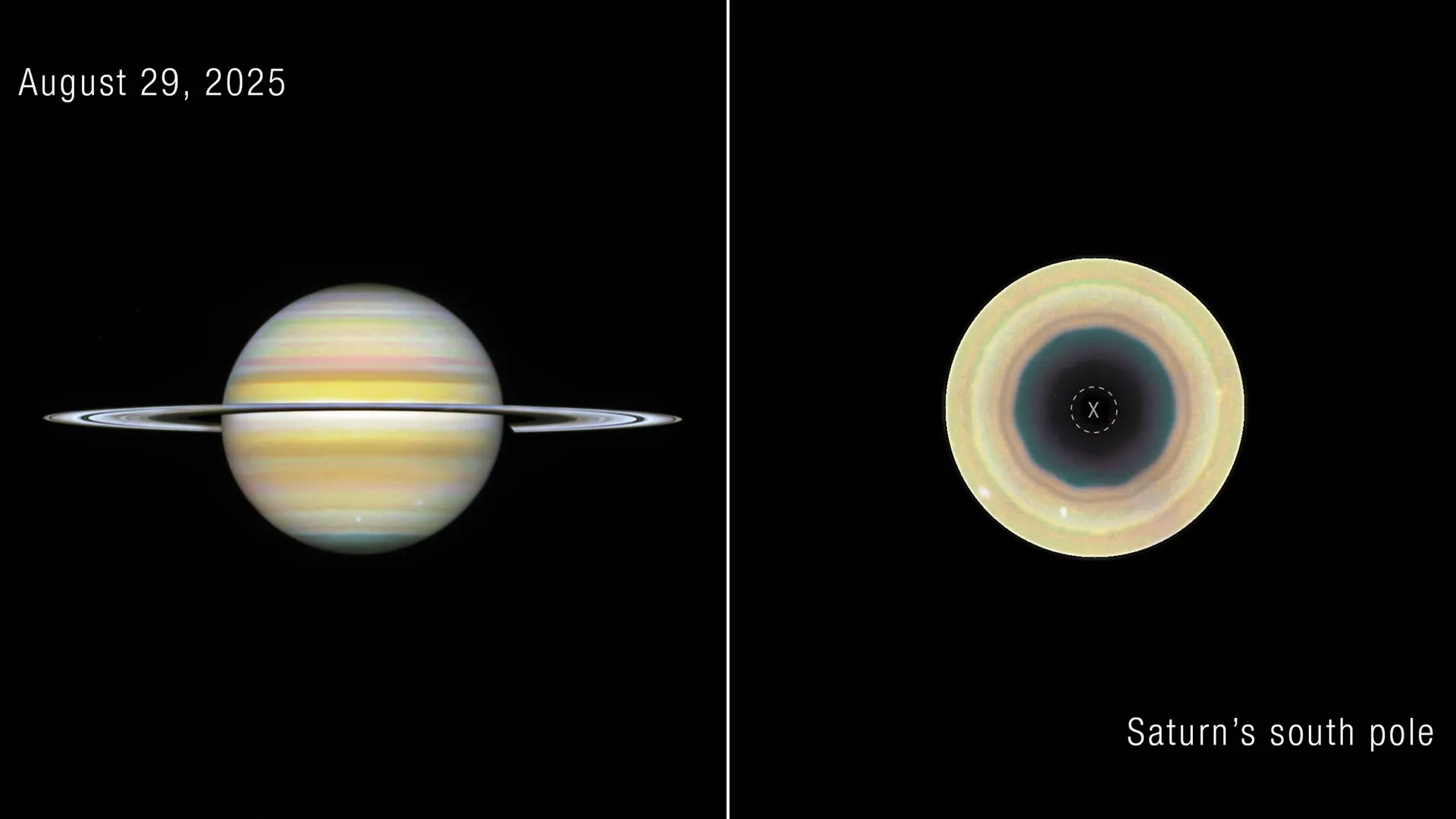
NASA-гийн Хаббл сансрын дуран авай Санчир гарагийн өмнөд туйлыг тойрон эргэлдэх арав талт долгион бүхий өвөрмөц тогтцыг илрүүлсэн нь эрдэмтдийн анхаарлыг татаж байна.
Санчир гарагийн агаар мандалд анх удаа ийм төрлийн тогтмол хэлбэртэй тийрэлтэт урсгалын хэв шинжийг ажиглажээ. Энэхүү бүтэц нь тус гарагийн хойд туйлд байдаг алдартай зургаан талт тогтоцтой төстэй боловч эрдэмтэд үүнийг агаар мандлын цоо шинэ, ялгаатай үзэгдэл хэмээн таамаглаж байна. Судалгааны үр дүнг Science Advances сэтгүүлд нийтэлжээ.
Уг үзэгдлийг Агустин Санчес-Лавегаар удирдуулсан баг Хаббл сансрын дуран авай болон дэлхийн гадарга дээрх ажиглалтын төвүүдийн мэдээлэлд тулгуурлан нээн илрүүлсэн юм. 2023 оноос хойшх Хаббл дурангийн цуглуулсан мэдээллүүдийг шинжлэхэд уг бүтэц нь бүдэгхэн байснаа сүүлийн үед тодорхой арав талт хэлбэрт шилжсэн нь тогтоогджээ. Сонирхогч одон орон судлаачдын дэлхийн гадаргаас авсан гэрэл зураг болон Хаббл дурангийн өндөр нарийвчлалтай дүрсүүд нь энэхүү нээлтэд гол үүрэг гүйцэтгэсэн байна.
Ажиглалтаар уг долгион нь Санчир гарагийн хүчирхэг тийрэлтэт урсгалын бүсэд байрладаг бөгөөд зөвхөн үүлний оройд бус агаар мандлын хэд хэдэн давхаргаар дамжин өргөн хүрээг хамарч байгаа нь тодорхой болов. Гэвч энэхүү арав талт бүтэц яагаад гэнэт үүссэн, хэр удаан тогтвортой байх нь одоогоор тодорхойгүй байна.
Эрдэмтэд уг үзэгдлийн үүсэл, хөгжил болон хойд туйлын зургаан талт тогтоцтой хэрхэн холбогдохыг судлахын тулд Жэймс Вэбб сансрын дуран авай болон компьютерийн загварчлалын тусламжтайгаар цаашид үргэлжлүүлэн ажиглахаар төлөвлөж байна. Энэхүү нээлт нь аварга гарагуудын агаар мандлын динамик болон тэдгээрийн үйл ажиллагааны талаарх шинэ ойлголтыг өгөх юм.
Дэлгэрэнгүйг эх сурвалжаас харах
↓Эх сурвалжийг нээх ↓
NASA’s Hubble Space Telescope has spotted a striking new feature in Saturn’s atmosphere: a huge, evolving 10-sided wave circling the planet’s south pole.
It is the first time scientists have observed a large, regularly shaped jet pattern in Saturn’s southern hemisphere. The structure has some similarities to Saturn’s famous hexagon at its northern pole, but important differences suggest researchers may be watching a distinct atmospheric phenomenon take shape.
The results were published in the journal Science Advances.
A New Pattern Emerges on Saturn
Researchers reconstructed the development of the feature using several years of Hubble observations going back to 2023. Earlier images contained faint signs of the structure before it developed into the much clearer pattern seen more recently.
The observations came from Hubble’s Outer Planet Atmospheres Legacy (OPAL) program, which has captured annual images of the outer planets for more than a decade.
“We’ve never seen anything quite like this in Saturn’s southern hemisphere,” said Amy Simon, study co-author and OPAL principal investigator at NASA’s Goddard Space Flight Center in Greenbelt, Maryland. “The northern hexagon has been there every time we’ve looked for more than 40 years. This feature is different — it appears to be strengthening, giving us the rare opportunity to watch a giant atmospheric pattern develop.”
Saturn’s changing seasons played an important role in the discovery. As the planet moved through its seasonal cycle, its south pole gradually became visible again from Earth. Astronomers studying images from ground-based observatories were the first to recognize the unusual structure.
Amateur Astronomers Help Spot the Decagon
Study lead author Agustín Sánchez-Lavega is a researcher at the University of the Basque Country in Spain. The university operates the Planetary Virtual Observatory Laboratory, a website that collects ground-based images of solar system planets submitted by observers around the world.
In images from 2024, Sánchez-Lavega and amateur astronomers Trevor Barry and Jean-Paul Oger noticed a faint, wavy band near Saturn’s south pole. Ground-based observations collected in 2025 provided stronger evidence that the feature had developed into a decagon.
Researchers then turned to Hubble for a more detailed view. Because the telescope observes from space, it can capture sharper images across complete rotations of Saturn without the blurring caused by Earth’s atmosphere.
“Given Saturn’s symmetry in its north-south jet stream system, we have been searching for a counterpart to Saturn’s northern hexagon on the south pole in Hubble images since 1990,” Sánchez-Lavega said. “Images from NASA’s Cassini spacecraft, which orbited Saturn between 2004 and 2017, showed no inkling of a long-lived formation, either. The Hubble data confirmed the feature’s presence back to 2023.”
A Deep Atmospheric Structure
The newly identified wave lies within one of Saturn’s powerful jet streams. Observations also show that it extends through several layers of the atmosphere, meaning it is not simply a pattern visible at the cloud tops. Instead, it appears to be a vertically extended atmospheric structure.
Its apparent location changes slightly depending on the wavelength used by Hubble. Different wavelengths allow astronomers to observe different altitudes within Saturn’s atmosphere, producing small shifts in where the decagon seems to appear.
“The most intriguing part to me is that this seems to have just formed recently,” said Simon. “The question is, why did it suddenly form now when we haven’t seen one before?”
Scientists still do not know what triggered the decagon or whether it will remain stable. The researchers say additional observations from Hubble and NASA’s James Webb Space Telescope, along with computer modeling, will be needed to determine how the structure formed, how long it might survive, and how closely it resembles Saturn’s long-lasting northern hexagon.
Decades of Hubble Observations Reveal Change
Hubble’s long operational history has given astronomers an unusual ability to follow changes on planets and other astronomical objects over many years.
The OPAL program is especially valuable because it provides more than isolated snapshots. Its repeated observations allow scientists to monitor seasonal shifts, follow temporary storms, and identify atmospheric patterns that develop gradually.
“When we started the OPAL program, we expected compelling surprises, but we didn’t know what to expect specifically,” said Mike Wong, study co-author at the University of California, Berkeley. “A lot of the discoveries we see coming from OPAL are not just based on one observation, but on years and years of data. Regular observations over time are enabling a lot of new findings.”
Researchers will continue monitoring Saturn to see whether the southern decagon becomes a stable, long-lived feature like the northern hexagon or keeps changing.
Future observations may also help explain what powers the wave and what it can teach scientists about atmospheric behavior on giant planets across the solar system. Those findings could even provide broader insights into atmospheric dynamics that also occur on Earth.

