Эрдэмтэд удаан хугацаагаар өвдөж, амиа хорлох бодолтой байсан 14-30 насны зургаан иргэний нас барсны дараах шинжилгээгээр халдварт өвчин үүсгэгч нянгийн ДНХ-г илрүүлсэн байна.
North Carolina State University-ийн халдварт өвчин судлаач Эдвард Брейтшвердт тэргүүтэй баг 125 төрлийн биологийн дээжид ДНХ-ийн нарийвчилсан шинжилгээ хийжээ. Үр дүнд нь таван хүний биеэс Babesia хэмээх шимэгч хорхой болон Bartonella henselae нянгийн ДНХ илэрсэн байна. Эдгээр эмгэг төрүүлэгч нь хачиг болон муурны маажилтаар дамждаг болохыг тогтоожээ.
Судлаачид эдгээр халдвар нь тухайн иргэдийн сэтгэцийн шинж тэмдэг эсвэл нас баралтад хэрхэн нөлөөлсөн эсэхийг шууд нотлох боломжгүйг онцолсон байна. Parasites & Vectors сэтгүүлд нийтлэгдсэн энэхүү ажиглалтын судалгаа нь хяналтын бүлэггүй, түүвэр цөөн тул халдвар болон сэтгэцийн эрүүл мэндийн хоорондын шалтгаант холбоог тогтооход хангалтгүй юм.
Эдвард Брейтшвердтийн тайлбарласнаар, архаг өвчлөлтэй өвчтөнүүдийн оношилгоонд вектор буюу тээгчээр дамждаг халдваруудыг одоогоор хангалттай авч үздэггүй байна. Цаашид ийм төрлийн халдварууд хүний сэтгэцийн эрүүл мэндэд хэрхэн нөлөөлдөг болон архаг өвчлөлийн шалтгаан болдог эсэхийг судлахын тулд илүү өргөн хүрээтэй, санхүүжилт бүхий судалгаа шаардлагатай гэж үзжээ.
Дэлгэрэнгүйг эх сурвалжаас харах
↓Эх сурвалжийг нээх ↓
He had been athletic and healthy. Then came years of exhaustion, pain, memory problems, and psychiatric symptoms. Eventually, he had to leave college.
By the time the 27-year-old died, six years of illness and specialist care had failed to restore his health.
Tests performed after his death revealed DNA from two species of Babesia, tiny parasites that infect red blood cells, and Bartonella henselae, the bacterium that causes cat-scratch disease.
His was one of six cases in a postmortem investigation driven by families still seeking answers about their children’s illnesses.
Researchers confirmed DNA from one or both groups of microbes in five individuals.
The discovery left a crucial question unanswered: what role, if any, had these infections played in their illnesses?
The individuals were aged 14 to 30, and all had experienced chronic illness and suicidal thoughts or behaviors.
Four died by suicide, one through medical assistance in dying, and another from a severe disorder involving excessive immune activation.
Their parents contacted Edward Breitschwerdt, an infectious disease researcher at North Carolina State University, after learning about his team’s work on Bartonella and neurological illness.
They supplied medical histories and arranged for postmortem samples to reach his laboratory.
Some had already been tested or treated for these infections while alive. The investigation was therefore not the first indication of infection in every case.
At the laboratory, the initial search returned no clear answers.
The researchers analyzed 125 DNA extracts from blood, laboratory blood cultures, tissues, and other body fluids. Initial quantitative PCR screening, which searches for selected genetic sequences, was negative throughout.
Digital PCR, which divides samples into many tiny reactions, then produced faint signals in some samples. None reached the study’s threshold for a positive result.
Additional targeted tests and DNA sequencing, which reads genetic material to identify organisms, provided confirmation.
Babesia DNA was identified in four people, including two with more than one species. B. henselae DNA was confirmed in two. One person had both, bringing the total to five.
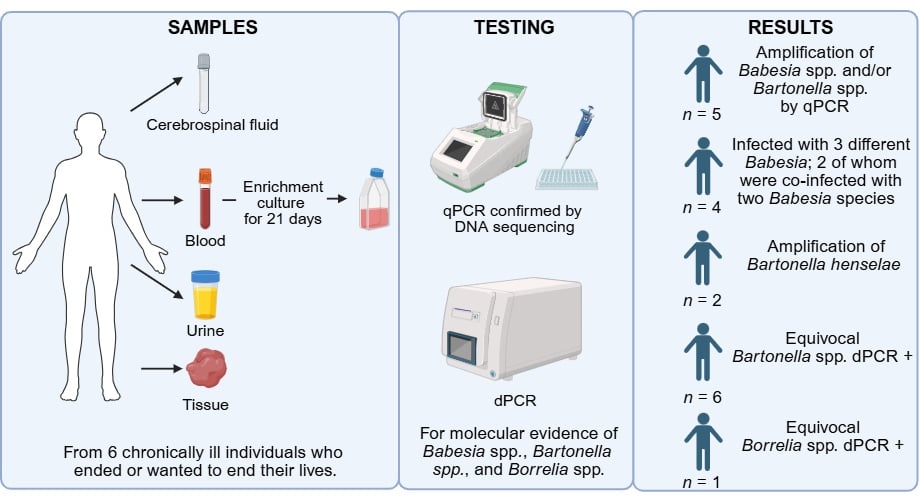
Laboratory controls used to check for contamination remained negative. A weak signal for Borrelia, a bacterial group that includes Lyme disease pathogens, could not be confirmed by sequencing.
These microbes have different routes into the body. Babesia can spread through tick bites, which can also transmit other disease-causing microbes.
B. henselae can spread through scratches from cats infected by fleas. The US Centers for Disease Control and Prevention says there is no evidence that ticks transmit Bartonella to humans.
The next question was whether that DNA pointed to an infection still active at the time of death.
Asked whether the results distinguish active infection from residual DNA, Breitschwerdt acknowledged scientific debate but said detecting a known pathogen’s DNA in clinical specimens is medically accepted as evidence of “active infection”.
Clinical interpretation still requires context. Infectious Diseases Society of America guidelines note that PCR tests for Babesia microti, one of the parasite species identified, can remain positive for months to more than a year after standard treatment, even after symptoms resolve.
Persistent DNA usually does not indicate treatment failure.
Detecting these infections does not establish that they caused the young people’s psychiatric symptoms or deaths.
How could an infection affect the mind?
Areview cited by the researchersdescribes two possible routes: microbes acting directly on the nervous system, and the body’s immune response affecting brain function.
The team suspects inflammation could help connect infection with some of these young people’s symptoms, but the postmortem findings cannot establish that chain of events.
“This was an observational study, not a prospective case-controlled study,” Breitschwerdt told ScienceAlert.
“I think the best interpretation is that infections with vector-borne pathogens that have evolved to induce persistent infections in animals and human patients are not a current diagnostic consideration in patients with chronic illnesses or neuropsychiatric symptoms.”
The families had specifically sought testing, and there was no comparison group. The results cannot show whether these infections are more common in people with suicidal symptoms.
Samples varied in type and timing, sometimes being collected days after death. All six individuals had received antimicrobial drugs, potentially reducing detection. Bacterial movement after death could also have affected blood cultures.

Breitschwerdt says substantial evidence and research funding are needed to determine whether persistent infections contribute causally to suicidality. He wants a national center to investigate chronic infections in people with unexplained illnesses.
“We need an initiative similar to the start of the National Cancer Institute,” he says.
Related:New Tick-Borne Disease Discovered in Dogs May Pose a Risk to Humans
The paper discloses that Breitschwerdt and Ricardo Maggi cofounded Galaxy Diagnostics, which provides Bartonella testing, and hold leadership roles there. Coauthor Henry Lindner is related to one of the individuals studied.
For these families, the investigation has uncovered molecular evidence to pursue. Whether those infections help explain what happened to their children remains unresolved.
The research is published inParasites & Vectors.
If this story has raised concerns or you need to talk to someone, please consult this list to find a 24/7 crisis hotline in your country, and reach out for help.
This article was fact-checked by Fiona MacDonald and edited by Fiona MacDonald. While we pride ourselves on our process, we are only human. If you spot a mistake, please let us know.


Энэ мэдээний талаар ямар нэгэн шалтгаан эсвэл холбоо байж болох уу гэж бодогдохоор байна. Залуусын сэтгэцийн өвчлөл, архаг өвчин ямар ч байгаад энэ паразитуудыг илрүүлж болохыг бодоход сонирхолтой. Таны бодлоор энэ төрлийн халдварт өвчин сэтгэцийн эрүүл мэндэд хэр нөлөөлдөг байж болох уу?