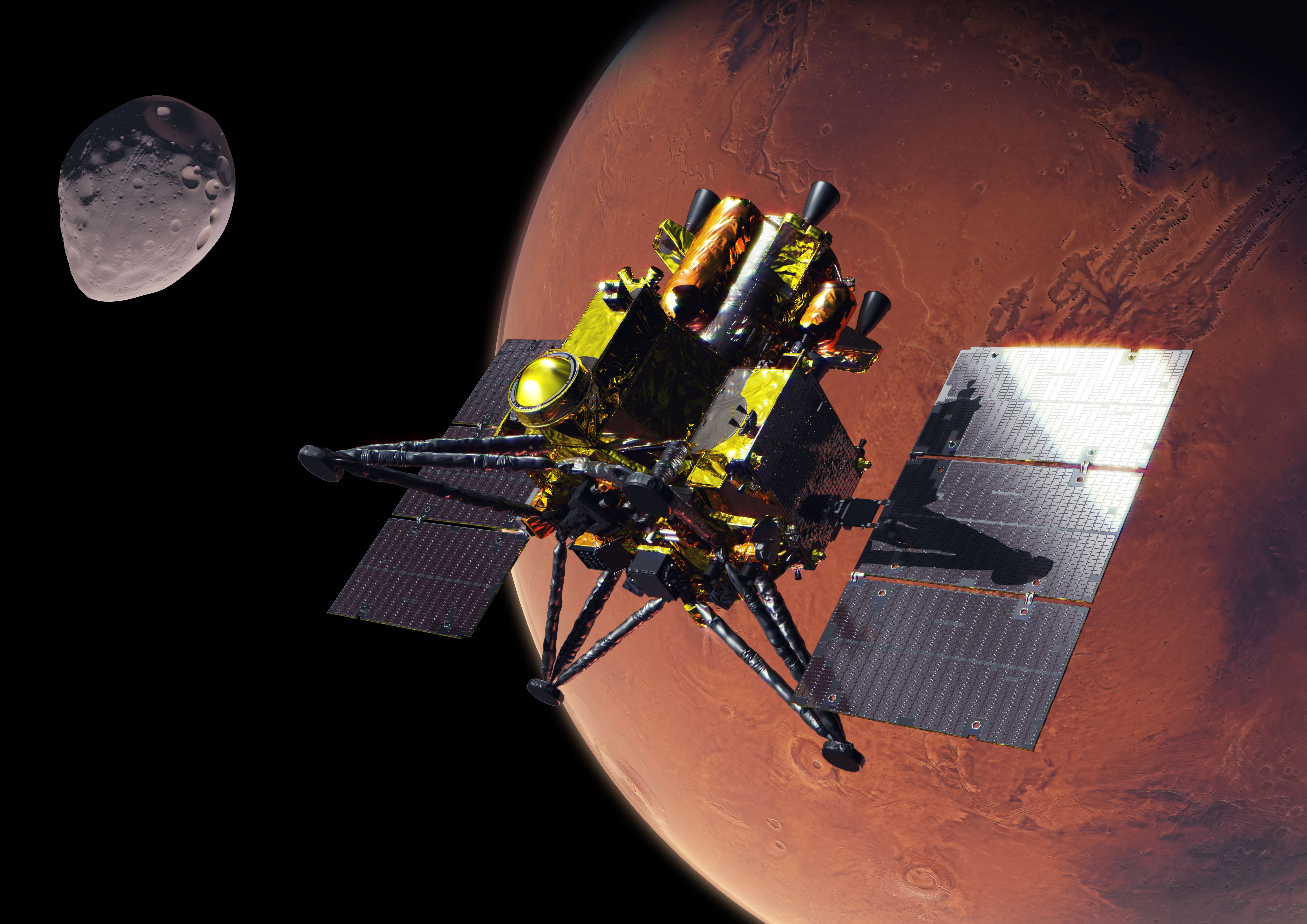
Martian Moons eXploration (MMX) төслийн хүрээнд Фобос дагуулаас анх удаа хөрсний дээж авч, түүний үүслийн нууцыг тайлахаар төлөвлөж байна.
Японы сансрын судалгааны агентлаг (JAXA) Ангараг гарагийн хоёр дагуулын нэг болох Фобос руу судалгааны MMX хөлгийг илгээхээр бэлтгэж байна. Энэхүү номлолын гол зорилго нь Фобосоос дор хаяж 10 грамм хөрсний дээж авч, Дэлхий рүү авчрах явдал юм. Хэрэв амжилттай болбол энэ нь Ангараг гарагийн дагуулаас авсан анхны дээж болно. MMX хөлөг Ангараг гарагт хүрэхийн тулд нэг жил, дараа нь гурван жилийн хугацаанд тойрог замд ажиллаж дээж цуглуулаад, буцаж ирэхэд нэг жил зарцуулах бөгөөд 2031 онд дээжийг Дэлхийд авчрах төлөвтэй байна.
Эрдэмтэд энэхүү дээжийн тусламжтайгаар Фобос болон Деймос дагуулууд хэрхэн үүссэн тухай онолуудыг шалгах боломжтой болно. Нэгэн таамаглалаар, эдгээр дагуул нь Ангараг гарагт асар том биет мөргөлдсөний улмаас үүссэн хэлтэрхий бол, нөгөө таамаглалаар тэдгээр нь Ангарагийн таталцлын хүчинд баригдсан астероидууд байх магадлалтай юм. Тэдний тойрог замын хэлбэр нь мөргөлдөөний онолыг илүү дэмждэг ч, гадаад төрх нь нүүрстөрөгч болон усаар баялаг астероидуудтай төстэй байгаа нь эргэлзээ төрүүлж байна.
Фобос нь ердөө 11 километр радиустай жижиг биет тул түүний гадаргуу дээр буух нь техник технологийн хувьд өндөр сорилт юм. MMX хөлөг нь радио дохионы 20 минутын саатлыг тооцон, бие даасан удирдлагын системээр гадаргуугийн топографийг таньж, аюулгүй газардах зориулалттай. Мөн үндсэн хөлөг буухаас өмнө Франц, Германы сансрын агентлагийн хамтран бүтээсэн IDEFIX ровер нь Фобос дээр 100 орчим хоног бие даан судалгаа хийж, буух талбайн аюулгүй байдлыг хангах үүрэгтэй.
Дэлгэрэнгүйг эх сурвалжаас харах
↓Эх сурвалжийг нээх ↓
A Mars probe from the Japan Aerospace Exploration Agency (JAXA) may answer some longstanding questions about the Red Planet and its moons. The mission—dubbed MMX for “Martian Moons eXploration”—aims to collect at least 10 grams of samples from Phobos, one of two moons orbiting the planet, and if successful, these will be the first rocks from a Martian moon ever brought to Earth.
They won’t arrive quickly, however. The MMX probe will take approximately one year to reach Mars. It will then collect samples during three years of operations while orbiting the red planet before taking another year to return to Earth. If all goes well, scientists expect to receive the moon rocks in 2031.
One of the most interesting questions the probe can answer is how Mars’ moons, Phobos and Deimos, formed. There are two main possibilities. One is that the moons condensed from material ejected during a massive collision with Mars. The other hypothesis is that the moons were asteroids from the outer solar system that were captured by Mars’ gravity.
The moons are dark in color, and their light-reflecting properties closely resemble those of asteroids rich in water and carbon. Their orbits, however—which are nearly circular along Mars’ equatorial plane in the same direction as the planet’s rotation—are better explained by the giant impact hypothesis. Comparing samples from Mars’ moons to those previously collected from the Martian surface could help settle this debate.
To get the Martian moon rocks and transport them back to Earth, however, means overcoming some significant technical challenges in space flight and communication. At launch, the spacecraft will have a mass of 4,480 kilograms (9,900 pounds). More than half of this weight will be fuel, divided into three reserves: one for the outbound leg, one for exploration, and one for the return leg. Once in the vicinity of Mars, MMX will jettison the outbound module after its propellant is exhausted; following the flyby of Deimos, the exploration module will also be jettisoned.
The probe, designed by Mitsubishi Electric, will then land on the surface of Phobos, a delicate procedure given the moon’s size, with an approximate radius of just 11 kilometers. (In comparison, Earth’s moon has a radius of more than 1,700 kilometers.) Descent methods used on Earth’s moon rely on its specific gravity, which is about 300 times as strong as that of Phobos. However, Phobos’ gravity is approximately 50 times greater than that of the asteroid Ryugu, where JAXA has previously landed probes. Landing on Ryugu involved prolonged hovering, a typical method for landing on smaller celestial objects, but this is not feasible for MMX as it would consume too much fuel given Phobos’ greater pull.
To overcome this challenge, the probe is equipped with high-precision autonomous navigation, which it will need, given that there will be a delay of up to 20 minutes for radio signals to travel between Earth and MMX. The probe must therefore autonomously decide on and execute the descent, landing, and later takeoff sequences.
During the descent, the probe will compare the terrain to data on the topography of Phobos’ craters, using this information to adjust its position toward the target landing site. Once it’s reached an altitude under 300 meters, the probe will also detect whether parts of the surface have changed in elevation, labeling significant discrepancies as hazardous areas. This mechanism allows the probe, if necessary, to change the landing site or abort the landing and temporarily ascend.
Just ahead of the main spacecraft’s landing, the IDEFIX rover—jointly developed by the French and German space agencies—will be deployed onto the surface of Phobos to conduct approximately 100 days of independent exploration. This preliminary survey by the rover will serve as a scout to ensure a safer landing.


Японы сансрын хөлөг Фобосоос хөрсний дээж авч, Ангарагийн дагуулуудаас анх удаа дээж цуглуулах гээд байгаа нь сонирхолтой юм. Энэ судалгааны үр дүнд ямар нээлтүүд гарч болох вэ, та ямар таамаглалыг илүү үнэмшилтэй гэж бодож байна?