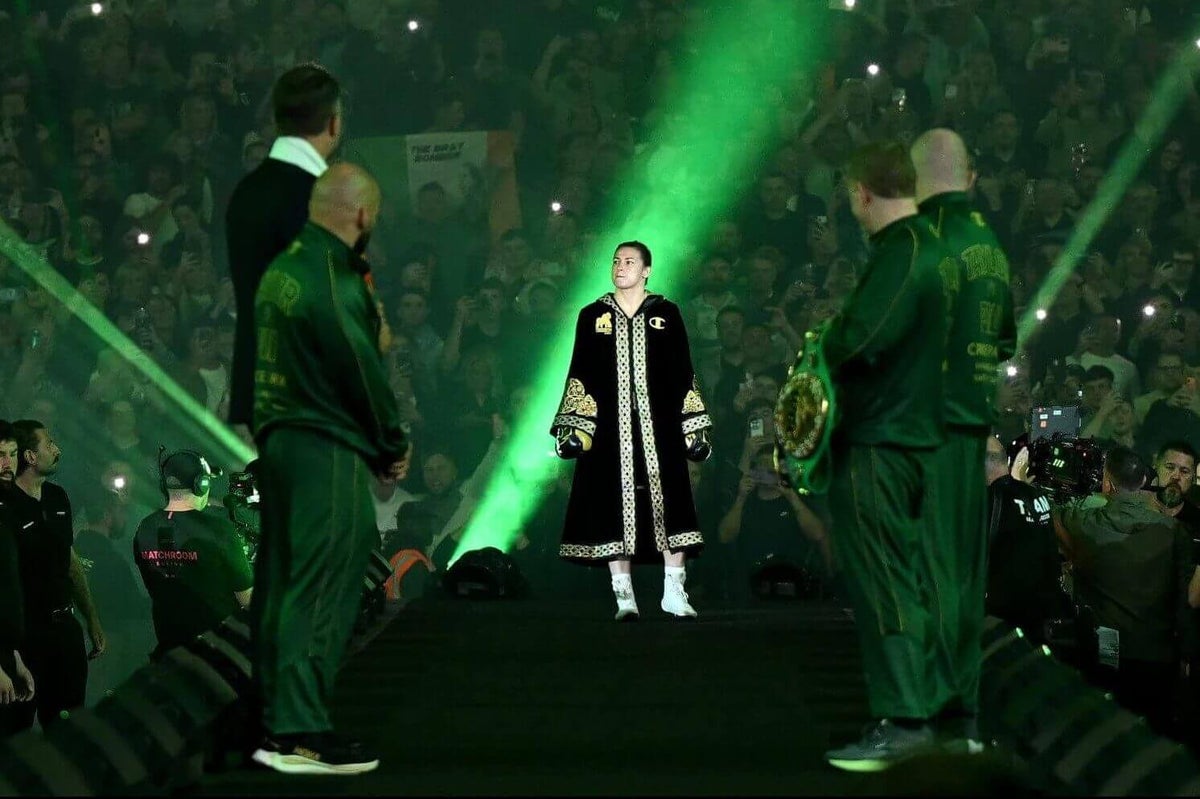
Дэлхийн үнэмлэхүй аварга Кэти Тейлор карьерийнхаа сүүлчийн тулааныг Дублин хотын Кроук Парк цэнгэлдэхэд хийж, ялалт байгуулснаар спортын замналаа өндөрлөв.
Ирландын нэрт боксчин Кэти Тейлор мэргэжлийн боксын рингэнд 26 дахь ялалтаа байгуулж, Францын тамирчин Флора Пилиг ялснаар карьераа амжилттай дуусгалаа. Тэрээр сонирхогчдын боксын дэлхийн таван удаагийн аварга, Олимпын алтан медальт бөгөөд мэргэжлийн боксын гурван удаагийн үнэмлэхүй аварга гэсэн алдартайгаар спортын талбарыг орхиж байна.
Кэти Тейлор нь эмэгтэйчүүдийн боксыг Олимпын наадамд оруулахын төлөө тууштай тэмцэж, спортын түүхэнд шинэ хуудас нээсэн нөлөө бүхий тамирчин юм. Тэрээр 2012 оны Лондоны Олимпоос эхлэн эмэгтэй боксчдын боломжийг тэлж, дэлхийн хэмжээний томоохон рингүүдэд тулалдан, спортын хөгжилд үнэлж баршгүй хувь нэмэр оруулсан билээ.
Зодог тайлах шийдвэрээ гаргасан Тейлор боксын зааланд үргэлжлүүлэн ажиллаж, дараа үеийн тамирчдад урам зориг өгөх хүсэлтэй байгаагаа илэрхийлсэн юм. Түүний байгуулсан амжилт, спортод оруулсан хувь нэмрийг нь мэргэжилтнүүд болон хамт тулалдаж байсан тамирчид өндрөөр үнэлж байна.
Дэлгэрэнгүй эх сурвалжийг харах
Эх сурвалжийг нээх ↓
In March 2009, 9,000 boxing fans filled Dublin’s O2 arena to see Bernard Dunne (The Dublin Dynamo) fight for a world title against Panama’s Ricardo Cordoba. On the undercard of that fight was a name that many inside the arena had heard before, but few had seen in action. Katie Taylor was one of Ireland’s most successful sportspeople; a two-time world amateur champion, three-time European champion and the fighter pushing hardest for the International Olympic Committee to allow women’s boxing into the Olympic Games for 2012.
There were huge cheers as she walked to the ring that night to take on three-time Pan American champion Caroline Barry in a four-round fight under amateur rules (four, two-minute rounds).
“Just wait ‘til you see Katie Taylor,” said legendary RTE commentator Jimmy Magee, well aware that many of those watching will not have done so before. “She’s the most talked about and least seen Irish sportsman,” he surmised.
Taylor in action with Barry in Dublin (PA Images via Getty Images)
As the fight began, Magee’s partner in the commentary booth Dave McAuley took in what he was seeing: A female fighter with lightning-quick hands, punch power, neat footwork and impeccable balance.
“She punches better than some men I have seen,” he said in the opening round.
By the end of the fight, an enthralling contest which Taylor won by a somewhat wide 27 points to 3, the crowd was on their feet.
“That’s as good an amateur fight as I’ve seen, and I’ve been doing it for 46 years,” said Magee. “A night that few of us who’ve seen it will forget. Women’s boxing is alive, well and pumping in the O2 arena.”
Few could have imagined then, just how far women’s boxing would travel, carried high on Taylor’s shoulders, over the next 17 years.
On Saturday night, she put on the gloves for one last time and recorded the 26th victory of her professional career, defeating previously unbeaten Frenchwoman Flora Pili in front of 80,000 adoring fans at Croke Park — a venue filled with prestige and history — in a fight shown live on free-to-air television in Ireland. She retires as the winner of five amateur world titles, an Olympic gold medal, and a three-time undisputed world champion as a professional.
Success inside the ring is only one part of the Taylor story, though. Beyond it, there is so much more.
“I first saw Katie when she was like nine or 10, beating up some poor young fella,” says Mercedas Taaffe-Cooper, who was one of the first female boxing coaches in Ireland in the 90s and trained Irish amateur stars including brothers Alan and Stephen Reynolds. Speaking from her home in Australia, where she combined her clinical psychology and sports science background to found CounterPunch, a resilience program using boxing and psychology to support teenagers, Taaffe-Cooper says she saw Taylor’s ability straight away.
“She was one of those athlete types — she was a top-quality soccer player as well. And she had natural hand speed. She didn’t really care that it was boys (she was sparring). I actually felt sorry for the boys because some of them would have potentially hesitated a bit. But I think after they got a few claps off Katie, that went out the window.”
At that time, girls and women were not allowed to box in Ireland (or many other countries). Taylor was desperate for that to change. Seeing the boys from her gym — including ones she was beating up in spars — entering and winning championships was galling, when there was no opportunity for her to do the same.
She took matters into her own hands, tucking her hair into a headguard and registering at competitions as K. Taylor. It was a time that instilled in her the purpose that has fuelled her ever since: to ensure that the women and girls who came after her would not have to face the same barriers.
Change soon came. In England, boxer Jane Couch took the British Board of Boxing Control to an industrial tribunal over their refusal to grant her (or any woman) a professional boxing licence. In March 1998 she won, earning the right to box professionally in the UK. It was a landmark ruling.
Ireland followed suit three years later, and in October 2001, a 15-year-old Taylor found herself facing Alanna Audley, a year her senior, at Dublin’s National Stadium, in Ireland’s first officially sanctioned amateur women’s boxing match. The pair have remained friends ever since.
Five years later, Taylor became Ireland’s first-ever amateur boxing world champion. It was just the beginning. She did not lose a single fight from the time she won that title in November 2006 until March 2010, picking up another world title in that period. She dreamed of something even bigger, though.
“I had this dream of being Olympic champion,” she told The Athletic in a video call from her training base in Connecticut, U.S., ahead of her final fight. “And my whole childhood was based around that dream, just preparing for the Olympic Games.”
Taylor’s success on the global amateur stage gave her a platform to try and convince a sceptical International Olympic Committee (IOC) that women’s boxing should be included in the Games — a stage it hadn’t featured on since it was included as a demonstration sport at the 1908 Olympics.
She took part in exhibition fights in Russia and Chicago, U.S. The pressure was immense. Speaking to BBC Radio Ulster, Taylor recalled getting a visit from an IOC member a few days before she fought in Chicago in 2007, who told her that her performance would determine whether women’s boxing was going to be included in the Olympic Games or not.
“I had to perform,” she said. “I wasn’t just boxing for me. I was boxing for every single female who ever dreamt of boxing in the Olympic Games.”
A huge part of Taylor’s legacy is wrapped up in that Olympic story. It started with a record-breaking noise recorded during her first contest, against Great Britain’s Natasha Jonas (London 2012 officials declared the roar of the crowd as louder than a jumbo jet taking off, with a 113.7 decibel reading) and culminated in her winning her country’s first gold of the games.
“She broke down doors in the amateurs — made the whole world pay attention,” Jonas tells The Athletic. “She forced people to look, to respect the skill and single-handedly changed the trajectory of what was possible for women in this sport.”

Taylor celebrates after defeating Jonas in the 2012 Olympics (Photo: Scott Heavey/Getty Images)
In 2016, Taylor left the amateur ranks, having won five world titles in a 15-year amateur career spanning 189 fights (12 defeats, 1 draw). She’d gone to the Rio Olympic Games without her father (who’d coached her from the start of her career) in her corner, after family issues divided them, and suffered a heartbreaking loss in the quarter-finals. She felt she had nothing left to prove in the amateur scene and needed a fresh challenge.
At the time, there was no real professional scene for female fighters, with the major promoters not seeing any commercial value in it.
Taylor knew she had the skill and support to change that. She recruited the experienced Brian Peters to be her manager and then did something she still cringes about a decade later.
On October 4, 2016, the famously quiet, reserved fighter picked up her phone, opened her Twitter (now ‘X’ ) app and clicked on the ‘search’ function. Taylor typed in Eddie Hearn’s name and tapped on the ‘message’ button on the promoter’s profile.
Deep breath.
“Hi Eddie, hope you’re well. I hope you don’t mind me reaching out like this out of the blue. I’ve been seriously considering turning pro the last few months …”
Not wanting to be rude, the Matchroom chairman agreed to a meeting with Taylor and Peters, fully believing it would end with him having to let them down gently. Instead, it ended with him agreeing to put her on a card at Wembley Arena. Her passion, determination and single-minded focus had completed the deal. The salesman had been sold to.
“There was no women’s boxing back then,” Peters tells The Athletic. “I know we had Christy Martin, Laila Ali and all them, but the truth is it never stood the test of time because consistency is the true measure of greatness, in many walks of life. People have to care. We grew up with Katie, we saw the Olympics, we saw her fall, we saw the peaks and the valleys, so we all cared deeply.”
Four fights in, Peters says Taylor was earning £10,000 per fight. “We don’t know where we are going, there’s no minimums, there’s no world title numbers.”
They were struggling to bring in opponents, and Peters remembers Taylor telling him she was ready for anything: “What do you call the Belgian cop one?” she asked him, referring to the notoriously tough WBC lightweight champion Delfine Persoon. “Give me the Belgian cop.”
“I said, ‘Katie, when we fight Persoon, I want to shake Eddie Hearn down for a lot more money. I want it to be at Madison Square Garden (MSG).’ I honestly didn’t think it would be. ‘And I want it on the biggest platform possible.’ Katie looks at me with the gunfighter eyes and says, ‘You just make sure that I’m the one to beat her’.”
In June 2019, Taylor got her wish, taking on Persoon for the chance to unify the lightweight division. And Peters got his, with the fight taking place at the historic MSG. The fight was a brutal, bloody battle that Taylor edged (though it was by no means a clear victory), and one that would have stolen the night had it not been for Anthony Joshua’s shock defeat to Andy Ruiz later that evening.

Katie Taylor (left) in action against Persoon (Nick Potts/PA Images via Getty Images)
Nevertheless, it was an event that pushed Taylor, and women’s boxing, into new territory, and paved the way for what was to come three years later.
“The first Serrano fight everyone wanted to go to the small room in the Garden,” says Peters, talking about Taylor’s historic fight against seven-division title winner Amanda Serrano at MSG.
“I talked them into going into the main room. To take a chance.”
In April 2022, Serrano and Taylor became the first female boxers to headline the legendary New York venue, and, thanks to the involvement of Jake Paul’s Most Valuable Promotions (MVP), the first to earn over $1m each. In front of a sellout crowd of 19,187 (4,000 of whom had flown from Dublin to New York for the fight), the two women put on one of the fights of the year: an intense, tumultuous battle that swung back and forth for 10 rounds. Taylor emerged with the victory, but as they embraced after the final bell, both understood that what they’d done that night was an even bigger win for women’s boxing.
Throughout it all, Taylor has remained the same person, with the same values. Deeply religious, she invites her family into her dressing room before each fight to pray. She refers to her Christian faith as the “whole lens through which I see the world. It’s the whole lens through which I view my career and see the people in my life.
“It also helps me put fame and recognition in its right order, which is very far down in my value system.”
Taylor fought Serrano twice more, the first rematch coming after she suffered her first defeat as a professional, to Britain’s Chantelle Cameron. Taylor avenged that defeat six months later and, a year on, was back in the ring with Serrano, on the undercard of one of the most-watched fights in history: Jake Paul versus Mike Tyson, which was streamed on Netflix in November 2024.

Taylor and Serrano last year (Photo: Stephen McCarthy/Sportsfile via Getty Images)
“Like, what the hell?” laughs Peters. “Whoever thought we would be fighting on a Mike Tyson card. Let’s be honest, it was a bit of a circus. But the power of Netflix is serious.”
The fight set a record for punches landed in a 10-round women’s fight, with Taylor once again getting the win after another enthralling war, giving the pair momentum to sell out MSG for a second time as they completed their trilogy last July.
The most comprehensive win of them all for Taylor looked as though it could be her final bow. At the age of 39 and a two-time undisputed world champion, she had nothing left to prove.
She did have one more dream, though.
“After that fight, I was sitting in the hotel room with my team, and I said, ‘Guys, this has been an amazing journey. This is probably going to be the end unless I get Croke Park. What could top Madison Square Garden?
“The only thing that could have, for me, was Croke Park. Now here I am. I get this opportunity. I’m blown away by it all.”
Croke Park is more than a stadium. To the people of Ireland, it is a symbol of Irishness. The historic headquarters of theGaelic Athletic Association (GAA), it has a history Ireland cannot forget, as the place where 14 people lost their lives when British forces opened fire on the crowd attending a Gaelic football match, against the backdrop of the Irish War of Independence. It is the grand cathedral of Irish sport and national identity — the perfect place for Taylor to lay down her gloves.
She wanted her last fight to be in Ireland as a way to pay respect to those who have supported her throughout her career. “People have spent their hard-earned money travelling around the world to support me, both as an amateur and as a professional. I want to put on a performance worthy of everyone’s support.”
She leaves the sport in a very different place to how she found it as that 10-year-old girl hiding her hair in a headguard.
“She carried the entire sport on her back to the grandest stages in the world,” says Jonas, who shared a ring with Taylor as an amateur and professional. “As a rival, sharing the sport’s golden era with her has been an honour. Though I won’t miss trying to prepare for someone who brings a whole nation with her.
“She pushed all of us to be sharper, train harder and raise our game, because we had to if we wanted to be competitive.”

Taylor lays in a punch on Saturday night (Charles McQuillan/Getty Images)
For Taaffe-Cooper, who says she will be watching Taylor’s final fight from her home in Australia, Taylor’s legacy is one that goes far beyond boxing.
“At Croke Park, I doubt if even a quarter of the people there will just be pure boxing people,” she says, of the 84,000 tickets that were sold in just 17 minutes when they went on sale. “That’s the influence that she has. People who have never been to a boxing match want to come and see Katie Taylor. They just love her, as opposed to her as just a boxer. For someone who’s so shy and retiring, her charisma is huge.
“To me boxing is just her medium, but her influence and her purpose is a lot bigger than that.”
Couch says she has seen the difference Taylor’s career has made in her gym in Fleetwood, where the girls coming in “are getting younger. You look at them, and they’re 12 years old, and they’re mustard. I think the next set of amateurs that come through are going to be better than the last lot and then the ones after them are going to be better than them.”
She describes Taylor as “instrumental” to the sport, and to showing promoters that “you can sell. Look at Ireland,” she says, speaking days before Taylor’s final bout at Croke Park. “You won’t be able to get a ticket. And that’s the secret of it, because professional boxing is all about money.”
Last month, MVP put on an all-female card in Birmingham, headlined by a unification fight between Chantelle Cameron and Mikaela Mayer. On the undercard was British super-bantamweight champion Tysie Gallagher, who told The Athletic: “This show [MVP UK v USA] wouldn’t exist without her (Taylor).
“Female boxing is so big on the cards now. We wouldn’t have cards like this without her — no way. Katie’s really paved the way and inspired pretty much all of us.”
Peters does not hold back in his feelings about a fighter with whom he’s never had a contract, but has developed a bond strong enough to survive a decade in the chaos of professional boxing.
“I do believe God did send me Katie Taylor,” he says. “She’s a very special person. And not only is she the greatest [Irish sportsperson], without doubt, no disrespect to Roy Keane and the likes, because look how long she’s been at the top of her game – over 20 years, she’s been a world champion between amateur and pro. And the way she’s held herself, she’s never changed one moment.”
Peters spent time with Muhammad Ali and says that at the time, he doubts if people fully realised the cultural impact he would have. “Ali is the ultimate,” he says, “but Katie has a lot of cultural impact also. And the difference that she made culturally I don’t believe people will acknowledge, accept or even recognise for many years to come.”
As a retired fighter, Taylor faces the daunting task of deciding what comes next. Never one to chase (or even enjoy) the limelight, she’s unlikely to take on a regular role in punditry, but she is sure of one thing: boxing will remain a large part of her life.
“I’ll be popping into the local boxing gym over here on a daily basis,” she says of her U.S. base. “I just love the gym environment. I love being around and looking at some of the spars and just the intensity of the gym; the gritty stuff, the determination, the heart that’s shown in the ring.
“It’s a fantastic place to be. I’m so grateful my whole life has been based around this boxing gym environment. The character that it actually develops in a person.

Taylor leaves her gloves in the ring after the fight (Charles McQuillan/Getty Images)
“So I’m definitely going to be involved in some way, but what that looks like right now, I’m not too sure.”
Taylor got her “fairytale ending” at Croke Park, but what she wanted more than anything was to leave a lasting legacy on her sport. “I think that’s how I want to be remembered,” she told The Athletic, “just knowing that I left my sport in a better place.
“And I’m seeing so many girls around the country boxing now. Every single boxing club is packed with female fighters. That, to me, is the greatest legacy that I could have left.
“And I can’t wait to see what those young girls are going to grow up to achieve.”
Additional reporting: Amelie Claydon

