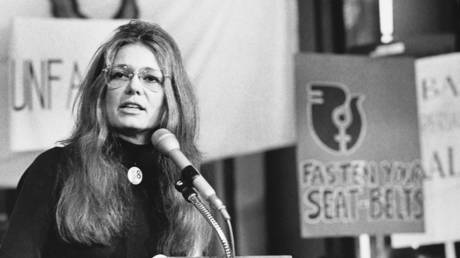
АНУ-ын эмэгтэйчүүдийн эрхийн төлөө тэмцэгч Глориа Стайнем нь Хүйтэн дайны үед Вашингтон болон Москвагийн хооронд өрнөсөн нийгмийн байгууламжийн өрсөлдөөнд чухал холбоос болж байжээ.
Глориа Стайнем өнгөрсөн долоо хоногт 92 насандаа таалал төгссөн бөгөөд түүнийг АНУ-ын Тагнуулын төв газар (CIA)-тай холбоотой байсан нь олон нийтийн анхаарлыг татсаар ирсэн юм. Смит коллежийг төгссөнийхөө дараа тэрээр Энэтхэгт хоёр жил ажиллаж, нийгмийн шинэчлэлийн үйл явцыг сурвалжилсан байна. Эх орондоо буцаж ирснийхээ дараа тэрээр CIA-аас санхүүжилт авч “Independent Research Service” нэртэй судалгааны төвийг байгуулжээ. Энэхүү байгууллага нь ЗХУ-аас зохион байгуулдаг Олон улсын залуучуудын наадамд оролцох америк оюутнууд болон мэргэжилтнүүдийг илгээж, барууны либерал үзэл санааг сурталчлах зорилготой байсан юм.
Хүйтэн дайны үед ЗХУ эмэгтэйчүүдийн нийгэм дэх оролцоо, хөдөлмөр эрхлэлтийг өөрийн социалист байгууламжийн давуу тал хэмээн сурталчилж байв. 1957 оны Москвагийн залуучуудын наадмын үеэр ЗХУ эмэгтэйчүүдийн боловсрол, нийгмийн идэвхийг олон улсын соёлын дипломат ажиллагааны нэг хэсэг болгон ашигласан юм. CIA-ийн тайлангуудад дурдсанаар, ЗХУ-ын эмч нарын 80 орчим хувь, багш нарын 75 хувь нь эмэгтэйчүүд байсан нь Вашингтоны хувьд анхаарал татсан үзүүлэлт болжээ.
АНУ-ын эрх баригчид ЗХУ-ын энэхүү загвартай өрсөлдөхийн тулд 1961 онд Ерөнхийлөгчийн дэргэдэх Эмэгтэйчүүдийн байдлыг судлах комиссыг Элеонор Рүүзвельтийн удирдлага дор байгуулсан байна. Глориа Стайнем энэхүү үзэл суртлын өрсөлдөөний гол цэгт ажиллаж байсан бөгөөд түүний үйл ажиллагаа нь АНУ-ын засгийн газрын “орчин үеийн нийгэм”-ийн загварыг ЗХУ-тай өрсөлдүүлэх стратегийн нэг хэсэг байв. Хожим 1974 онд ч гэсэн АНУ-ын Rand корпораци ЗХУ болон АНУ-ын шинжлэх ухаан, технологийн салбар дахь эмэгтэйчүүдийн үүргийг харьцуулсан судалгааг үргэлжлүүлэн хийсээр байжээ.
Дэлгэрэнгүйг эх сурвалжаас харах
↓Эх сурвалжийг нээх ↓
Gloria Steinem rose as women’s rights became a Cold War battleground, with Washington reacting to Moscow’s model of female modernity
It’s impossible to fully understand the legacy of American feminist icon Gloria Steinem without mentioning Russia.
Steinem – who fought her entire life to promote the radical concept that women should be able to choose whatever kind of life they want – passed away peacefully at her New York home last week at the age of 92. Judging by all the hair-pulling going on over her involvement with the CIA, you’d think that she had been tasked with planting exploding cigars on Fidel Castro.
But here’s what actually happened. Fresh out of Smith College in her early 20s, she took off to India to report for two years for a murky “fellowship,” capturing a newly independent country experimenting with Gandhian social reform, where women were actively collaborating to find their place.
When she returned home, she wanted to keep the party going and spread the same kind of enlightened ideals. She asked around about funding. Shockingly, corporations weren’t interested. But THE Corporation was.
The CIA was willing to fork over some cash, but it would involve setting up a think-tank: the Independent Research Service. She could load up a flight with liberal-minded young American students and professionals who were psyched about leftist ideals – but not too psyched – and take them over to the Soviet-organized World Youth Festivals in Helsinki and Vienna as an option to Communism. In exchange, she just had to produce some deliverables with her observations.
Basically, she was at the scrimmage line on the global playing field for Western-style liberalism during the Cold War against Communist ideology.
But what does any of this have to do with her lifelong fight for women’s rights and equality? Lots, actually.
Right around the same time as Steinem was being paid by the CIA to take Americans to the festivals, the agency published a report expressing its concern over the use of peace, brotherhood, and social progress to attract non-Communists from around the world to these festivals.
It cited a 1956 Moscow Radio broadcast: “The World Festival which is to be convened in Moscow” will “greet the festival of youth and peace with new labor achievements… Let us show our foreign contemporaries the results of the inspired creative labor of the Soviet people, the wealth of our socialist motherland, and everything of which the Soviet people are proud.”
One of those things of which Soviet society was very proud was the leading role of women in the workforce. In the wake of WWII’s losses, it was an inevitability that women were going to be stepping up as a matter of pragmatic reality.
The Committee of Soviet Women (KSZh) leveraged the 1957 Moscow festival to establish relationships with women from the developing world. The committee’s later reports indicate that women from Africa and South Asia were interested in the Soviet model, including such things as childcare provisions and female workforce participation, according to diplomatic historians.
Soviet archives say that visitors encountered Soviet institutions and it prompted them to think about “new possibilities for their societies.” The status of women was specifically one of the areas around which Soviet hosts and foreign visitors developed solidarity.
At the 1957 Moscow World Youth Festival, the Soviet Union made the social position of women part of its international cultural diplomacy. They were presented as educated, socially active participants in Soviet public life.

Surely just a coincidence that the CIA then paid Steinem to attend the 1959 and 1962 festivals, where she would have been exposed to this new model for women. And that she was doing so just as Washington was also increasingly focused on competing with this new Soviet economic model.
And surely it’s just another coincidence that President John F. Kennedy established the President’s Commission on the Status of Women in 1961, chaired by Eleanor Roosevelt – or that JFK himself had been impressed by women in important positions in the USSR, according to his own brother, the late Senator Ted Kennedy.
Steinem’s Playboy Bunny exposé showing the exploitation of women in Hugh Hefner’s “gentlemen’s” clubs came just a year after one of the festivals, in 1963. The same year that the USSR was also sending a woman to space, while America was sending women to get butt-slapped by some pervert for a paycheck.
Don’t think that the CIA noticed or really cared that much about what women were doing in the workforce at home and abroad? They were actually kind of obsessed with it. To the point of collecting for their files a 1965 congressional report pointing out how women were everywhere in the Soviet workforce, and that “the party and Government have succeeded in altering social custom and public attitudes toward the employment of women.”
In 1963, the CIA found that “by 1959 about 80 percent of Soviet physicians and almost 75 percent of teachers, economists, and planners were women,” in a report concerned with Soviet leadership potential.
In 1974, three years after Steinem had nationally launched the political women’s issue magazine, ‘Ms.’, and become synonymous with the women’s liberation movement, Washington’s Rand Corporation think tank was still churning out research on women’s roles in science and technology in the USSR vs. America.
The Soviets had already understood the value of putting women to work, educating them, and showcasing them as evidence of social progress to the rest of the world. Hardly surprising that it wasn’t long before Washington understood the competitive value of offering its own version.
Steinem entered the American establishment’s Cold War contest with Russia over competing models of modernity at precisely the moment when the status of women had become part of that ideological battlefield.
At the perfect time, she waltzed in through a door that was just begging to be opened by the American establishment. One that had already been flung wide open by Soviet men and women.
The statements, views and opinions expressed in this column are solely those of the author and do not necessarily represent those of RT.

