Огторгуйд идэвхгүй байдалтай орших хар нүхнүүд нь хос одны системд хэрхэн тогтвортой хадгалагдан үлдсэн нь эрдэмтдийн анхаарлыг татаж байна.
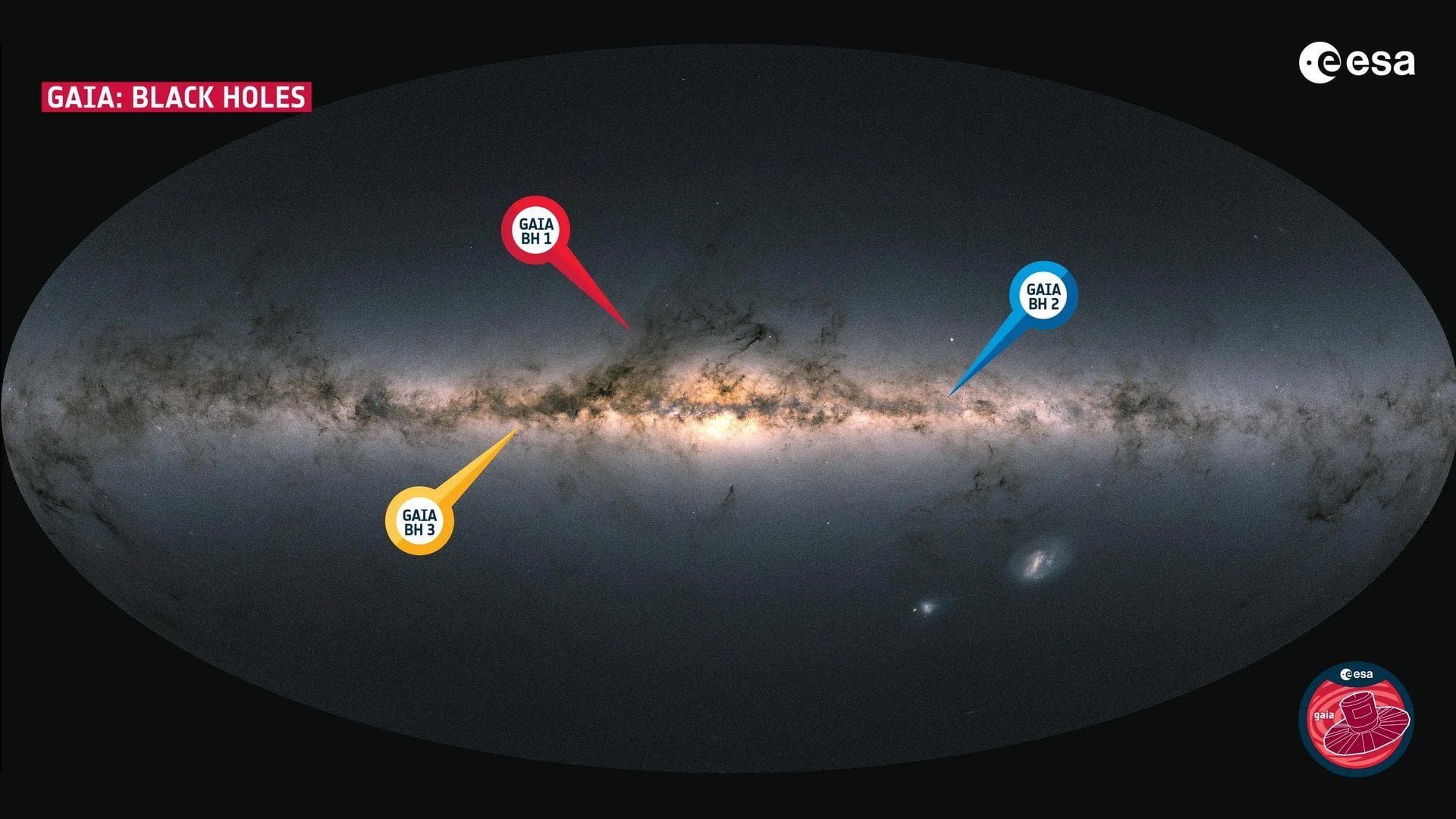
Идэвхтэй хар нүхнүүд нь хүчтэй рентген туяа цацруулж, бодис залгин, тод ажиглагддаг бол ихэнх одны масстай хар нүхнүүд огт идэвхгүй байдаг тул тэдгээрийг шууд ажиглах боломжгүй юм. Гэвч ESA-гийн Gaia сансрын дурангийн өндөр нарийвчлалтай хэмжилтийн ачаар оддын хөдөлгөөнд гарч буй бага зэргийн хазайлтаар дамжуулан ийм гурван хар нүхийг илрүүлээд байна. Эдгээр хар нүх нь жижиг одтой хамт хос систем бүрдүүлэн эргэлддэг бөгөөд энэ нь тэднийг анх тэгш бус масстай хос одны системээс үүссэнийг гэрчилж байна.
Gaia BH3 систем нь таамаглаж байсанчлан өргөн тойрог зам бүхий хос систем боловч BH1 болон BH2 системүүдийн хувьд оддын хоорондын зай хэт ойр байгаа нь эрдэмтдийн хувьд оньсого болж байна. Том масстай од мөхөж, хар нүх болон хувирах явцдаа хэмжээгээрээ асар их тэлдэг тул ойрхон эргэлдэх хамтрагч одоо залгих эсвэл хоёр од нэгдэх эрсдэлтэй байдаг. Судлаачид энэхүү тогтвортой байдлыг тайлбарлахын тулд “Roche Lobe Overflow” буюу Рошийн хязгаараас бодис шилжих процессыг нэр дэвшүүлжээ.
Энэхүү загварын дагуу тэлж буй одны гаднах давхаргын бодис Рошийн хязгаараас даван гарах үед хамтрагч од нь түүнийг өөртөө татаж авдаг байна. Хэрэв шилжиж буй бодис хангалттай сийрэг байвал хоёр од хоорондоо мөргөлдөж нэгдэлгүйгээр тогтвортой тойрог замд үлдэх боломжтой. Гэсэн хэдий ч ажиглагдсан гуравхан системийн мэдээлэл нь энэ онолыг батлахад хангалтгүй бөгөөд цаашдын судалгаагаар тэгш бус масстай хос одод хар нүх болон хувирах үйл явц урьд өмнө төсөөлж байснаас илүү нарийн төвөгтэй болохыг харуулж байна.
Дэлгэрэнгүйг эх сурвалжаас харах
Эх сурвалжийг нээх ↓
Active black holes are pretty easy to detect. Their superheated accretion disks emit bright x-rays, and the jets streaming from their poles are easily seen at visible and radio wavelengths. But most stellar-mass black holes are inactive. They either drift through the galaxy alone or orbit a companion star without consuming its material. We can’t observe inactive black holes directly. We can only observe their effect on nearby objects. We currently know of three such black holes thanks to the Gaia spacecraft.
The main mission of Gaia is to map the positions and motions of more than a billion stars in our region of the Milky Way. To achieve its goal, the motion measurements must be very precise. Precise enough that we can detect small wobbles in a star’s motion. Usually this means the star has a planet, and the gravitational tug of the planet causes the star to wobble. But in at least three cases the gravitational tug is so large that the companion must have a stellar mass. If it were a star, Gaia would see it. Since Gaia doesn’t, the companion must be a black hole.
Each of the quiet black holes we’ve discovered this way has a small stellar companion. This means that in the past these were asymmetrical binaries, meaning that one of the stars was much larger than the other. The remnants of the large stars became black holes, forming the systems we see today.
An illustration of the Roche lobe overflow model for mass transfer. Credit: MPA/A. Olejak
In one of these systems, Gaia BH3, the system is a fairly wide binary just as we would expect. But the other two, BH1 and BH2, the binaries are much closer. This poses a challenge as to how they formed. When a large star dies, it expands tremendously. A close-orbiting companion would be engulfed by the dying star, causing the two of them to merge before the system becomes a single black hole. Given the orbits of the companions in BH1 and BH2, how did they survive? One idea is a process known as Roche Lobe Overflow.
The Roche lobe for a particular star is the region of space where its own gravity dominates. Beyond that region, the companion star has a stronger influence. This means that when the outer layers of an expanding star move beyond the Roche lobe, tidal forces will allow the material to be captured by the companion star. If the initial material that expands beyond the lobe is diffuse enough, then the smaller star could capture it without causing the two stars to spiral into each other. The small companion can then maintain a stable orbit long enough for the large companion to collapse into a black hole.
With only three observed systems, we don’t have enough evidence to confirm the Roche Lobe Overflow model. But this initial study demonstrates that the way asymmetrical binary systems become black hole binaries is more complex than we realized.
Reference: Olejak, Aleksandra, et al. “Nonconservative Mass Transfer as a Formation Channel for Gaia Black Hole Systems.” The Astrophysical Journal 1006.1 (2026): 13.

