Эртний чулуулагт агуулагдах органик молекулуудын судалгаагаар далайн хөвөн нь манай гараг дээрх хамгийн эртний амьтдын нэг болохыг баталж байна
Оман, Энэтхэг, Сибирийн бүс нутгаас олдсон эртний тунамал чулуулагт 31 нүүрстөрөгчийн атом бүхий хоёр төрлийн органик молекул илэрчээ. Эдгээр “стеран” хэмээх молекулууд нь эсийн мембраны бүтцэд ордог стеролын үлдэгдэл бөгөөд орчин үеийн далайн хөвөнгийн биед мөн агуулагддаг байна. Эртний зөөлөн биетүүд яс, бүрхүүл үлдээдэггүй тул эдгээр химийн ул мөр нь тэдний оршин байсныг батлах гол нотолгоо болж байгаа юм.
Судлаачид лабораторийн нөхцөлд найман төрлийн стеролыг гарган авч, тэдгээрийг геологийн хувьслын явцад хувирах боломжтой нүүрсустөрөгчийн хэлбэрт шилжүүлэн туршжээ. Үүний үр дүнд лабораторид бүтээсэн хоёр молекул нь эртний чулуулаг дахь молекулуудтай яг таарч байгааг тогтоосон нь эдгээр нэгдлүүд нь санамсаргүй шинж чанартай биш, харин далайн хөвөнтэй холбоотой болохыг харуулж байна. MIT-ийн геологич Рожер Саммонс болон түүний баг энэхүү гурвалсан нотолгоо буюу чулуулаг дахь олдвор, орчин үеийн хөвөнгийн бүтэц, лабораторийн туршилтын үр дүн нь далайн хөвөн бол Дэлхий дээрх хамгийн эртний амьтдын нэг гэсэн таамаглалыг дэмжиж байгааг онцолжээ.
Гэсэн хэдий ч судалгааны багийнхан эдгээр амьтан яг хэзээ анх үүссэнийг тодорхойлох боломжгүй хэвээр байгааг хүлээн зөвшөөрөв. Неопротерозойн эриний чулуулагт хийсэн дүн шинжилгээ нь далайн хөвөн байсныг нотолж байгаа ч криогенийн үеийн чулуулгийн дээж хангалтгүй байгаа нь он цагийн хувьд тодорхойгүй байдлыг үүсгэж байна. Энэхүү химийн ул мөр нь эртний амьтдын гадаад төрхийг бүрэн дүрслэхгүй ч тэдгээр нь далайд амьдардаг, силикат ясгүй, зөөлөн биетэй организмууд байсан гэж эрдэмтэд таамаглаж байна.
Дэлгэрэнгүйг эх сурвалжаас харах
↓Эх сурвалжийг нээх ↓
In ancient rocks from Oman, western India and Siberia, researchers have identified what appear to be two unusual organic molecules with 31 carbon atoms. These same molecules appear in modern-day sea sponges; likewise, those created in laboratories act identically to the molecule created by fossilization.
Steranes represent neither identifiable shells, bones nor impressions. Steranes are stable organic remainders of sterol(s) which represent part of the membrane structure of cells. Although hundreds of million years may pass for some soft-bodied organisms leaving behind no evidence of their presence via shell/bone/body impression type fossilization, sterols may continue in altered configurations.
A chemical comparison lends further support to the notion that ancestors of the demosponge were present on Earth prior to the Cambrian explosion of animal diversity. Researchers did not claim to identify a single ‘first animal,’ however, they believe based upon their research published in the Proceedings of the National Academy of Sciences in 2025, that sponges were among the first animals to inhabit our planet.
A Chemical Clue With a Disputed History
The search had started years earlier, with a different set of molecules.
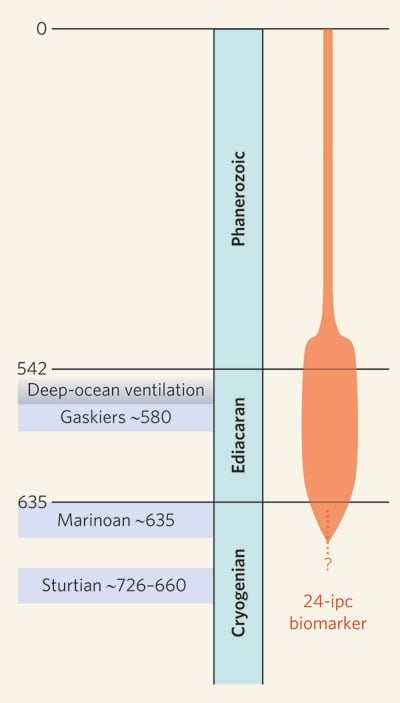
In 2009, researchers studying ancient sedimentary rocks in Oman reported unusually abundant 30-carbon steranes, particularly a compound called 24-isopropylcholestane. Modern demosponges can produce the sterols from which these molecules form, leading the team to read them as chemical fossils of ancient sponge life. Their Nature paper placed some of that evidence around or before the end of the Marinoan glaciation, roughly 635 million years ago.
That date sits within the Neoproterozoic, the final era of the Precambrian. It includes the Cryogenian, a period marked by severe glaciations, and the later Ediacaran, when increasingly complex multicellular organisms become far more visible in the fossil record. Roughly 635 million years ago.
But the chemical interpretation became contested. Researchers proposed that the 30-carbon steranes might have come from other organisms, including single-celled Rhizaria, or that ordinary algal sterols could have been chemically altered after burial into molecules resembling the supposed sponge biomarkers. The problem was not whether the molecules existed in the rocks.
It was whether ancient sponges really put their precursors there.
The 2025 study tackled that problem by hunting for another chemical signature, one that would be harder to dismiss as an accident of geology.
Two 31-Carbon Molecules Provide Another Test
Lead author Lubna Shawar and colleagues zeroed in on two previously unrecognized C31 steranes: 24-n-butylcholestane and 24-sec-butylcholestane. Using targeted gas chromatography and mass spectrometry, the team identified the compounds in Neoproterozoic sedimentary rocks and oils from the South Oman Salt Basin, eastern Siberia and the Bikaner-Nagaur Basin of western India.
Next came living demosponges. Some species contained C31 sterols that could serve as biological precursors to the fossil steranes.
The researchers also synthesized eight different C31 sterols in the laboratory, confirmed their structures and converted them into the more stable hydrocarbon forms expected after geological alteration. Only two of those eight synthetic products matched the key C31 steranes in the ancient samples. Their chromatographic behavior lined up with the fossil compounds, and those same two forms were associated with sterols from modern demosponges. Eight sterols, two matches.
That selectivity matters. Random chemical alteration during burial would be expected to yield a messier mixture of structural variants.
Instead, the rocks held a narrow, distinctive set of C31 molecules, and the way those molecules varied with the thermal maturity of the rocks indicated that they had passed through the same burial history as other ancient steranes.
“It’s a combination of what’s in the rock, what’s in the sponge, and what you can make in a chemistry laboratory,” MIT geobiologist Roger Summons told MIT News. He described the three lines of evidence as mutually supportive and pointing toward sponges as some of the earliest animals.
The Evidence Still Does Not Name the First Animal
The study strengthens the biological and sponge-related interpretation of the biomarkers. One important dating question, though, remains unresolved.
The researchers found particularly convincing C31 steranes in early Ediacaran rocks, and the combined C30 and C31 record backs the presence of demosponges during the Neoproterozoic. But the primary paper says the available Cryogenian biomarker record remains sparse, with limited numbers of samples and uncertainties in important rock sequences. The authors therefore say they cannot yet confidently determine whether these steranes first appear in Cryogenian rocks.
That qualification matters because the earlier 2009 work had reported sponge-related chemical fossils from rocks extending back to around the Marinoan glaciation. The newer study makes a stronger case that this family of unusual molecules genuinely traces demosponge biology, but precisely when the first sponge appeared is still unsettled.
Nor can the chemistry reconstruct the animal in detail.
Summons said the ancient organisms would have been marine and soft-bodied, and the researchers presume they lacked silica skeletons. Their bodies disappeared. What remained was a highly selective molecular pattern preserved in sediment, repeated in living sponges and reproduced molecule by molecule in the laboratory.
Enjoyed this article? Subscribe to our free newsletter for engaging stories, exclusive content, and the latest news.

