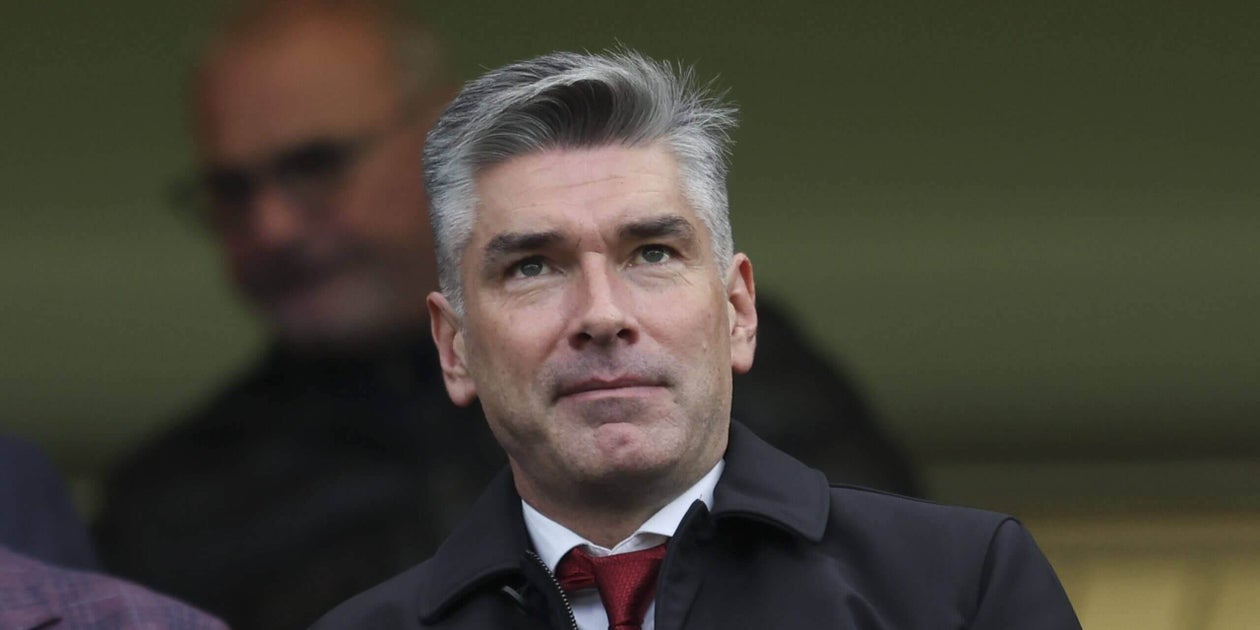
Ливерпүүлийн спортын захирал асан Ричард Хьюз Саудын Арабын Ал Хилал клубт шинэ алба хашихаар болсон нь клубийн удирдлагын бүтцэд томоохон өөрчлөлт авчирлаа.
Ричард Хьюз Ливерпүүлийн бүрэлдэхүүнийг шинэчлэх их ажлын хүрээнд өнгөрсөн хугацаанд 400 сая фунт стерлингээс давсан хөрөнгө оруулалтыг хийж, Флориан Виртц, Александр Исак, Жереми Фримпонг зэрэг тоглогчдыг эгнээндээ нэгтгэсэн юм. Гэвч багийн амжилт тогтворгүй байж, Премьер лигт тавдугаар байрт орсон нь дасгалжуулагч Арне Слотыг ажлаас нь чөлөөлөхөд хүргэв. Түүнчлэн Хьюз албан үүргээ гүйцэтгэх хугацаандаа Борнмут дахь гэрээсээ алсаас ажиллаж байсан нь хөгжөөн дэмжигчдийн зүгээс шүүмжлэл дагуулж байлаа.
Хэдийгээр багийн бүрэлдэхүүнд хийсэн өөрчлөлтүүд нь эргэлзээ төрүүлж байсан ч клубийн удирдлага Хьюзийн ажлыг өндрөөр үнэлж, түүнийг шилжилтийн үеийн чухал алхмуудыг хийсэн хэмээн талархал илэрхийлэв. Ялангуяа Диогу Жотагийн эмгэнэлт явдлын дараах хүнд хэцүү цаг үед түүний үзүүлсэн манлайлал нь клубийн дотоод үйл ажиллагаанд томоохон нөлөө үзүүлснийг эх сурвалжууд онцолж байна.
Одоогийн байдлаар Ливерпүүл дараагийн спортын захирлыг хайх үйл явцыг эхлүүлээд байгаа бөгөөд Фенвэй Спортс Групп-ийн ерөнхийлөгч Майк Гордон энэ сонгон шалгаруулалтыг удирдан явуулна. Тус албан тушаалд Жюлиан Уорд, Дэвид Вудфайн болон Педро Маркес нарыг нэр дэвшигчээр нэрлэж байна. Хьюзийн хувьд Ливерпүүлд үлдээсэн өв нь амжилттай эхлүүлсэн дасгалжуулагчийн томилгоо болон шинэ залуу бүрэлдэхүүнийг бүрдүүлсэн ч ажлаа бүрэн дуусгаж амжаагүй төвөгтэй үлдэгдэл болон үлдэж байна.
Дэлгэрэнгүйг эх сурвалжаас харах
↓Эх сурвалжийг нээх ↓
Richard Hughes did not hang around. The transfer window closed late last Tuesday, his departure for Liverpool was announced on Saturday lunchtime and by Sunday evening he was in Riyadh, starting work as sporting director of Saudi Pro League side Al Hilal.
Thus ended a curious chapter in Liverpool’s recent history. The post-Jurgen Klopp era that began in the spring of 2024 was to be built around Hughes, Fenway Sports Group CEO of football Michael Edwards and Arne Slot, the coach they chose to succeed Klopp. Less than two and a half years later, all three have gone.
So much happened in that short time. Liverpool won the Premier League title last year before embarking on by far the biggest spending spree in the club’s history in a bid to rejuvenate an ageing squad. If it was a long-term rebuilding operation, it is one which is yet to bear fruit — with big-money signings Florian Wirtz and Alexander Isak struggling to make anything like the expected impact — and which Edwards and Hughes both chose not to see through.
In Saturday’s statement, FSG president Mike Gordon thanked Hughes warmly, wishing him well, praising the work he had done “at the start of a period of change” and making clear his departure had been sanctioned reluctantly but with respect for his “life choices” in pursuing his “next venture”.
Those sentiments were not echoed widely among Liverpool’s fanbase. Among many supporters, Hughes was regarded favourably when he oversaw that £400million-plus ($541m+ at current exchange rates) outlay in the summer of 2025 but with growing scepticism or worse after a) Wirtz, Isak, Jeremie Frimpong and Milos Kerkez all struggled during a troubled first season, b) the club sided with Slot in a dispute with a disillusioned Mohamed Salah, c) this summer’s transfer business left the squad thin in certain areas and d) details emerged of Hughes’ imminent move to Al Hilal.
In English football’s relatively short history of appointing sporting directors, or directors of football, very few have generated such scrutiny or discussion as Hughes did at Liverpool. So, what was he really like and has he been unfairly criticised?
Over the course of the past decade, the role of sporting director has become a recognised part of the English football landscape.
But an element of suspicion remains. Perhaps the most notable sporting director success stories in the Premier League have come at smaller clubs where strategies, budgets and ways of working are clearly defined and where there is a willingness to build slowly rather than crave immediate results.
Hughes, at Bournemouth, was one of those success stories, signing players such as Nathan Ake, Illia Zabarnyi, Milos Kerkez, Antoine Semenyo and Dominic Solanke, who were sold on for significant profits. But like others — Dan Ashworth moving on from Brighton and Hove Albion to Newcastle United and then Manchester United, Paul Winstanley leaving Brighton for Chelsea — he struggled to replicate that hit rate at a bigger club in a state of transition.
The strange aspect of Hughes’s two-and-a-half-year spell at Liverpool is that appraisals of his performance fluctuated so wildly — and rarely presciently.
In the summer of 2024, he was lambasted by many supporters for adding only one player (injury-plagued Italy forward Federico Chiesa) to the first-team squad, but Liverpool ended that season as champions under Slot, whose appointment as Klopp’s successor looked inspired.
In the summer of 2025, he was lauded for pulling off the big-money signings of Wirtz, Isak, Frimpong, Kerkez and Hugo Ekitike, only for the team to go backwards, finishing fifth in the Premier League, leading to Slot’s dismissal.
Arne Slot won the Premier League in his first season as Liverpool’s head coach but was sacked 12 months later (Catherine Ivill – AMA/Getty Images)
This summer saw any appreciation for the appointment of Andoni Iraola and the arrivals of Ronald Araujo (on loan), Jeremie Jacquet, Victor Munoz and Bradley Barcola far outweighed by criticism of certain holes in the squad.
In that context, Hughes’s living and working arrangements — he continued living near Bournemouth, on the south coast, spending much of the time working remotely rather than on Merseyside day to day — also came under external scrutiny.
The way people judge Hughes’s record at Liverpool, as well as his character and working style, vary, as The Athletic discovered after speaking to those who experienced different aspects of his time at the club. Some of the sources spoken to during research for this article were granted anonymity to protect their relationships as Hughes begins his new job at Al Hilal.
One difficulty supporters face in forming an opinion of a sporting director is that they rarely take (or are given) the opportunity to outline their vision and plans. During his spell at Liverpool, Hughes faced the media just once, at Slot’s unveiling in July 2024.
It is reflective of a culture in English football where club executives and owners rarely appear above the parapet; if there was a way Hughes could have explained various decisions regarding squad depth, or the overarching plan behind the new signings, or the sale of Luis Diaz to Bayern Munich, he chose not to take it.
Among fans, he was viewed as a suit, a distant figure — literally so, given that he did not relocate from the south coast to the north-west.
There is, as outlined here, concerns of a growing disconnect between the club’s supporters and its leadership, with the owners based on the other side of the Atlantic.
To have a sporting director working remotely from his home near Bournemouth, albeit travelling north regularly for meetings at FSG’s office in Cheshire as well as Liverpool’s training ground on Merseyside, was felt to be symptomatic of that wider issue.
Hughes’s move to Liverpool was bound up in Edwards’ return, so his days at the club were numbered once Edwards grew disillusioned over FSG’s reluctance to commit to a multi-club ownership model. The Athletic reported Al Hilal’s interest in Hughes as far back as March. By that stage, his decision to move on had been all but finalised.
Those who have worked closely with Hughes maintain that, even while working his notice, his commitment to the job did not waver — and that FSG would not have entrusted him with the summer transfer window had that been the case. In particular, sources cite an almost year-long pursuit of Barcola, who finally arrived from Paris Saint-Germain in a projected £123million deal the day before the transfer deadline.
Even among some who are sceptical of his overall record at Liverpool, there is a belief that the modern sporting director role can be done remotely, provided regular contact with the head coach and other staff is maintained. Questions about his overall record at Liverpool, they say, are more legitimate.

Hughes played a key role in Liverpool’s pursuit of Bradley Barcola (Jan Kruger/Getty Images)
When Hughes joined Liverpool in 2024, his in-tray was overflowing.
By far the most urgent task was to find a replacement for Klopp, who was stepping down as manager after presiding over the club’s most successful spell in the modern era.
Beyond that, Trent Alexander-Arnold, Virgil van Dijk and Salah were about to enter the final year of their contracts. Ibrahima Konate and Andy Robertson were about to enter the final two years. Liverpool had a strong squad, but it was built around a core of players signed between 2016 and 2020. Their transfer expenditure between 2020 and 2024 had been lower than West Ham United’s and Wolverhampton Wanderers’, let alone their ‘Big Six’ rivals.
In that climate, a quiet first summer in the transfer market surprised many people. They missed out on their top target, then-Real Sociedad midfielder Zubimendi (now at Arsenal), and Hughes contented himself with a cut-price deal to sign Chiesa from Juventus. That did not pay off, but the decision to hire Slot as Klopp’s successor certainly did in the short term.
But short-term success — which was to some degree unexpected — could not distract from long-term needs. Their starting XI in 2024-25 had an average age of 27 years and two months, the fifth-oldest in the Premier League that season.
Van Dijk and Salah both signed new two-year deals, but Alexander-Arnold had shown no desire to extend his contract, preferring to join Real Madrid (as would Konate a year later). A long-term successor to Robertson at left-back was needed, as were reinforcements in attack. Big decisions lay ahead.
Liverpool broke the British transfer record twice in one summer, signing Wirtz from Bayer Leverkusen in a projected £116million deal and then Isak from Newcastle United for £125m as well as those deals for Frimpong, Kerkez and Ekitike. Their big summer spend was partly offset by around £190m of sales, including Darwin Nunez, Jarell Quansah, Ben Gannon-Doak, Tyler Morton, and, more controversially, Diaz to Bayern and back-up goalkeeper Caoimhin Kelleher to Brentford.

Alexander Isak joined from Newcastle United last summer for a British record fee (Liverpool FC/Liverpool FC via Getty Images)
Former Liverpool defender Jamie Carragher recently said on Sky Sports he is worried that, unless Wirtz and Isak in particular improve, it could go down as “the worst transfer window we’ve probably seen in Premier League history”.
Inside Anfield, there is a desire to regard last season as a write-off, or at least as something to learn from. It was a horrible campaign, overshadowed first by the tragic death of Diogo Jota and then by a total loss of belief and intensity as individual struggles led to a collective tailspin and, ultimately, a loss of confidence in Slot.
There remains a belief that last year’s two big signings will work out. Isak, who never found his rhythm last season, has scored three goals in his last two appearances and Wirtz, though he had another difficult evening at Ipswich Town last Friday, showed much-needed signs of progress in his previous outing against Nottingham Forest.
Those appraisals are shared by other sources in recruitment circles, but the signings of Frimpong and Kerkez are regarded less positively.
Liverpool saw the Frimpong deal as a way of strengthening in two areas: a player who could provide cover and competition both at right back, where Conor Bradley was considered the long-term successor to Alexander-Arnold, and on the right wing, where Salah’s playing time was always expected to be rationed more carefully from the moment he signed his new contract in May 2025. So far, the £30million signing from Bayer Leverkusen has struggled in both positions.
Hughes explored the possibility of challenging Chelsea this summer with a bid to sign Marco Palestra from Atalanta. But Liverpool’s ability to do so was constrained by a need to strengthen in other areas, specifically on both wings, and a struggle to raise funds by selling fringe players. Ultimately, the club hierarchy hope Bradley’s recovery from injury will enable him to make the right-back spot his own.
Kerkez was among those signings synonymous with Hughes, who previously signed him for Bournemouth from Dutch club AZ in the summer of 2023. But Hughes’ initial target for left-back was Paris Saint-Germain’s Nuno Mendes, who was seen as feasible until he extended his contract with the French club in February 2025. Kerkez was signed as a young player with the skillset and character to improve — something he is under increasing pressure to do after a poor first season on Merseyside.
That said, the missed opportunity of Hughes’s tenure concerned another former Bournemouth player, Semenyo. Hughes urged the Liverpool hierarchy to sign him for £60million last January, regarding him as a ready-made replacement for Salah, who had indicated a willingness to leave just months into a new two-year contract. Salah’s future was not resolved until March, by which time Semenyo had joined Manchester City and hit the ground running.

Antoine Semenyo was recommended by Hughes but signed for Manchester City in January (Carl Recine/Getty Images)
Hughes is not the only senior executive to have left a Premier League club in the past seven days. Nottingham Forest have terminated the contract of Edu, barely 12 months after his much-trumpeted arrival from Arsenal as global head of football.
Edu’s departure has not yet been announced by Forest, though he had not been seen at the club for months and his name has now been removed from the “Who’s who?” section of the club’s website. The silence from the club appears to reflect a regrettable episode in which Edu’s appointment unsettled then-coach Nuno Espirito Santo, who was sacked last September.
By contrast, Hughes left Liverpool with the club’s gratitude — and having been retained to oversee the club’s transfer business even while working his notice this summer, when he might have expected to be placed on gardening leave.
People who have been in the room negotiating or discussing over the phone with him speak in different tones depending on their experience.
Hughes is seen as a man of his word: a sporting director who tries to be clear with players and their representatives when they are discussing moves in or out of the club. It is noted by one agent that, even though there are players Liverpool would happily have sold this summer and last, Hughes and his staff preferred to treat them respectfully rather than subject them to the ‘bomb squad’ treatment some clubs prefer.
A common theme is that Hughes is polite but stubborn and forceful, knowing that he has to remain firm because of FSG’s stance around maintaining a self-sustaining business. The budget at Liverpool has historically been less-easily loosened than at some of their rival clubs, though Hughes succeeded in persuading his bosses to break their transfer record to go big for Wirtz, Isak and Barcola.

Bradley Barcola was a big-money arrival this summer (Liverpool FC/Liverpool FC via Getty Images)
Another source, who recalls a couple of difficult conversations with Hughes during negotiations, says: “He’s a very honest guy, humble, no attitude and what he says usually is correct. With Richard you know exactly what’s going to happen because he doesn’t do things differently behind the scenes. There are a lot of d***heads in football and he isn’t one of them.”
Agents and intermediaries who crossed paths at Bournemouth also found him to be the same character when he moved to Liverpool. Executives at some rival clubs were not as favourable in their character referencing because of the way incidents played out over the last two seasons, sources have said.
One consistent message at Liverpool, when discussing Hughes’s legacy, relates to the leadership he showed in the days, weeks and months after Jota’s death.
“Richard, like Arne, led us through the aftermath of Diogo’s tragic passing,” a senior club source said. “That will always be Richard’s most important work, no matter how good any of his signings turn out to be.
How do you judge a sporting director? In the space of two and a half years at Liverpool, appraisals of Hughes’s performance fluctuated from one transfer window to the next. The recruitment drive that brought the signings of Wirtz, Isak, Frimpong, Kerkez and Ekitike, which was widely trumpeted at the time, is held against him a year later.
Will it, as Carragher suggests, go down as one of the great wasted opportunities? Will the sale of Curtis Jones to Inter, as well as those of Kelleher and Diaz, look like a case of cashing in on the wrong player? Or will Iraola’s influence help Wirtz, Isak and others to prove their worth in the longer term, enabling some of the more questionable decisions to be seen in a more favourable light?
The biggest decision Hughes made at Liverpool was the appointment of Slot. That paid off spectacularly in the short term, as his and Edwards’ research and analytics work told them it would, but such an impressive start was not maintained. Now they are hoping the opposite will apply to the players signed last summer.
Liverpool’s squad looks short in some areas (right-back, midfield, possibly right wing) while perhaps overloaded in others (left wing). On paper, the signing of their top summer target Barcola, another who favours the left wing, adds to the imbalance. The feeling shared by Hughes and Iraola is that, with such talent at his disposal, it will work out differently on grass.
There is a belief inside Anfield that the rebuilding job Hughes faced on arrival was far bigger than it appeared from the outside — particularly after that successful first season, when it all looked so easy. The critical question would be whether the steps taken, in terms of players sold as well as those signed, have made that post-Klopp transition smoother or whether, as Carragher fears, the club is now on the wrong track after several missteps.
Even with Van Dijk (35) and Alisson (33) still at the heart of things, it is a far younger squad now. In terms of their other key players, Alexis Mac Allister and Cody Gakpo are 27 (both having stayed after a summer of uncertainty), Isak is 26, Dominik Szoboszlai is 25, Ryan Gravenberch, Ekitike and Barcola are 24 and Wirtz, Bradley and Munoz are 23, Kerkez is 22 and Jacquet is 21.
Beyond that, there is a cluster of highly promising youngsters: not just Trey Nyoni (19) and Rio Ngumoha (18) but new recruits Giovanni Leoni (19) and others such as Lucca Brughmans, Ifeanyi Ndukwe, More Talla Ndiaye (all 18) and Samuel Martinez (17), the Colombian midfield prospect who is due to arrive from Atletico Nacional next summer.
Other clubs — most obviously Chelsea and Manchester City — have been making the same kind of investments in young players for years, whether in the genuine belief that they can make the grade or with more than one eye on their resale value.
Again, such deals can take years to evaluate. Succession plans are relatively easy to draw up but much harder to implement, as illustrated by Liverpool’s difficulties in moving on from Alexander-Arnold, Robertson and Salah, along with the struggles of goalkeeper Giorgi Mamardashvili as Alisson’s understudy.
The next challenge for Liverpool is to ensure that, at a time of change and long-term uncertainty at ownership level, stability is found at executive level. FSG president Mike Gordon will lead the search for Hughes’s successor, with FSG technical director Julian Ward likely to be a prime candidate to return to the sporting director role he filled briefly after Edwards during the 2022-23 season. External candidates will be considered, but Ward is highly regarded, as are assistant sporting director David Woodfine and FSG director of football development Pedro Marques.
As for how Hughes will be remembered at Liverpool with all of the above in mind, it is… complicated. He appointed a title-winning manager but then had to remove him 12 months later. He showed an ability to attract and acquire elite-level talent, but he leaves — and for Saudi Arabia, which will rankle with supporters, as it did with Jordan Henderson three years ago — before seeing whether those players can form a cohesive, winning unit.
And, just as he arrived to oversee a post-Klopp transition that reached a level few expected, he has left with his own reshaping of the playing staff still unfinished. It is, to borrow the title from the latest episode of Walk On, The Athletic’s Liverpool podcast, a complex legacy.

