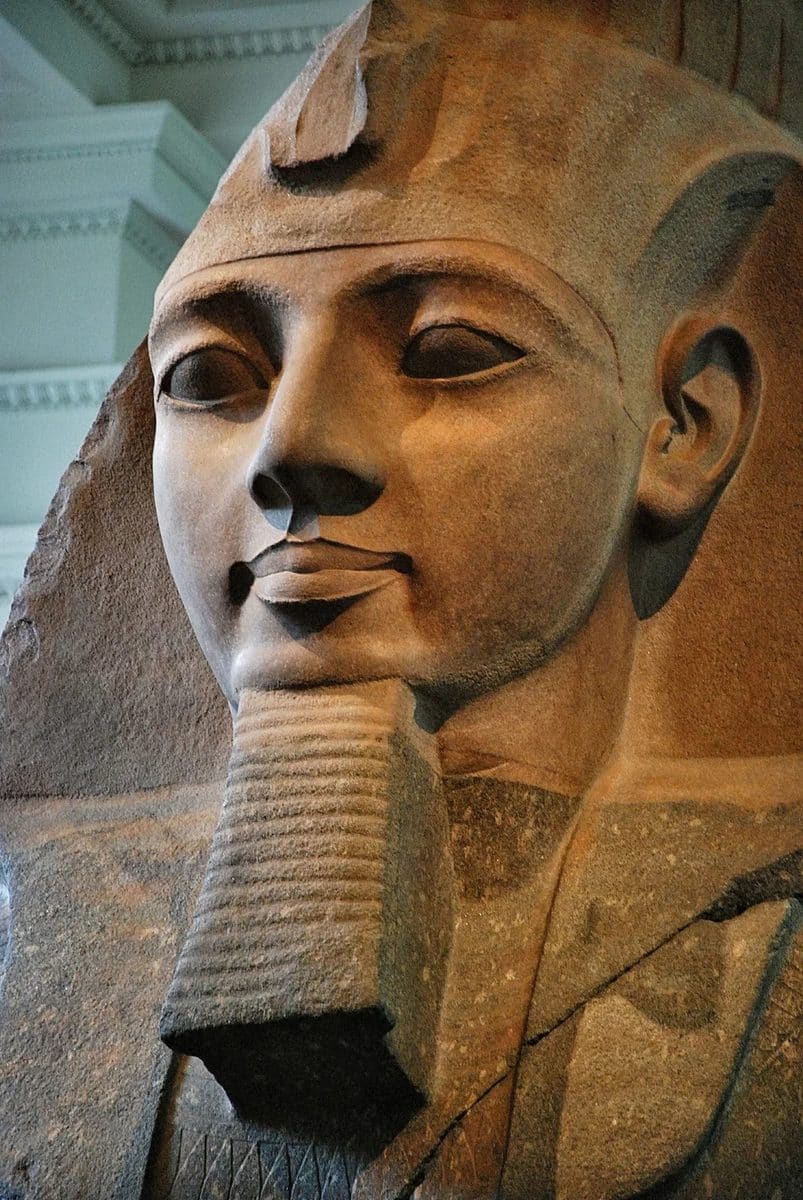
Эртний Египетийн Хермополис Магна хотын сүмээс олдсон фараоны хөшөөний хоёр хэсгийг нэгтгэн, анхны байршилд нь эргүүлэн байрлуулжээ.
Германы археологич Гюнтер Роедер 1930 онд Каир хотоос 150 орчим милийн зайд орших Эль-Ашмунейн хотын ойролцоогоос Рамсес II-ын хөшөөний доод хэсгийг анх олж байв. Харин 2024 оны гуравдугаар сард Египет-Америкийн хамтарсан баг хөшөөний дээд хэсгийг газрын гүнээс илрүүлснээр 3200 гаруй жилийн настай, 22 фут өндөр, 40 гаруй тонн жинтэй энэхүү аварга хөшөөг бүрэн эхээр нь дахин угсрах боломж бүрджээ.
Нил мөрөнтэй ойр байршил нь хөшөөний хадгалагдах байдалд эрсдэл учруулж байсан ч олж илрүүлсэн хэсэг нь маш сайн хадгалагдсан байв. Археологич Ивона Трнка-Амрхейны тайлбарласнаар, Асваны далан баригдсанаас хойш газрын доорх усны түвшин нэмэгдсэн нь элсэн чулуун олдворуудыг гэмтээх аюултай байсан ч уг олдворын гадаргуу дээр цэнхэр, шар өнгийн будагны ул мөр хадгалагдан үлдсэн нь ховор тохиолдол болсон байна.
Энэхүү олдвор нь Дундад Египетээс олдсон анхны бүрэн хэмжээний аварга хөшөө болж байгаа бөгөөд орчин үеийн археологийн аргачлалаар судалсан анхны тохиолдол юм. Египетийн Аялал жуулчлал, эртний олдворын яамны зөвшөөрлөөр 2025 оны есдүгээр сард эхлүүлсэн сэргээн засварлах ажлын үр дүнд хөшөөг дөрвөн үндсэн хэсэг, тулгуур чулуудын хамт 2026 оны эхээр бүрэн угсарч дуусгажээ.
“City of the Baboon” төслийн хүрээнд хийгдэж буй энэхүү судалгаа нь цаашид тус сүмийн үүдний хэсгийн суурийг тогтоох болон Хермополис Магна хотод өөр ямар эртний олдворууд байгааг илрүүлэх зорилготой юм. Судлаачид 2026 болон 2027 онд хийх дараагийн судалгааны ажлаараа тус бүс нутгийн түүхэн өвийг илүү нарийвчлан судлахаар төлөвлөж байна.
Дэлгэрэнгүйг эх сурвалжаас харах
↓Эх сурвалжийг нээх ↓
A statue of Ramesses II, split for nearly a century between a lower half found in 1930 and an upper half unearthed only in 2024, has been physically reassembled and re-erected at its original site in Egypt. Standing some 22 feet tall and weighing over 40 tons, the colossus once again guards the northern entrance of a temple at Hermopolis Magna, where it first stood more than 3,200 years ago.
The statue’s story spans almost a full century of Egyptology, beginning in 1930 when German archaeologist Günther Roeder uncovered the lower portion of the massive figure near the modern city of El Ashmunein, roughly 150 miles south of Cairo. In antiquity this site was known as Khemnu, a provincial capital of the Old Kingdom later renamed Hermopolis Magna under Roman rule.
For decades, the upper half of the statue remained missing, one of many treasures believed to still lie buried beneath the desert surrounding the ancient city. The reassembled statue is the first complete colossus from Middle Egypt, and the first studied using modern archaeological methods.
A Chance Discovery Weeks Before the Announcement
The missing fragment was actually found lying face down in the earth weeks before the joint Egyptian-American team made its announcement in March 2024. Speaking with Reuters, experts from the Egyptian Ministry of Tourism and Antiquities described the recovered piece as standing about 12.5 feet tall, depicting Ramesses II wearing a headdress topped with a royal cobra.
The find was not entirely unexpected, given how much of Hermopolis Magna’s ancient wealth was known to remain underground, but its precise location still came as news to the team. According to co-leader Yvona Trnka-Amrhein, assistant professor of classics at the University of Colorado Boulder, the group knew such a discovery was plausible without actively searching for it at that moment.
A Water Trouble Beneath the Nile
Excavating so close to the Nile carried real risk for the stone’s condition. Trnka-Amrhein noted in a press statement that the site’s location near the river had created persistent problems with the water table, noting that:
“One problem with Hermopolis is that it’s close to the Nile. After [the building of] the Aswan Low Dam, the water table became a huge issue. There was no guarantee that the stone would be OK,” she said. “Sometimes sandstone is uncovered that is basically just sand or degraded limestone. It could have just been a lump ofrock.”
Further excavation confirmed the fragment was remarkably well preserved. Researchers also identified traces of blue and yellow pigment still clinging to the surface, a rare survival that could eventually help scholars understand more about the statue’s original coloring and the circumstances of its creation.

What Happens After the Restoration?
After Egyptian co-leader Basem Gehad submitted a proposal to reunite the two halves, the Permanent Committee for Ancient Egyptian Antiquities approved it. Restoration work began in September 2025, and by early 2026 the statue stood whole again, re-erected at its original position at the northern entrance of the temple at El Ashmunein, as reported by Hyperallergic.
Having been assembled from four main pieces, comprising the upper and lower body segments together with three inscribed base stones resting on uncarved foundation blocks, the finished colossus now holds the distinction of being the first complete colossal statue from Middle Egypt, as well as the first studied using modern archaeological methods.

The work is part of a larger initiative called the City of the Baboon Project, a collaboration between Egypt’s Ministry of Tourism and Antiquities and the University of Colorado Boulder’s classics department. Future surveys, planned for 2026 and 2027, will focus on locating the foundations of the temple pylon the statue once guarded, as well as identifying what else may lie buried at Hermopolis Magna.
Enjoyed this article? Subscribe to our free newsletter for engaging stories, exclusive content, and the latest news.

