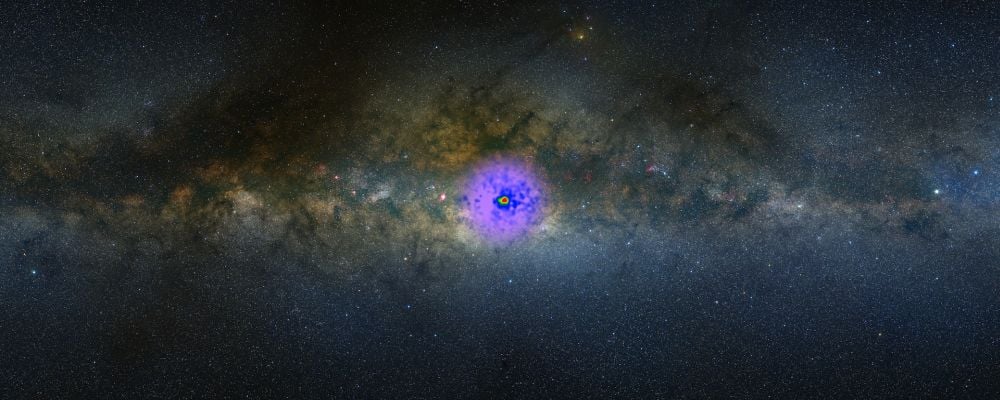
Шинэ судалгаагаар манай галактикийн төв хэсгээс ялгардаг өндөр энерги бүхий гамма туяаны илүүдэл нь пульсар бус, харанхуй материйн харилцан устгалын үр дүн байх магадлал өндөр хэвээр байгааг тогтоожээ.
2009 онд Fermi Gamma-ray Space Telescope-ийг ашиглан манай галактикийн төвд “Galactic Center GeV Excess” (GCE) хэмээх эрчим хүчний илүүдлийг анх илрүүлсэн билээ. Энэхүү үзэгдлийн шалтгааныг эрдэмтэд олон жил судалж байгаа бөгөөд өмнө нь үүнийг мянга гаруй миллисекундын пульсар эсвэл нягт оддын бөөгнөрөл, эсвэл Сүүн замын төвд орших супермассив хар нүхнээс үүдэлтэй хэмээн таамаглаж ирсэн юм.
Венийн их сургуулийн судлаач Флориан Листээр удирдуулсан багийнхан Physical Research Letters сэтгүүлд нийтлүүлсэн судалгаандаа машин сургалтын аргачлалыг ашиглан гамма туяаны фотонуудын энергийн түвшинг нарийвчлан шинжилжээ. Тэд нэг сая гаруй симуляци хийсэн фотоны өгөгдөлд үндэслэн орон зайн болон спектрийн мэдээллийг зэрэгцүүлэн үнэлсэн байна. Үр дүнд нь, хэрэв энэхүү гамма туяа нь пульсаруудаас үүдэлтэй гэж үзвэл дор хаяж 35,000 орчим пульсар байх шаардлагатай гэсэн дүгнэлтэд хүрчээ.
Энэхүү тоо нь урьд өмнө таамаглаж байсан хэдэн зуун эсвэл хэдэн мянган пульсарын тооноос хэтэрхий их байгаа тул пульсарын таамаглал нь эргэлзээтэй болж байна. Судлаачдын үзэж буйгаар, харанхуй материйн бөөмс өөрсдийн эсрэг бөөмстэйгээ харилцан устгалцаж гамма туяа ялгаруулдаг гэх онолыг үгүйсгэх боломжгүй хэвээр байна.
Гэсэн хэдий ч галактикийн төв нь маш тод, хүн ам ихтэй бүс тул дохиог тайлбарлахад хүндрэлтэй хэвээр байгааг эрдэмтэд онцолжээ. Энэхүү судалгаа нь GCE-ийн гарал үүслийг бүрэн тайлбарлаагүй ч харанхуй материйн таамаглалыг шинжлэх ухааны маргаанаас хасах хараахан болоогүй гэдгийг нотолж байна.
Дэлгэрэнгүйг эх сурвалжаас харах
Эх сурвалжийг нээх ↓
In 2009, astronomers using the Fermi Gamma-ray Space Telescope discovered an excess of energy in the Milky Way’s galactic center. Deep observations found no source for the energy, called the Galactic Center GeV Excess (GCE). What’s generating it?
There are multiple hypotheses. Some suggest that pulsars could be responsible, some say the dense stellar population in the region could be the cause, and some say that Sgr. A*, the Milky Way’s SMBH, could be responsible for it.
Yet other say that dark matter could be the source of the GCE. In this case, self-annihilating dark matter would be the culprit. Self-annihilating dark matter is when dark matter particles are their own anti-particles. When they annihilate, they release gamma rays. Weakly Interacting Massive Particles (WIMPs) are the leading candidate for these dark matter particles, however, they’re strictly theoretical, as is the identity of dark matter itself.
Research in Physical Research Letters say that dark matter can’t be ruled out as the source of the GCE. It’s titled “Energy Distribution of the Galactic Center Excess’s Sources,” and the lead author is Florian List, a researcher at the University of Vienna.
“The Galactic Center Excess (GCE) may yet herald the discovery of annihilating dark matter,” the authors write.
But reaching that conclusion is difficult because the galactic center is crowded with high-energy light. “Interpreting the signal is particularly difficult because the Galactic Center is an exceptionally bright and crowded region of the gamma-ray sky,” lead author List said in a press release.
Previous research into the GCE showed that bright yet unresolved point sources must be responsible. That means pulsars. By this way of thinking, 1000+ millisecond pulsars in the Milky Way’s core are responsible for the gamma-ray excess. But individually, they’re mostly too dim for Fermi to detect.
The panel on the left is a map of gamma rays with energies between 1 and 3.16 GeV detected in the galactic center by Fermi’s LAT; red indicates the greatest number. Prominent pulsars are labeled. The panel on the right removes all known nearby gamma-ray sources, and reveals excess emission that could be from dark matter annihilations. Image Credit: T. Linden (Univ. of Chicago)
Much previous analysis of the GCE was based on statistical analysis that didn’t include what List and his fellow researchers call a crucial piece of information: the precise energy level of individual gamma photons. In this work, the researchers developed and used a machine-learning method that was trained on the individual energy levels of more than 1 million simulated gamma-ray photons. This let the researchers, for the first time, evaluate spectral and spatial information simultaneously.
“Here, we demonstrate that a neural network simulation-based inference approach can jointly analyze the spatial and spectra data,” the authors write. “The addition is profound: energy information drives the putative point sources to be significantly dimmer, indicating either the GCE is truly diffuse in nature or made of an exceptionally large number of sources.”
This means that if the sources are millisecond pulsars, there would have to be at least 35,000 of them. That’s far more than the several hundred to several thousand thought to be there. There’s no direct census of how many there becuase they’re so difficult to resolve. But multiple previous studies based on models have shown that there could be far fewer than that. “If due to point sources, our median prediction is 𝒪(105) sources, or more than 35 000 at 90% confidence—both orders of magnitude larger than the hundreds preferred by earlier point-source analyses of the GCE,” the researchers write.
The source of the GCE is a stubborn problem in astrophysics. The authors aren’t saying they’ve solved it; instead, they’re saying that self-annihilating dark matter can’t be ruled out.
“What powers the GCE remains a key question of the Fermi era,” the authors write. “Although a notoriously difficult problem, progress remains possible, and machine learning is proving a powerful tool for pushing past long standing limitations.”
By including individual photon energies in their effort, the source count distribution becomes indistinguishable from emissions predicted by dark matter. So this work undercuts “one of the key pieces of evidence in favor of the point-source hypothesis,” according to the researchers.
“The origin of the Galactic Center Excess is one of the longest-running debates in astrophysics,” List said. “Our work does not show that dark matter is responsible for the signal. However, it suggests that it is still too early to rule out this possibility.”

